


Welcome back, everyone, and thank you for reading. Today, I wanted to follow up on my article from Tuesday—the one on the failure of conservatism and its resultant incoherence—by addressing the matter of a positive vision, and what a future built to our benefit might look like. If you find this article valuable, it would be hugely helpful if you could like it by tapping the heart at the top of the page to like the article; that’s how the Substack algorithm knows to promote it. Thanks again! Listen to the audio version here:
![[AUDIO] What Victory Will Look Like](https://substackcdn.com/image/fetch/$s_!k_VO!,w_140,h_140,c_fill,f_webp,q_auto:good,fl_progressive:steep,g_auto/https%3A%2F%2Fsubstack-video.s3.amazonaws.com%2Fvideo_upload%2Fpost%2F192334259%2Fe67614d5-d43a-4693-acdd-fc529e8fe321%2Ftranscoded-1774631627.png)
A cork pops, and intoxicating foam fizzles out of the bottle. The waiter laughs, keeping a single drop from besmirching his white gloves or traditional livery while quickly bringing a crystal glass to the mouth of the magnum. That’s for the best, as he’s a humanoid and it simply wouldn’t do to short his circuits with a bit of bubbly. A problem to be fixed, an alteration over which to worry later. We are celebrating, after all. This would not have been possible a few short years ago. None of it would. These clean streets on a pretty and oak-lined avenue, the marble balustrade-fenced porch on which we sit, glancing out over a small but dignified procession of promenading women, businessmen marching on a mission, and the occassional electric car quietly whizzing by over the cobblestones below. The orange sun of the late day gently bounces off the stone faces of the other townhomes while similar parties gently jabber—a pleasing sound now that no barbarian tongues like Hindi or Urdu are mixed in—and the fading rays diffuse into the oaken leaves and branches that give our little street its sweetness.
A clatter of hooves breaks the near-silence of the avenues’ quiet buzz. Well, that’s different. It is the state chariot1 of our Viceroy, clattering off to the gleaming dome of our Capitol, recently completed. The Viceroy of the Detroit Dominion, who’d have ever of thought… He stiffly nods from inside, his gloved hands unmoving atop his walking stick—planted like a pillar a mere inch in front of his knees, as typical—as the silken hat dips ever so slightly in recognition. Recognition of us, I must add; the ever so slight vanity boost pleased me greatly. He probably wishes he too could be well on his way to sliding under the table. Knowing that, too, pleased me greatly. The victory is his as much as ours. No matter. He has official business to which he must attend, and it can’t be put off.
Even from here, the ant-like armies of humanoids can be seen putting the last scrubbing finishes on the titanium-gold alloy of the dome as legions more clatter off the Palladian marble atop which it sits. Why the devil they chose such a ridiculous alloy is beyond me—but it does look nice enough, and I suppose will last more than a bit better than either base metal would’ve. Looking at the mechanical beings still working, I can’t help but notice that someone’s ever so slightly behind. No matter. They’ll be done by the time his bone-shaker finishes rattling its way there…still, the ceremony of it all is impressive, as are the deep blue tunics of the Colonial Horse that trots behind him. Soon the clankers will be following behind to ensure the streets remain gleaming, so the aroma of the droppings don’t bother me overly much. The blue smoke we’re all creating to go with the bubbly helps with that anyway…turns out solving the attendant issues of cancerous growths was quite simple,2 once the rotters who held such cures hostage out of greed were, how to put this delicately, removed and replaced by more civic-minded individuals. There’s a lesson in that, I do believe.
Anyway. The celebration. No, it’s not the new nuclear plant we just added to the holdings. Such additions are typical now that we've got that “regulatory” mess sorted. It turns out, you might be curious to learn, that what Voltaire said about admirals is true of well-paid bureaucrats as well.3 Lights a fire under their belly to do the job well. Same with judges; recidivism, I’m proud to say, is a thing of the past thanks to what I call the Byngian Reforms. No more mistakes in letting the, to use polite terms, “unreformable” back out onto our gleaming boulevards. Hence why they are gleaming, after all, as are the magnificent stone edifices that tower over them, and we can enjoy the fragrance of the blossoms on this glorious spring day. Back when I was a lad, the vagrants were all about what asphalt streets hadn’t been torn up for cooking fuel yet, and one couldn’t even walk or think upon them, much less sit and enjoy a good vintage. A thing of the past, much like not being able to visit the cousins on Mars…or Memphis. All has been fixed.
I can’t help but notice—while also noting with a grimace that I’m falling behind on the path to a six-bottle celebration4—that the population has been fixed as well. No, not “fixed” like a dog. Fixed as in healthy, vibrant. The scrubbers got the PFAS, the plastics, the birth control out of our water…and we deported 100 million or so souls who belong quite on the other side of the world, thank you very much, and everything looks so much better than it used to. The people are healthy. Vibrant. The women are sparkling beauties, the men muscular and dapper, within the bounds of taste and reason. Fashion has changed, aye, but it looks nice again. None of that “comfort through slovenliness” claptrap of my youth. The path to perdition, that was. No, things are different now, no morning coats and few suits, just the “Packard,” which I can’t help but think looks like a better-trimmed, double-breasted tunic…but they look nice. It’s an outgrowth of military fashion…perhaps they’ll return to the older forms as the Reconquests settle. Or perhaps not. No matter. The young people look sharp, and are brimming with vigor. That’s what matters. A few of the ladies are lolling about, but the men are striding with purpose. We’re what we could have been. Should have been…but weren’t.
Oh yes, the victory. The celebration. It keeps slipping my mind. Perhaps I oughtn’t switch to anything stronger. It’s the Silver Jubilee of our Independence. The day we celebrate breaking the yoke of that horridly “democratic” regime that used to rule, and replacing it with what we have now. One that governs well, and with purpose. One that—as I put it when snarling at the last meeting of the UN—embraces human flourishing rather than the delusion of human equality. Those rotters in what I can’t help but call the Islamic Raj of England still call me the Despoiler of the District for what we did along the Potomac…revenge for what Sheridan did to the Shenandoah, I say! And of course for all the crimes that then followed, with the regime he instituted. In any case, I got an American dukedom out of it. Our former cousins abolished those long ago because not enough Formerly Undervalued Britannic-Living People had them.
No matter, no matter. It’s over now. Such is banished to the fever dreams of a fetid, and better off forgotten, past. We won. It’s the jubilee. The city is beautiful. The country is prosperous. The people are wonderful. We’re no longer weighed down by equity and its discontents. That albatross was severed from our necks “with the battle axe, sir, with the battle axe.” And now we rule, and those over whom we govern are flourishing in a beautiful world. Such is all I wanted. Back to the bubbly.
The Principles of Our Victory
I hope you found my attempt at fiction entertaining rather than tiresome. It was fun to write. If you enjoyed it, please let me know with a comment; I’d be happy to try my hand at a bit more of it.
Particularly, it was fun as a thought experiment: towards what are we striving? Yes, there are a few key principles that undergird any rightist movement. To reiterate, they are natural hierarchy, order, and tradition. But those can be applied in a great variety of ways that do or don’t lead to that which made the great rightist states pleasing ones and good examples: human flourishing.
Such is a difficult thing to achieve, and will take much doing. As the political chasm between here and there is large, and I have written about the only currently legal pathways to get on path to achieving it in my past articles on salami slicing the end of mass democracy and the Lee Kuan Yew path to fixing our woes, in this article I’d like to focus on the positive vision, and what I think must be included in it.
I’ll stick to the three I think are most important, in order, with explanations of each: the sanctity of public order, no land without a lord, and the paramountcy of uplifting aesthetics.
The Sanctity of Public Order
By far the worst issue we face on a day-to-day basis is that of disorder. This makes it the central problem that must be solved, as the niceties of high civilization can only flourish after the establishment of order has given them breathing room to do so.
Public transit is unusable because you might be stabbed in the neck or set on fire by some illegal alien or felon released by a Soros DA. The roads are, as a result, crowded and require sitting in traffic for hours; often this means driving alongside “leased Nissan Altima drivers” whose reckless manner of driving puts your life and limbs at risk while driving up insurance premiums. Those roads are used to commute to suburbs because the cities have been turned into war zones in which the pond scum of humanity can act out their imbecility and depravity on a grand scale, often with significant collateral carnage occurring in the process. As the point of those suburbs is to escape the disorder, something nearly everybody wants but which is quite difficult to establish because of the Civil Rights Act, houses in them are quite expensive.
That grand expense often buys little other than a life of debt slavery-induced drudgery, as the homes have to be within driving distance of the “opportunity” in the hive cities. One’s home might be broken into, and your family murdered by some illegal alien gang tolerated by the municipal government. You might be carjacked on your way to or from it by some 35x felon released by the same government. You might be mugged while trying to go for a jog to stay in shape despite all the driving. If you defend yourself, you will be punished. If you don’t defend yourself, you will die. The best case scenario is that you pay extortionate taxes for 60 or so years and then die peacefully, after having spent a lifetime trying to dodge the increasingly inescapable and state-imposed disorder.
Meanwhile, your city will spend vast sums replacing copper wire with aluminum in an attempt to dissuade thieves.5 It could just hang them, but that would be mean. Euthanizing the pit bulls, as it were, is a “fix everything button” that it’s illegal to press.
Such is the cost imposed upon us by disorder. Americans used to enjoy living in cities. They walked to work, lived amongst and around like-minded people, and generally avoided the vast inefficiencies and expense of suburban life until they could well afford it. But then civil rights law abolished private property,6 and order with it. Now we all pay taxes to governments that are seethingly hostile to us, get nothing from so doing, and still have to modify our lives just to avoid the crime and disorder that plagues everywhere. Like the Anglo-Saxons of yesteryear, we pay the Danegeld and hope that will fix things, while in reality it just attracts more vultures and blowflies to a putrefying corpse.
Such is a massive problem, and it has wrecked American life. This happening over and over again to city after city is why Americans are so unwilling to invest in community building of the sort that is necessary to live in a real country rather than a strip mall. It has also absorbed vast amounts of capital—trillions of dollars—that should be invested in productive enterprise, but is instead spent on merely avoiding disorder. Doing so for decades has sucked the life force out of our productive economy, blunted our innovation advantage, demoralized the American people, and made life increasingly unaffordable for those trying to start out in it.
It’s also entirely unnecessary. As Bukele shows, you can simply fix crime by locking up the 1% of the population that commits essentially all of the crime. As early-modern Europe shows, if you develop the sternness to hang rather than warehouse the malefactors, you can breed crime out of the gene pool and build a high culture.
In short, crime is a choice. Disorder is a choice. It exists because we tolerate it. We must stop tolerating it. When we stop tolerating it, every aspect of life will be invigorated by no longer having to struggle under the millstone-weighted albatross of public disorder.
As such, fixing the disorder and refusing to allow it to ever again occur must be a central tenet of what we do. It is the key that unlocks having a functional civilization again.
No Land Without a Lord
The second principle we must establish, as it supports the first and encourages the third, is the concept of “no land without a lord”. This is a way of thinking and structuring social relationships, not a call for a titled individual or oligarch to own every patch of land. It is, rather, a way of re-establishing the primacy of duty among great and small landowners and real estate owners alike, from the greatest of fortunes to the smallest of homeowners. It would ameliorate many of our problems.
One of the central problems of our time, as I discussed in recent articles on abstracted wealth and country house nationalism, is that there is a great deal of space over which there is no specific individual who is sovereign.
The state always has its perogatives, of course, but those are largely oppositional: the right to come onto it and demand you pay taxes, comply with byzantine regulations, or whatever else. But that is not about what I am talking.
Whose job is it, for example, to keep vagrants out of a public park in which children would like to play? The state refuses to do so. The public will face the state’s wrath if it does so, and in any case, few have any real sense of ownership over the space that would lead them to get in a fight with a bum over it. There is no clear owner or collection of owners who will do so to benefit shops or apartment-dwellers in the adjacent areas; that land and the real estate upon it is generally owned by a nameless and faceless corporation thousands of miles away. To contact it and request it deal with a bum in land it doesn’t own, or even a building it does own, would be to argue with some AI program or call-fielder in the former Raj. He, she, or it will be entirely unhelpful, and the vagrant will remain. There is no one who cares enough about the space to enforce the state of normalcy desired, and so it will decay inexorably until someone thanklessly assumes the significant liability of dealing with the situation.
That space has been bought, but it is not owned.7
The same is true of much else. What happens, for example, if an out-of-town real estate development corporation backed by a bevy of similarly opaque and diffused capital-holders decides to build a massive, horrendously ugly apartment building right next to your neighborhood? Maybe there is a tedious bureaucratic process that can stop it, maybe not. But there is no individual to whom appeals can be made to halt that project in the name of decency. Amorphous capital has no compunctions, but only a bottom line. There is no human of last appeal, no sovereign with whom the matter can be intelligently discussed. There is just the grey and unyielding mass of bureaucracy.
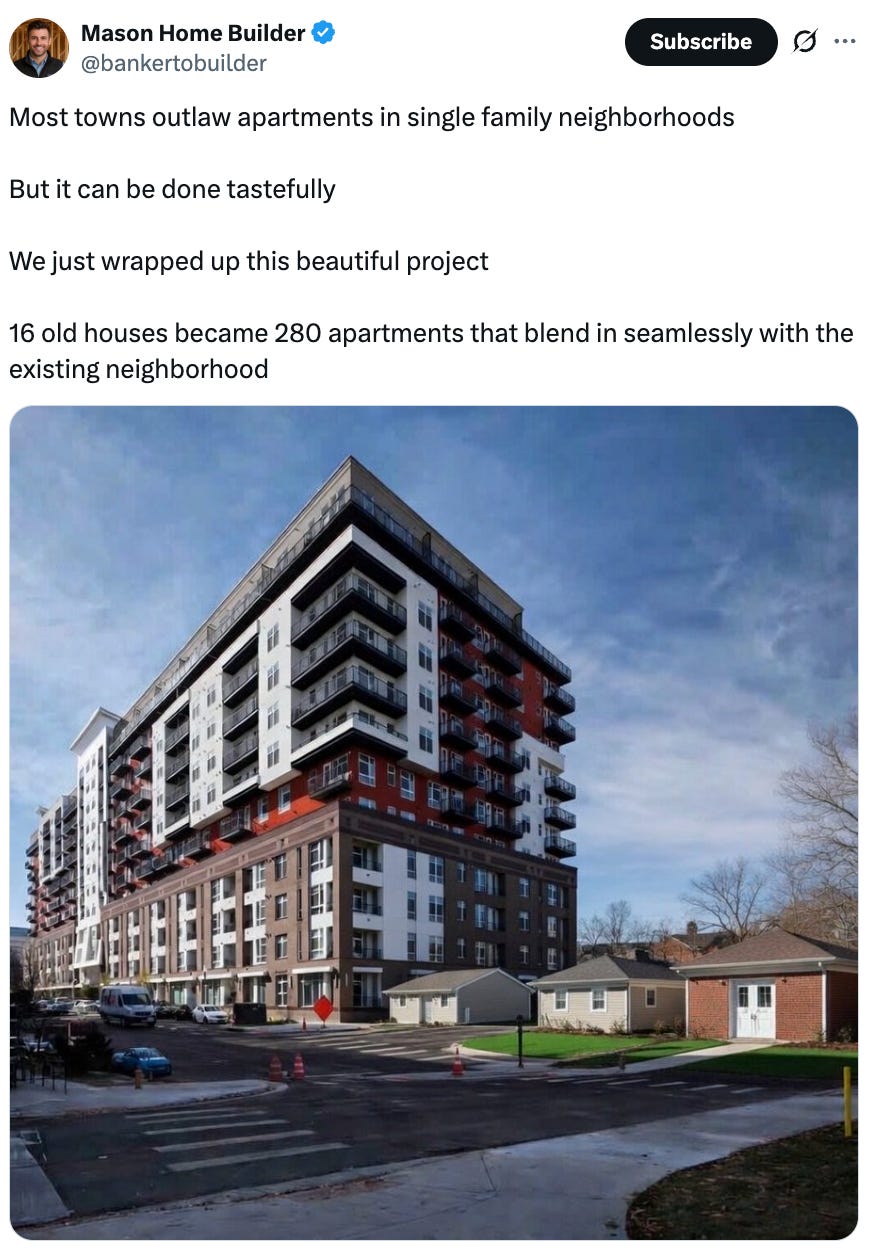
The same becomes generally true as one looks through the various ills, from crime to ugliness, that plague us.
The city has no real interest in preventing crime on buses or subways because no officials will face direct, personal consequences over the disorder. The REITs and funds that own increasing percentages of single-family housing in America have no interest in making the homes they own any more beautiful, well-built, or healthful than required to rent them, for no one will be held directly and personally responsible for the intangible blight they bring upon us. Nor do they have anything other than a financial incentive when bidding on homes; if consistently paying cash to outbid young families who need a starter home to start a life is profitable, they have no compunctions about doing so, for no one involved will ever be held directly and personally responsible. On much the same note, the municipal debt issue that Marohn identifies in Strong Towns has grown out of control because no one can or will be held directly and personally responsible for problems their decisions now create years down the line; the decisions are faceless, and the faces in the background are soon forgotten.
Such is not the way things always are, or have been. One of the chief attributes of lordly ownership was that it was known rather than opaque, and the nature of it meant that he could always be identified as the culprit and held responsible by the tenantry if up to no good.
Much of the Earl of Dunraven’s fabulously entertaining Past Times and Pasttimes, for example, consists of him explaining how he dealt with his ornery Irish tenantry about everything from farm size to rent rates. They knew he was the owner of their farms and set the rates, and felt no compunction about approaching—with pleasantness or churlishness, depending—him or his stewards about what issues cropped up.
The same sort of thing was even true in the big city of developing London, as is covered well in The Growth of Victorian London. The owners of this or that city block were known, and were held responsible by the dwellers and the city for appropriately stewarding what they owned, such as by building and maintaining clean and safe roads in front of their property.
It was an imperfect system, as all are, but it at least meant that there was always a face to whom one could appeal, a real and specific individual who was directly responsible and treated as such.
The traditional grounding for this system, one that existed well before the Victorian times I just highlighted, is the idea of no land without a lord. The idea that property is not some amorphous thing to be merely owned and treated like a tankard, but a sacred obligation that carries with it duties and responsibilities, for it is intertwined with the state and the church.
This is a term of which I learned through my reading of Morris Talapar’s The Sociology of Colonial Virginia in preparation for the upcoming Virginia series on The Old World Show. Talapar notes, describing the attempt of the royal government to turn the early Virginia colony from a commercial one to a chivalric one through land policies:
Governor Harvey had come to the colony with instructions from Charles First to introduce the proprietary system with its implications concerning entail and sub-infeudation, or the reunion of property with state and church. This meant the bringing about of a social transformation in Virginia, by replacing the commercial economy with feudalism through the imposition of the Cavalier principle of no land without a lord.
In Virginia’s case, the insistence upon this by Governors Harvey and Berkeley was primarily a political struggle between the interests they represented8 and the Puritan-aligned mercantile interests they aimed to replace,9 rather than a spiritual fight about the duties and responsibilities of landowners, though that was tangentially involved.10
Still, it is a good term that raises an important point about social structure: there should always be a specific individual who rules over a given patch of ground, and is held responsible for treating its stewardship as a sacred duty to the community as a whole, within the bounds of reason. That need not be an actual “lord”. Great and small alike can and should be included, this time around. What matters is the duty of sovereignty, the burden to preserve the thing and decide the exception. That sense of duty must be rebuilt.
There are glimmers of this in America, despite our generally commercial mind. Take, for example, the small farmer who refused a $26 million dollar offer for family land because it would mean that the land would be used for some horrid, community-blighting data center. “If it’s my way, I’ll stay at home and feed a nation. $26 million doesn’t mean anything,” she said. Such is the attitude that builds nations and functional communities, and the seriousness with which land ownership should be treated. It probably helps that her family is known to own the land, and so she is personally responsible for the decision of what to do with it, and would be at the very least ostracized if she blighted her town by selling it.
That same attitude must be inculcated nationally, for every patch of land. Individuals can buy, own, and sell property as they please. That so many Americans own rather than rent their homes, and buy and sell homes and other forms of real estate to build wealth has long been a good thing about our culture, as it created an ownership society that was more stable than that of renters in Europe. Such is a right and general state of things we have long held dear, and ought continue to cherish.
But allowing opaque, shadowy owners to hide from public scrutiny is no right, and ought not be allowed. If a corporation owns a building or farm, every individual involved with its ownership or management ought be named and their contact information freely available. If a person owns it, the same. If a trust owns it, the trustees and the beneficiaries ought face the same scrutiny. If they want to build an ugly apartment building/strip mall/data center—or sell it to someone who will do the same—that is their right. But scrutiny and public outcry ought be involved and taken seriously, so as to constrain anti-social behavior.
They should, as part of that, be empowered by law to keep it nice, and socially expected to do so. Loitering vagrants, filthy parking lots, dangerous neighborhood conditions, and all the rest that blight our lives in a world without true ownership are unacceptable. The expectation ought be that they are dealt with—as was once the case—and owners should be entirely free from liability in so doing.
That sense and expectation of true ownership is important. It, and only it, breeds a sense of noblesse oblige. Wealth that remains detached remains insouciant, and wealth that is insouciant is exploitative and oligarchic. Wealth that is exploitative and oligarchic cares not about its duties, and without duty, we face the spectre of decline and dysfunction.
Overall, this must be an expectation rather than a law. The West was built into a high civilization characterized by human flourishing because those who governed it were guided by a sense of duty. They understood what they ought do, and largely did it. They did so in no small part because they and their wealth were widely known, and they were expected to take its management seriously while being held personally responsible by angry mobs if they did not. That is the state of things that the idea of “no land without a lord” built, and it must return. Those who allow evil, dysfunction, disorder, or decay to flourish ought to be known, and held accountable for doing so. Were that the case, they’d probably just nip it in the bud.
The Aesthetics Will Be Uplifting
We have been ruled by the left ever since the Great War, a civilizational catastrophe from which we never recovered. Whether the government has been nominally conservative, nominally liberal, or outright leftist hasn’t mattered, as at root they have all been leftist governments. Namely, “equality” has increased at every step. Every bond has been broken—many of them by “conservative leaders”—and so the leftist vision of an atomized and egalitarian society has come to pass.
As the left hates beauty because beauty is a natural rejection of equality, that means our world has gotten uglier and uglier by the day. Where once there was beauty—in the people, in the art, in the architecture—now there is a degraded ugliness.
Clothes are designed to be comfortable rather than dignified and sharp, with the natural result that they look slovenly. Years of “beautiful at any size” propaganda, exhortations to do as one wishes rather than as one ought, and a general lack of standards have further degraded the people. Architecture is designed to be “efficient” and to depress while serving as constant reminders of the onerous welfare state for which we must pay.11 Art, as parodied by Tom Wolfe, is designed to shock, offend, and create a sense of queasiness in the viewer. Breaking down norms is good, you see, as norms are racist and inegalitarian.
All of that must be replaced and reversed. The lived environment must be aesthetically uplifting, for beauty is important and animates our spirits while creating a refined world in which it is pleasant to live. As Roger Scruton notes in his Beauty: A Very Short Introduction:
“Our need for beauty is not something that we could lack and still be fulfilled as people. It is a need arising from our metaphysical condition, as free individuals, seeking our place in a shared and public world. We can wander through this world, alienated, resentful, full of suspicion and distrust. Or we can find our home here, coming to rest in harmony with others and with ourselves. The experience of beauty guides us along this second path: it tells us that we are at home in the world, that the world is already ordered in our perceptions as a place fit for the lives of beings like us.”
Much as being around beautiful women increases a man’s testosterone and encourages him to do bolder deeds,12 being around beautiful buildings, art, and the like increases our desire to be a functional part of the civilization that created them. It is an encouragement to do great things to contribute to the wonderful world of which we are a part. It is animating. Such is why the left has tried to dismantle and destroy every last vestige of it, and why we must reject that.
Aesthetics matter. They set the civilizational and social tone. They can inspire or depress, inculcate brave action or encourage cowardly sitting on the sidelines. They determine how we feel when out in the world, what state our subconscious is in, and how we act. This is why those states defined by their greatness and grandeur built incredible and gorgeous public temples, forums, and palaces. It is why the Medieval Europeans devoted so much energy and resources to building cathedrals that still astound us. It is why the cultivated and landed society of 18th and 19th-century Britain devoted so much care and attention to awe-inspiring country homes. The awe, inspiration, and uplifting sense of greatness were the point.
We must create an aesthetically refined, beautiful, and inspiring world. Yes, that requires more than a desire to do so. As Heine said, “People in those old times had convictions; we moderns only have opinions. And it needs more than a mere opinion to erect a Gothic cathedral.” But that spirit can be recovered, particularly if we return to a “no land without a lord” model of sovereignty over every little patch, something ignites the duty of building beautifully. It must be recovered. And clawing our way back to aesthetic glory is, when paired with the other principles, the way to start doing it.
The Positive Vision
Many, including myself, point to Singapore as a better-ordered society. This is accurate. It is ordered, and prides itself on remaining such. But it is also tacky rather than beautiful, and sterile rather than vital. Paired with the expense of living there, that means it has one of the lowest fertility rates in the world.
Rhodesia is a better example. It functioned well. Those within it flourished. Order was maintained, but not at the cost of civilizational vitality. Instead, to look at it is to see how Anglo man ought live. Vast farms that inculcate a habit of command and sense of duty and responsibility attached to that land. Healthy, vibrant people proud of what they and their ancestors built and willing to fight to the end for it. Rustic but clean and beautiful buildings. The same is true—though with more wealth and bigger country homes—of the British country society on which much of Rhodesian civilization was based and adapted.
America is not Singapore. It is not Rhodesia. It is not Britain. It is unique, a new civilization. But it can and must learn from them. If we are to build our way out of this present, egalitarian mess, that will require rebuilding a sense of duty and responsibility attached to both public and private places, reestablishing order, and renewing our aesthetic by cultivating beauty once again. That will not be easy. But it is what must be done.
Featured image credit: Childe Hassam, CC0, via Wikimedia Commons
If you found value in this article, please consider liking it using the button below, and upgrading to become a paid subscriber. That subscriber revenue supports the project and aids my attempts to share these important stories, such as the one on Civil War, and what they mean for you.
The carriage version, not what Caesar rode around in: https://en.wikipedia.org/wiki/Chariot_(carriage)


Talapar notes:
In 1630 Sir John Harvey arrived as royal governor the first Cavalier ever to set foot in Virginia and he immediately proceeded to do what was necessary in order to take away the colony from the Puritans.
As Talapar notes:
The transfer of ownership changed the political alignment in the colony: the Presbyterian was replaced by the Cavalier in the opposition to the Puritan. There were remote areas of agreement between Cavalier and Puritan: they both avowed the principles of monarchy and of the union of state and church, and they were both members of the Church of England. But the differences between them were profound and irreconcilable: tradition wanted the union of state, church and property; while the cornerstone of the Puritan sociology was the freedom, or the separation, of property from state and church; and theirs was a struggle for mastery, not as between persons or political parties, but as between sociologies or ways of life each with its own institutions and values.
As Thomas Nelson Page notes of the military reason for this system in his The Old Dominion: Her Making and Her Manners:
As the country developed, the grant of lands in large tracts to gentlemen, on condition that they should settle bodies of tenants on them, served to foster class-distinctions, and the settlement of separate plantations along the rivers wholly isolated, and surrounded by deadly enemies, created conditions somewhat feudal in their form, the planter-employer engaging to take care of his people and the latter binding themselves to work for him and march with him in any exigency demanding their service. Thus, when grants were made like that to William Byrd, of lands at the Falls of the James, the condition would be that the grantee should settle so many families on them and in time of danger furnish so many fighting men. This was the very form of feudalism.
Thank you for this excellent article. Lots of interesting points to ponder. Please write more about how we could get from here to there. Especially how we could develop a mass of people to hit the "fix everything button" outside the political establishment. AKA, if a "total outsider populist" like Trump (a 78yr old billionaire who will be hunted relentlessly by his enemies after 2028) won't cross the Rubicon and save America, its obvious that nobody "elected" to DC ever will. Thus, it must be a mass action by We The People, but how?