


To glance around a normal place in America is to stare in the face of decline. Grungy strip malls, an aging vehicle fleet,1 ugly and decrepit buildings, potholed roads, and a vile stew of vagrants and refuse characterize the state of the infrastructure in non-luxury locales. Art, at least as traditionally understood, is non-existent; subversion and money-laundering have replaced it. The movies are worse and TV shows comically terrible.
And the American people are degenerating. Gone is the stereotypical American of old, bursting forth with vigor and energy while dapperly attired in a three-piece suit; replacing him is a slovenly cur bedecked in sweatpants, listening to rap “music”, of unclear ancestry, and thinking only of how to squeeze a bit more indolence out of the day.
That’s not always the case, of course. Groups like the Old Glory Club do a reasonable job of cultivating those who are a cut above the common fold, and the posh areas haven’t degenerated quite as much as the average.2 Still, as anyone who has had to visit an airport recently can attest, the degeneration of the American man is depressingly common.
The general impression, in short, is that no one really cares anymore. Businesses generally don’t build for the long term or cultivate excellence in their employees; instead, they just get away with doing the least possible work to squeeze the most out of similarly surly and apathetic customers.
Refrigerators designed to be obsolete bounce over potholed roads in the backs of dirty delivery trucks to houses that haven’t been powerwashed in years and are surrounded by yards covered in a mix of dirt patches and weeds, and little dents in the drywall are made by the delivery team and never repaired by the homeowner as the fridge is deposited in some awkard corner of the kitchen. Indifference and languor are the primary aspects of not just an economy but an entire society characterized by its ennui.
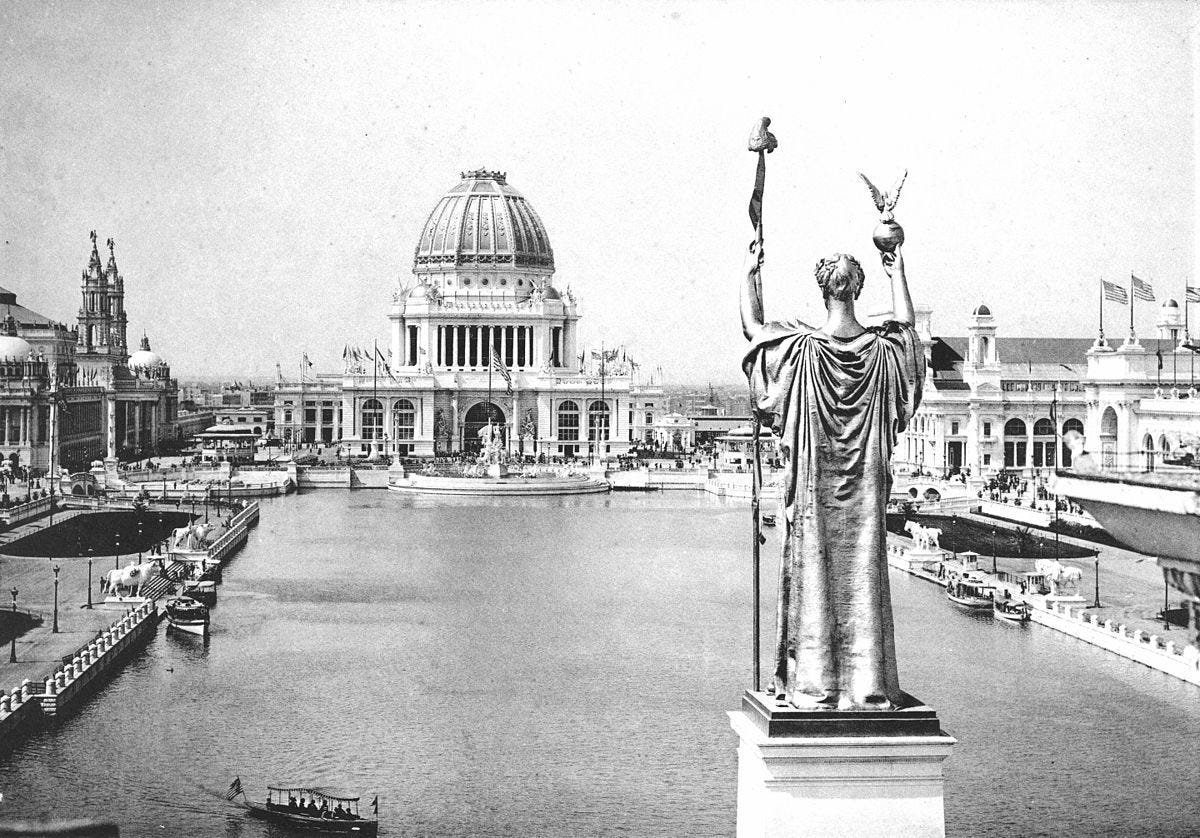
Such was not the America of old. Our ancestors were not listless or indolent. They were bold. They were excellent. They conquered a continent, and raised over it gleaming cities that dotted what had been primordial wilderness mere years before,3 and took pride in the civilizational vigor and wealth represented by their monumental, beautiful architecture and the happy and healthy people that populated such places. The gleaming city of light4 that was the 1893 World’s Columbian Exposition in Chicago characterized such a society.
So, what happened? Some blame financialization, and it certainly played a role. Globalism certainly did as well, though that more explains the state of the Upper Midwest than the rest of the country. Crime is a major nuisance, but hardly the reason most small towns are in a sorry state.
No, the problem is more general than any of those manifestations of it. The issue is that those who should care generally don’t, as they have been taught that all of their efforts can be stripped from them and destroyed in a relative instant. Such is a tale best told by Detroit.
Equality and the Destruction of Detroit
In the middle of the 20th century, Detroit was the Paris of the West. It was hugely prosperous, beautiful, and intimately developed by families such as the Fords who cared deeply about the city and its inhabitants and so built hospitals, schools, and museums while living there and staying involved.
It was the culmination of the great American spirit, and represented it wonderfully, standing as a testament to our immense might, inventiveness, and prosperity. That took monumental levels of investment, attention to detail, and close attachment to a place rather than cosmopolitan insouciance regarding rootedness. But in the end it was achieved, and it was glorious. Below is a video with some clips from the last gasp of that halcyon era.
Then it died. The Civil Rights Act was passed in 1964 and enforced with increasing ruthlessness and vigor over the successive years, meaning that race was at the forefront of people’s minds and no neighborhood was safe from it. The danger posed by increasingly Third World-like levels of black on white crime and related riots meant the “blockbusting” realtors and developers had an easy time of it as they hurled black residents at white neighborhoods—neighborhoods that could no longer be shielded by restrictive covenants—to buy up swathes of urban neighborhoods on the cheap.
Such is how a community shrivels and dies on the vine. What had been white ethnic neighborhoods characterized by their distinctiveness and how their loving residents cherished life in them while investing deeply in them so as to improve the general quality of life for homogenous residents were destroyed and replaced by blighted zones created by the belief that nothing is higher than the almighty dollar, particularly if such dollars can be won while professing a belief in the equality of man. Successive waves of crime, riots, urban migration, and white flight hollowed out in a few short years what it had taken generations of steady work to build.
Darryl Cooper, describing the destruction of Detroit just a few years after the depiction of happy and healthy life shown in the above video in his excellent The Battle of Ocean Hill-Brownsville, noted:
As the weather warmed in early 1968, Americans were preparing for another summer of racial violence. Riots had increased in number and severity each year since Watts (1965), and there was no reason to believe that ‘68 would break the trend. The previous year, black residents of Detroit had fought pitched battles with the police amidst a city in flames, and only the intervention of the 82nd and 101st Airborne Divisions succeeded in putting down the insurrection. When it was over, wrote the Detroit News, what was left was “something worse than a slum.” The ruined downtown resembled “inscrutable megaliths in a wilderness of rubble so desolate that you can stand in the middle of Woodward St., the heart of the riot, at midday and not see a single auto for miles in any direction.” Forty-three people were killed in five days and nights of violence.
Where once there had been the pinnacle of American technological civilization, now there were only charred ruins of a vanished and nearly unbelievable past. All it took was a few schemers figuring out how to make a quick buck off of enforcing equality, and hurling the bowling balls of equity with due vigor.
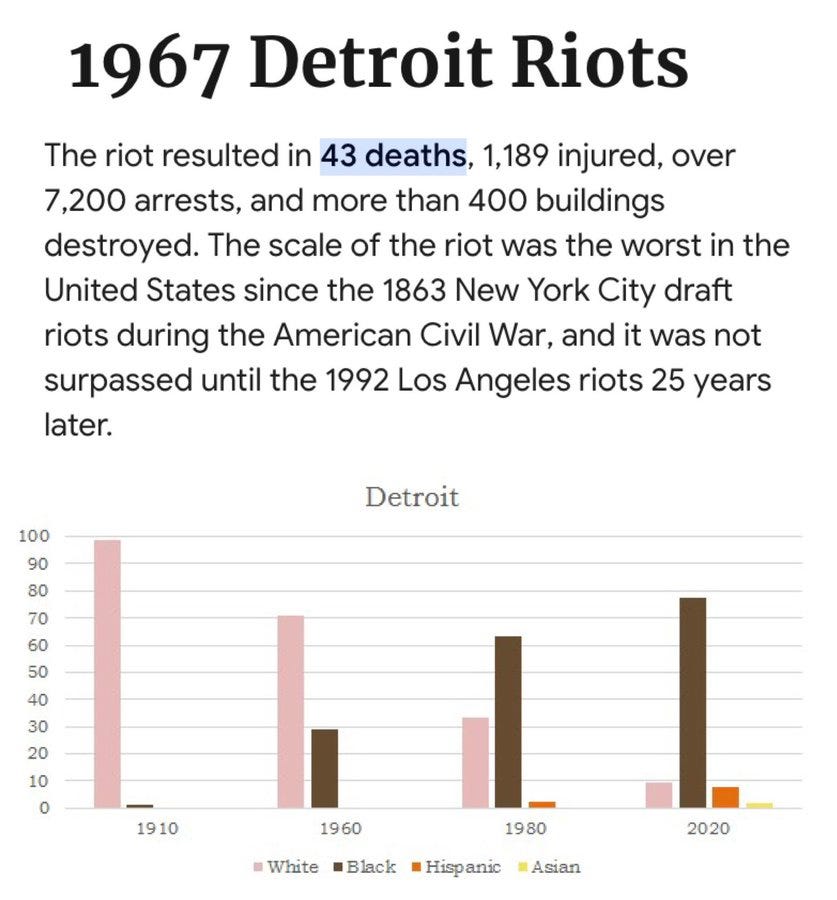
Yet further, the authorities more or less allowed it. Sure, there were some arrests and shootings as the police and National Guard troopers battled with rioters. But that was far from enough, and the sort of blasé attitude that characterized how the Black Panthers and Black Liberation Army were dealt with was the same sort of attitude generally applied to black criminality.
The result was that whites had to flee. Terrorized by suddenly unthinkable levels of crime that turned what had been good schools, peaceful neighborhoods, and pleasant communities into horrifying war zones characterized by atrocities such as murderously violent rape and organized school attacks targeting white kids, white families left. They weren’t willing to live in communities that quickly became reminiscent of the Simba Rebellion, and so they sold up and dispersed. The ethnic neighborhoods vanished, the hospitals fell to ruin, the infrastructure collapsed, the businesses went bust, and the city went bankrupt.
And it is important to emphasize that all of that occurred in just a couple of years following the passage of the Civil Rights Act. It was passed in 1964, and by the late 1960s, Detroit was a hellhole due to the racial apocalypse the authorities let occur for reasons of “equity”.
Such was one of the greatest tragedies in the history of urban civilization. Detroit had been the wealthiest city in not just America but the world, a center of high culture, technological progress, and industrial might all rolled into one, was utterly destroyed in the blink of an eye.
Thus, all the capital that had gone into painstakingly building it was set on fire.
Cities, like the great country estates of Britain, require generations of tireless investment and cultivation from all levels, but particularly the yeomen/homeowners and the great lords/industrial magnates. The rotten offshoots must be pruned, the proper sorts of infrastructure invested in and maintained, and the urban fabric of disparate groups kept intact with amenities and opportunities. If blight is to be avoided, not only must crime be kept away, but opportunities for young men to rise in society and established types to invest their wealth locally must exist.
The virtuous cycle of investment, development, and reinvestment that creates ever greater things must be kept intact, or else the human and financial capital that serves as the bedrock of any successful community will flee at the drop of a hat.
In Detroit, it was given cause to flee, and so it did. In the blink of an eye, world-beating prosperity was replaced by utter devastation. As there was no chance the devastation would be rolled back by the tireless efforts of invested authorities, as had happened in Chicago after the great fire, but rather that it would only grow ever worse as the agents of destruction were given ever freer hands to set civilization alight in the name of equality, blight came. And it wiped out everything that generations had built.
The huge industrial complexes built by local families, the towering and gorgeous office buildings of corporate behemoths atop an American Olympus like the Fisher Building, the local amenities like the gorgeous Public Library and theaters that were even more splendorous than those of old-money New York, were all rendered deserted and valueless in a matter of years, if not months.
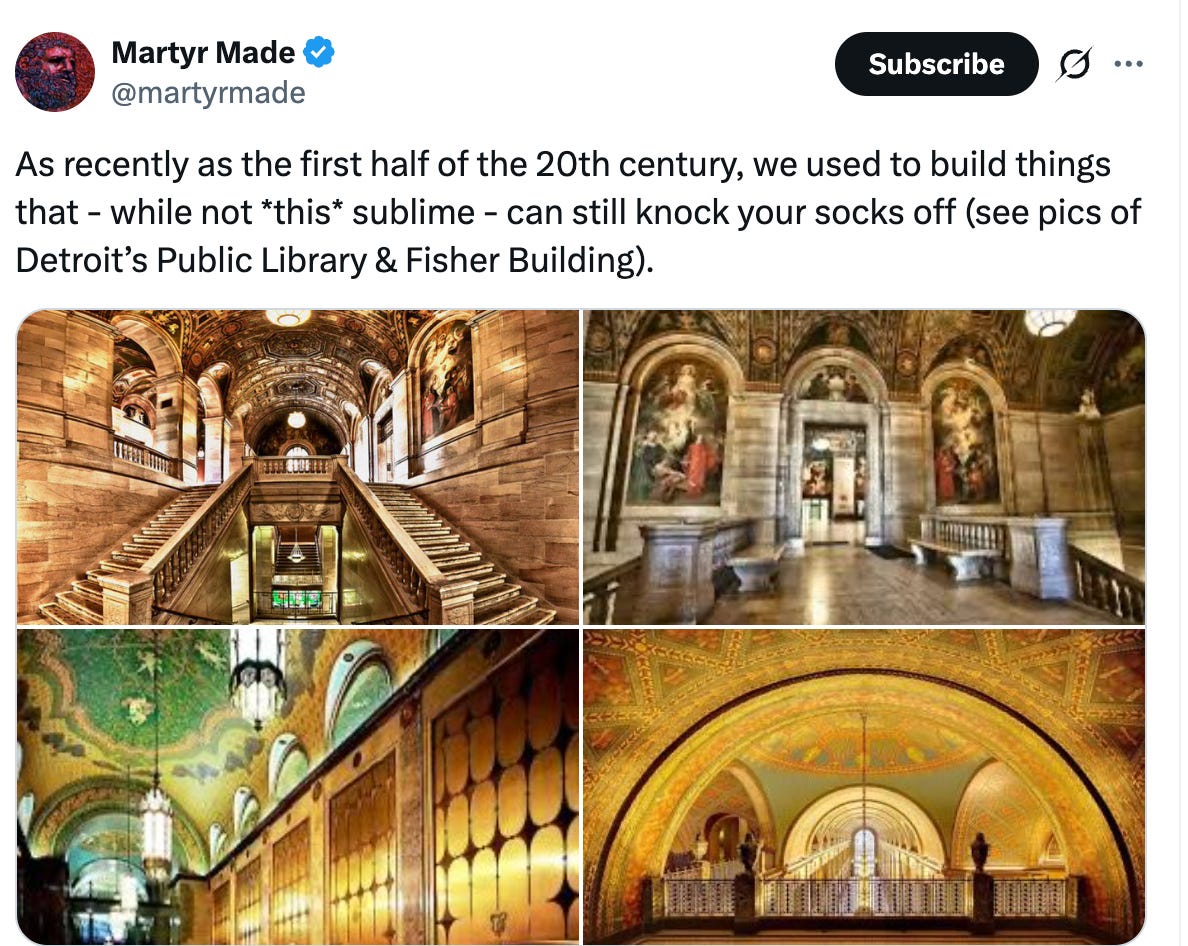
Neighborhoods lovingly cultivated by generation after generation of the same families who cared deeply for them and their neighbors were broken up, and the patient refinement that went into them was rendered valueless. Every hallmark of civilization was destroyed, and its value wiped entirely away. Now those neighborhoods are blighted and abandoned by all but the rotten denizens of decrepit crackhouses. See what Detroit’s neighborhoods now look like:
The Lesson of Detroit
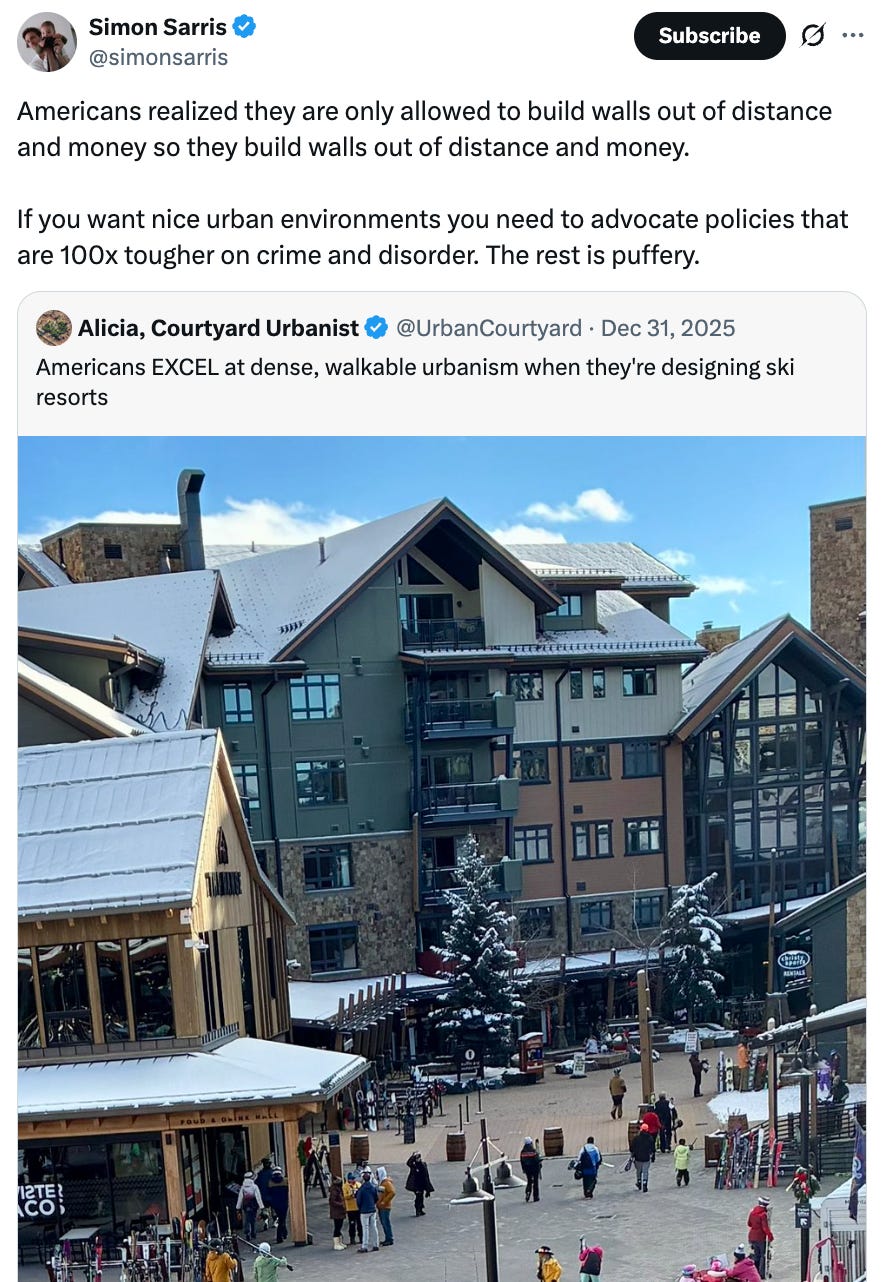
That taught a lesson: there could be no community in America that was protected by the love, care, and concern of its residents. Noblesse oblige as exercised by great families or patient neighborhood building as exercised by the humbler sorts was valueless, or at least could be rendered such if an urban mob got riled up by the death of a felon. Henceforth, the only walls that would be tolerated in America would be those of money and distance.
Thus, suburbs are characterized by their sterile and defensive architecture (broad spaces between houses with open yards, no real ability to walk to or from the neighborhood from anywhere with a bus stop, the requirement of driving everywhere to do anything in suburban life), and by the houses within them being treated as commodities rather than places where families will build, develop, and invest for generations. What nice, dense places exist—ski resorts and the like—are immensely expensive to keep the bowling balls of Detroit at bay.
Yet more importantly, the community building of the sort that made Detroit and other places like it not just pleasantly livable but rewarding and fulfilling, is entirely dead.
What is the point of being close with your neighbors if you’ll all have to scatter to the four winds at the first sign of trouble to salvage at least some of your investment? What’s the point of building a beautiful corporate headquarters or world-beating urban amenities that exude stability and permanence if the whole operation will have to up and leave because the authorities refuse to keep criminals at bay or even let you defend your own life and property? Who would dare invest for the long term if the future can be destroyed by a few junkies?
No one. And so that investment doesn’t happen. The community building doesn’t occur. Riots, crime, vagrancy, and the other cancerous outgrowths of the Civil Rights regime are never far from mind and are often ascendant. Depression and apathy follow, as what else can one do but shrug and hope for the best in the face of such a totalitarian and destructive force?
Such is the root of our present decline. American industry can still compete. We still know how to build pleasant places and beautiful things. There remains a desire for high civilization, as shown by the continual discussions regarding good books, proper dress, and beautiful architecture online. But what should exist doesn’t because those who would do the hard work and engage in the low time preference investments of effort and capital into such things have no reason to.
The lesson of Detroit is that any effort to reach beyond the favela might be wiped away, and so most just stew in the vile sludge of equality and are depressed by the abscesses and boils of equity that form as a result.
The ennui, the apathy, and the indolence all stem from the recognition that cultivation and excellence in any field will be ruthlessly punished if the equity regime decrees such to be in conflict with the equality of man, as was the case in Rhodesia.
And so we have declined, with standards getting sloppier and sloppier as civilization falls apart not for lack of capital or the impossibility of defending it, but for lack of will to bear the cost of maintaining civilization. To escape it, all we need is the will to defend it, to show that Detroit won’t be repeated. We’ll see if such can be recovered in the face of the stifling torpor induced by the heretical doctrine of equality.
If you found value in this article, please consider liking it using the button below, and upgrading to become a paid subscriber. That subscriber revenue supports the project and aids my attempts to share these important stories, such as the recent one on John Brown and the Civil War, and what they mean for you.
Charles Murray was already noting this years ago in Coming Apart: The State of White America, 1960-2010
Nature’s Metropolis: Chicago and the Great West is a great book about this
Empires of Light: Edison, Tesla, Westinghouse, and the Race to Electrify the World is a great book on this.
Lack of incentive is big part. Why work hard when gubmint takes almost all you make? Why own property when the de facto ownership is in the hands of gubmint? Why try to start an enterprise when the vampire of gubmint has bled it dry before it even lived?
Futility.
One is likely to be more content getting off grid and becoming mostly self-sufficient. When all your efforts are spent sustaining yourself and achieving what you want in your life rather than involuntarily supporting an imperial system that steals all you make, your life-satisfaction is bound to be much higher.
This reminds me a lot of the fall of Baltimore. Baltimore used to be a top 10 city. In fact in the 1950s it's population neared 1 million. Then it was besieged by race riots. The ethnic, middle class, and upper class whites fled. It's a shell of what it used to be. It nearly has half the population it did in the 1950s. Civilization that took decades and centuries to build wiped away in a few years. I've heard it's better than it used to be, because of reinvestment and gentrification. I sure hope it continues on that trend.