


A fascinating and depressing aspect of life in the West since the 1960s is that nearly everyone recognizes that we are being governed quite badly. This is admitted near-universally, and is true regardless of which party comes into power, with a few limited exceptions characterized mainly by their being “less bad” rather than any variation of “good”.
Listen to the audio version of this here:
![[AUDIO] Why Tyrants Love Mass Democracy](https://substackcdn.com/image/fetch/$s_!-vW8!,w_140,h_140,c_fill,f_webp,q_auto:good,fl_progressive:steep,g_auto/https%3A%2F%2Fsubstack-video.s3.amazonaws.com%2Fvideo_upload%2Fpost%2F213159341%2Fb6f6b458-77dc-4b97-b6c7-2d61f92ebd3c%2Ftranscoded-1787929107.png)
Social Security trends toward bankruptcy regardless of who is in charge. Welfare programs balloon, and are ever more obviously a way of transferring resources from the industrious to the slothful. Gangsters with rap sheets longer than CVS receipts continue to prowl the streets because they are released time and time again by a “justice” system that has no intention of holding them accountable, and turn once-great cities into uninhabitable slums. Costco and airports look ever more like the Raj during the Mutiny, and European cities are so overrun with Africans that there’s a term for the psychological state that results when tourists arrive.1 Further, all of that is exceedingly unpopular.
Yet rarely is anything really done about any of that, or the terrible leadership and governance that leads to it. As The Black Horse put it on X, “Understanding that mass migration to the West has proceeded against popular support nearly universally and with little interruption is a great first step into understanding how politics actually works.”
Much as people complain, it must be said that they do very little about it. About half of Americans vote, so a quarter elect the president. Around the same percentage of each state and district elects senators and congressmen. But that has limited worth, given the scale of the matter. It’s easy to just shrug, admit that what you might do is worthless, and do something else instead. Perhaps the grocery store or gym will be less crowded, after all, if a few people are busy at the voting booth instead.
That oughtn’t be done; voting is a civic duty, and sometimes matters. A recent election in which the worst sort of Establishment Republican was replaced by a somewhat better Republican was decided by three votes, after all.2 And, in any case, despair is a sin for a reason. But apathy is easier than duty, and so is usually the impulse into which the apolitical person gives.
And why wouldn’t they? At the scale at which our elections occur—tens of millions on each side for the presidency, many millions for the Senate, and hundreds of thousands for congressmen—it’s hard not to just shrug and wonder what the point is, however awful the state of the nation is. Voting rates have fallen off a cliff in England as well.3 As voting is the easiest and least risky means by which a man can make his voice heard, the other forms of political action are similarly neglected, swamped by despair and festering apathy. It is a well-organized and motivated populace that rebels, and such a populace votes, or participates in what forms of civic participation are available. A demoralized and apathetic population doesn’t.
As a result, the destruction continues, as does the decline that comes from it. The malice-minded rulers pay no heed to popular discontent, for those who are discontented never feel a sense of ownership over the situation. Participation was not earned, but given broadly and freely. Whatever their station in life—high or low, rich or poor, somewhere in between—those who can participate in the political process have no real inducement to do so other than a lurking feeling of guilt or responsibility.
It’s hard to feel like a valued member of the civic process, or think you can much shape it one way or another, when your vote counts the same as that of the crackhead whose ballot was harvested for $20 and promises of more money for Dewayne Geld programs.
Such is largely why the bad governance continues as it does. There is never a moment when those who are deeply invested—not just financially, but spiritually and personally—in the situation realize that what has gone on has gone on for far too long, and that not only must it stop but they must be the ones to stop it. Such men, by and large, don’t exist anymore. They were destroyed, and destroyed for a reason.
Uncoincidentally, this happening is the moment hope begins in The Lord of the Rings trilogy. The forces of Darkness are strong, endless hordes are on the march, and all appears lost. And then an entity of the old world, his kind long since long since lost to memory and shrouded in myth, awakes and realizes that it is his duty to fight for the preservation of his people—in this case, Fangorn Forest—against the ever-encroaching hordes who have done so much damage to it. And so he marches on Isengard, and the forces of darkness receive their first real check in large part because of his leadership and bravery.
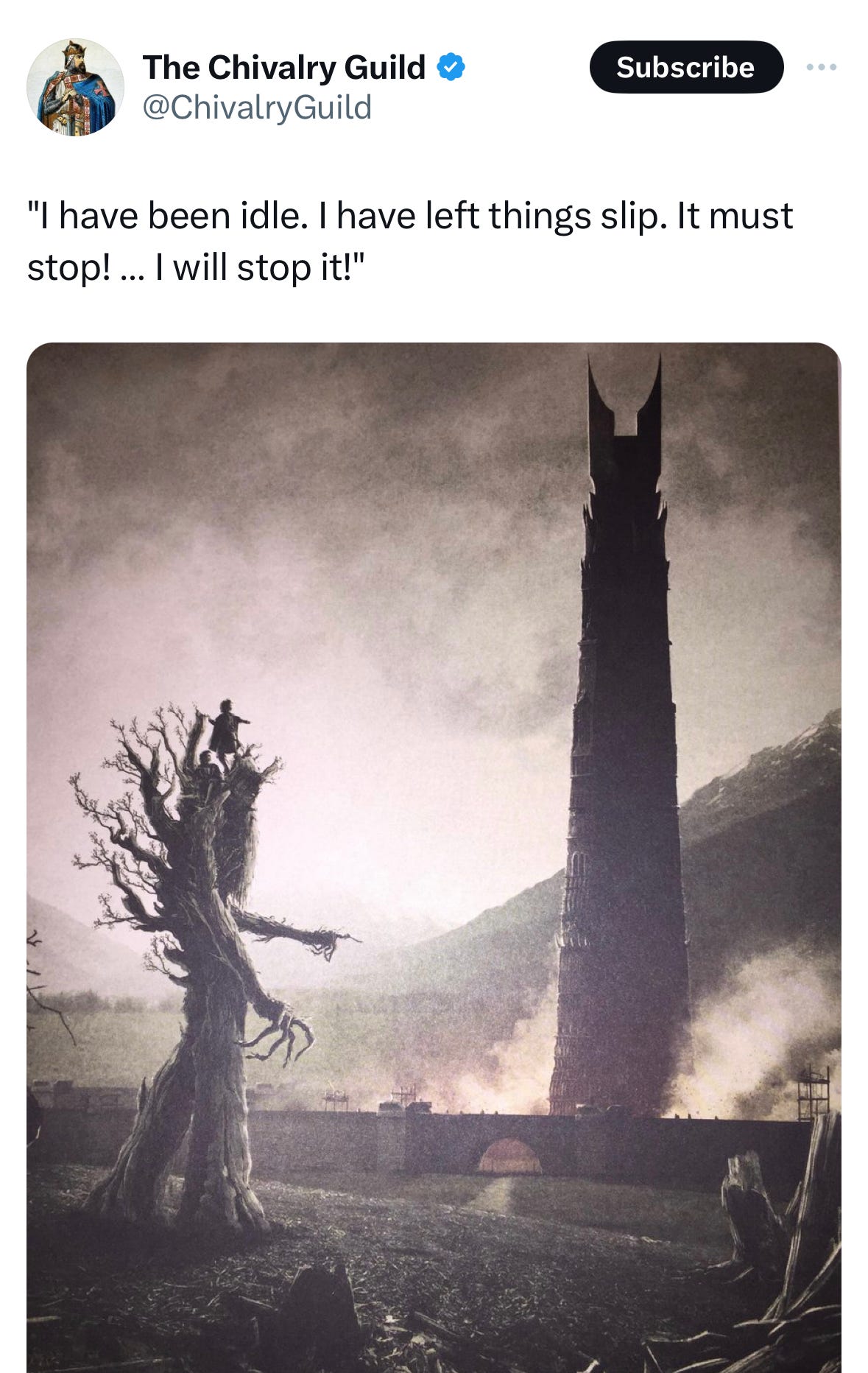
Such is just a story, of course. The Two Towers does not lay out a coherent path to political victory, however fun to read or watch it may be. Regretfully, very few of us are trees that can pull down a fortress of evil and drown its denizens, however much those denizens might remind us of current problem-causing Americans.
But there is something in it that gets to the central problem we now have: why is nothing done? Why does the bad governance continue, sticking around regardless of what attempts at treatment are imposed?
This wasn’t always the case, after all. Victorian governance was not always the model of picture-perfect leadership, but was generally competent and tended to eventually redress reasonable grievances of the industrious populace, rich and poor alike. Pre-Civil War American government might not have been universally good, but was generally competent. Even after the war, once Reconstruction was given up on and a state of relative normalcy returned, we had some good leaders. Cleveland, McKinley, Teddy Roosevelt, and Coolidge were all pretty good. Taft and Harding weren’t great, but were exemplars of excellent government compared to the general state of things today.
Worst in that period was Ulysses Grant, who, despite being a generally good man himself, was 1) utterly incompetent as president, and 2) taken in by corrupt plutocrats who used his presidency as an opportunity to loot the country. That they were able to get away with it, and that he was in office at all, was largely the result of the South being excluded from the political process and the mix of deeply egalitarian Radical Republicans and avaricious carpetbaggers “representing” the South instead. For that period, there was no brake upon democracy and its worst impulses, and so the Radical Republicans could impose their will without check after riding a rising tide of envy and vengeance all the way to its inevitable conclusion.
Fortunately, such men as Fitz Lee and Wade Hampton III—both of whom were dashing Cavaliers who served under JEB Stuart and who later served as post-bellum politicians who helped undo Reconstruction—stood as a check against them, in the end, and helped the South shrug off its burdens and resume its position as a check upon mass democracy. A much more minor check than previously, of course, but a check nonetheless.
This continued far longer into the 20th century than most imagine or remember. Governor and Senator Harry Byrd, the last distinguished member of another ancient Virginia line, built a hugely powerful political machine that dominated Virginia for decades, and he spent the last 30 years of his life using it to exercise a check upon FDR and egalitarian progressivism. Much damage was done despite him, but he always stood in the breach and held back the tide with as much strength as could be mustered, fighting in particular for fiscal restraint and against the Civil Rights Cultural Revolution. The Byrds of Virginia by Alden Hatch includes a relatively brief (~100-page) and generally sympathetic biography of him that describes his war with FDR, and what deeply inculcated, very Virginian political values and personal virtues led him to wage that war.
In Senator Byrd, one can see that about which Tolkien wrote coming to life. His blood was of the First Families of Virginia. His ancestors had crossed the Atlantic before the war with the Stuarts and built a great fortune that empowered them as one of the great leading families of Virginia and exemplars of what the American gentry could be, though it was a fortune and opportunity that William Byrd III frittered away. Consigned to relative poverty, they retreated to the Western frontier and rebuilt a small fortune in the Shenandoah, one that the hard-driving, hard-working Harry Byrd turned into a vast fortune once again, doing so largely through his own innate excellence rather than with the help of others.
Lurking in the Western woods, he grew disgusted with the machine politics he saw operating in Virginia, with all the waste, fraud, corruption, and bad government that grew out of it. From the immense debt burden that had to be assumed by an impoverished taxpayer to the backward state of country-managed roads, he saw what democracy at its worst could be.
He eventually decided that not only was that something that had to stop, but that he would be the one to stop it. This he did. He became governor, destroyed the old political machine, and built a new one that was characterized by its honesty and efficiency. In imposing poll taxes that limited the electorate, he constrained mass democracy, and used the opportunity for reasonableness that came from only answering to a limited electorate of competent men to ensure that good government and good policy remained the case in Virginia for decades. As a result of that action and the machine he constructed, one that lasted until the communistic Civil Rights regime finally won in the 1960s, he was able to restore Virginia and fight FDR’s pinkos, imposing a great many checks upon them.
The forgotten man of blood long consigned to myth emerged from the woods, and battered down the rot that had resulted from the absence of his kind.
Such is the very thing that mass democracy seeks to prevent. The reason that the pushers of equity sought with such vigor to destroy the gentry and abolish poll taxes and like constraints on the electorate is that those constraints on democracy, when paired with good government, allowed for men like Harry Byrd to remain in power for a long enough time to shape the course of history.
Any demagogue, populist, or talented politician can take office, even in a mass democracy. What voters there are will be upset, and vote against the terrible government of the present regime to spite it. That’s not much of a problem for the regime, for, as we have seen with Trump, it can just throw up procedural hurdles for long enough to avoid facing any real reforms or changes. With perfidy and obstinacy, it can buy itself enough time for the reformers to tire out or the voting base to turn on them over “betrayal” (being temporarily stymied by a regime that has long been in power). The typical Barabas-choosing tendencies of democracy result, those who might reform the system lose power, and from there, it can get back to “business,” which largely consists of looting in one form or another.
Constraining democracy to those who have shown they are stewards of their own lives and can thus be trusted to be stewards of the fate of the nation changes that. As shown in Rhodesia and the Virginia of Byrd’s ancestors, an electorate limited to such men as are personally capable of impulse restraint—shown largely through accumulating the wealth typical of the middle class (generally the bottom 50% was excluded)—can stick with good leaders long enough for them to do good things. In both Virginia and Rhodesia, this meant first building high civilization out of the wilderness and then using the riches of that new civilization to fight a grinding war against the great imperial powers of the day. Virginia won and Rhodesia lost, but in neither case would it have been possible had the electorate been governed by impulse rather than a sense of stewardship informed by deep life experience.
Similarly, it’s hard to imagine a Virginia other than the one led by the Byrd machine putting up such long-lasting and temporarily effective resistance to the Civil Rights regime (this was called Massive Resistance) at great financial and reputational cost. But it did so because it understood the importance of defending its culture. Non-coincidentally, Harry Byrd was also Rhodesia’s staunchest defender in the Senate, for it was fighting against the evils of egalitarianism as well, and doing so at the same time.
Such is what the egalitarian regime does not want. It knows it is unpopular. It knows its policies bring death and poverty rather than human flourishing; indeed, that is the point of race communist expropriation efforts. And it knows that long-lasting resistance to its failures, exactions, and intentional disasters would bring the defenestration of it, and creation of a pre-Great War type world in which excellence reigns triumphant once again.
Its method of preventing that, everywhere it has successfully done so, is mass democracy. The Congo, Rhodesia, and South Africa all went from (relative) heaven to certain hell when they got mass democracy, as such empowered equality and the machete it used to literally and figuratively hack civilization apart. America finally got the same when poll taxes were destroyed and the break upon democracy that was the South got obliterated; we’ve since been ruled largely by John Brown’s spiritual heirs, and that has gone much as could have been predicted. Europe went from the crowning flower of civilization to a backwater increasingly owned by China and populated by Muslims and Africans with the equality wrought upon it. Democracy and the trend towards despair-induced apathy it creates has constrained once great peoples of the world as Gleipnir constrained Fenrir,4 and our elites tremble like gay and imbecilic versions of the Aesir in the fear that we might muddle our way out of that wet paper bag.
So long as we remain constrained by the strictures of mass democracy and its magical ability to lull us to sleep in the face of national death, they have nothing to fear. But if a man such as Byrd rises…they have much to fear, for the catastrophes they have heaped upon us might be undone.
How so? At the very least, felony disenfranchisement—already on the books in most states, particularly red states—would allow a motivated politician to disenfranchise enough of the electorate in any state to achieve dominant control of it. By pairing tougher regulation/prosecution of marijuana offenses with felony disenfranchisement and plea deals that push those cases through the system, millions upon millions could be disenfranchised. This is why Tennessee is as deep red a state as it is; it has the most felony disenfranchisements in the nation. If that happens alongside the general trend of leftists having a rock-bottom fertility rate (about 1/4 that of conservatives), the world could be a very different place in a few generations. One that is less democratic, and much more focused on legacy, tradition, and the long-term.
It is our duty to make it so. Not only must what is happening at present stop, but we must be the ones to stop it.
Read about felony disenfranchisement and how it relates to the Rhodesian voting system here:

Read about fertility and the remaking of the electorate here:

Read about how we can form a political counter-elite of the sort needed here:

Great article as always!
Just remembered a great, out of copyright film from 1934 by the excellent Harold Lloyd that pertains to what you've written here. It's called "The Cat's Paw." You can find it free on most streaming platforms including YouTube and Archive.org.
It's very old-fashioned in that they dare to call the Chinese by their correct noun, namely "Chink."
But the way the main character handles the corruption and crime within his hometown makes it worth watching for that alone. It is a very enjoyable film.
That was very, very solid.
The author says that Trump is a barrier to proper reform through perfidious obstinacy.
Elsewhere, I just wrote that Trump’s biggest accomplishment will be shitting the Overton window to allow different types of debate. I’m of the opinion that he’s a net positive.