


![[AUDIO] Flock Cameras Won’t Fix Crime for the Same Reason Twitter Is Becoming Unusable](https://substackcdn.com/image/fetch/$s_!Uk0N!,w_140,h_140,c_fill,f_webp,q_auto:good,fl_progressive:steep,g_auto/https%3A%2F%2Fsubstack-video.s3.amazonaws.com%2Fvideo_upload%2Fpost%2F212703788%2F43cedfa9-0fe5-4860-9dcf-dbcf86285b60%2Ftranscoded-1787666137.png)
The debate about Flock cameras continues to rage online, particularly amongst the right.
On one hand, there are those who think that such technology is worth supporting because it could be used by pro-law-and-order local governments to crack down on the sort of rampant criminality that blights many of our communities.
It’s a tempting argument, to be sure, as there is a great deal of truth to it. Setting such cameras up in those urban zones that don’t have “good schools”—or whatever euphemism is currently in vogue—would certainly provide motivated prosecutors more evidence to use against the criminal underclass.
Were an American Bukele with the iron spine of Lee Kuan Yew readying a blitz against gangsters and that sort, such technology would probably be useful.
But, then again, Bukele didn’t need a surveillance panopticon to deal with El Salvador’s crime problem. To turn a nation that was the most hellishly violent place on Earth into a relative paradise safer than Canada in the blink of an eye, he simply locked up the gangsters who had been terrorizing his country. He sent in his legions of armed enforcers, rounded up the gangsters, and crammed them into hellish warehouses where they can reap the wages of their sins one bleak day at a time.
How did he do so? By arresting everyone with a face tattoo. Turns out, there’s a near-100% overlap between having gang signs tattooed on your face and being a net detriment to society. No camera network needed!
I jest, I jest…somewhat. He does appear to have locked up pretty much everyone who looks like a gangster, and that worked extremely well, as could be entirely expected. Discrimination works.
The truth, after all, is that crime is a solved problem. As our ancestors found, the pillory post, gallows, and gibbet make serious crime a non-issue so long as they are rigorously applied against the obvious criminals. You might still get pickpockets and occassional serial killers, but there were no Decarlos Brown Jr. equivalents in Georgian England, for they had all been hanged.
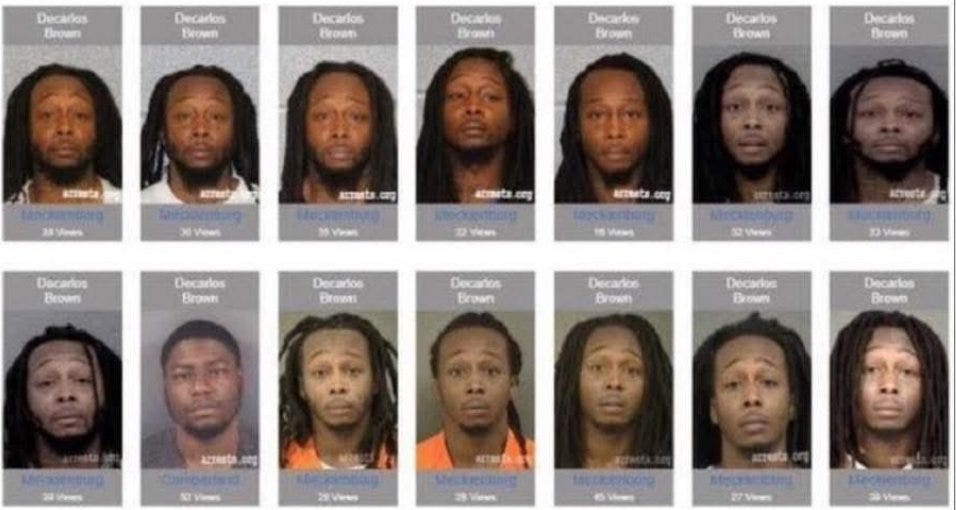
Further, the “lack of evidence” problem suggested by crime television and such loathsome groups as the Innocence Project is entirely made up. There is plenty of evidence to leave a reasonable jury satisfied in the guilt of pretty much every criminal… again, and again, and again, as they are generally recidivists: 1% of the population is accountable for 63% of all violent crime.1 Entirely coincidentally, I’m sure, that 1% number is also the percentage of each generation that Europe hanged when it solved crime.
Nearly all crime is committed by a small number of repeat offenders. Dealing with them would solve the problem and obviate any ostensible need for such a massive surveillance network.
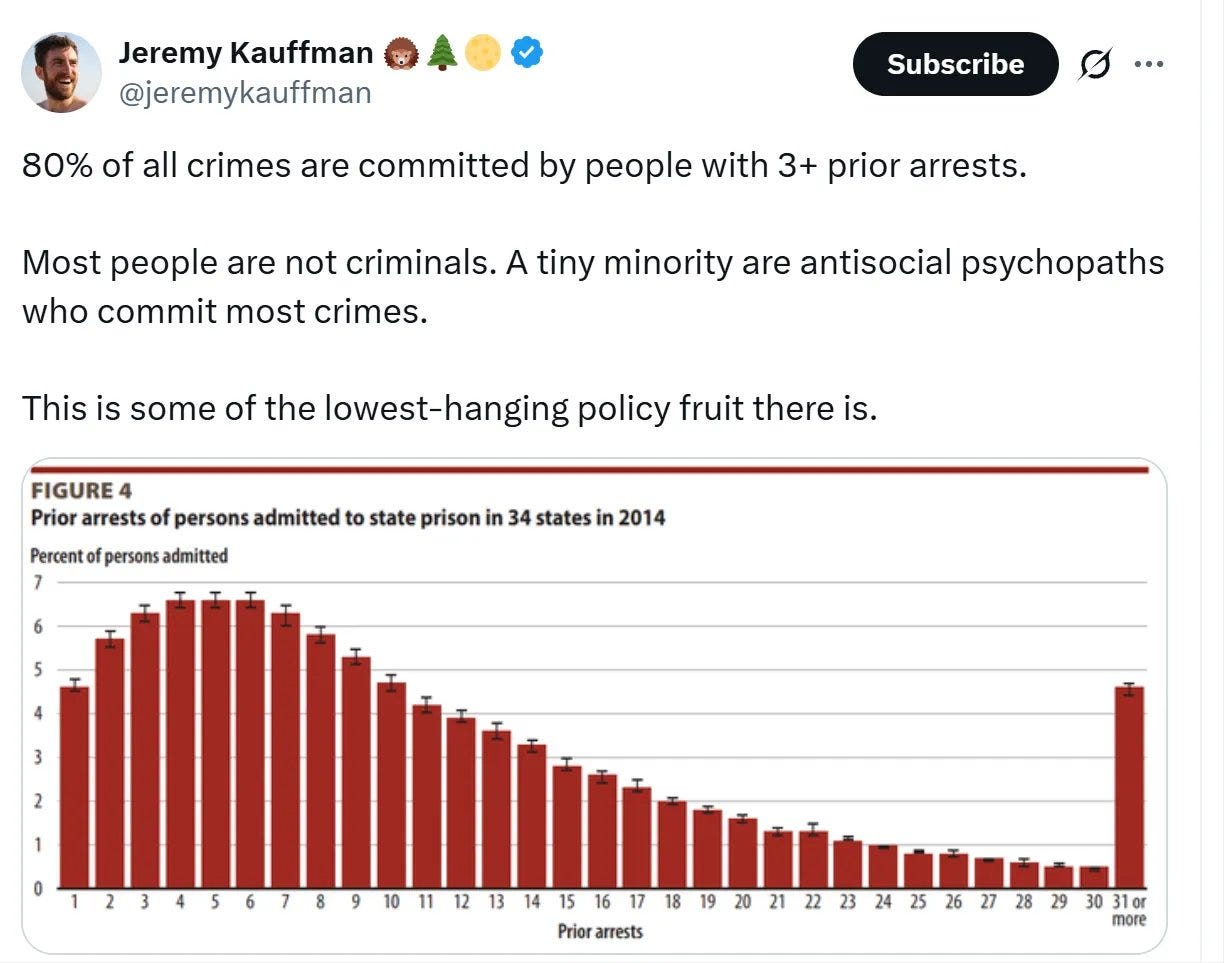
But, of course, we don’t do that. Anywhere. Red states and blue states, hellscape hive cities and small towns alike only “administer justice” in a very narrow band of ways calculated to be found acceptable by the softest-spined and weakest-willed amongst us.
Recidivists are put in programs that help them recover. Vast sums are lavished on feeding and housing criminal vagrants, so they can do drugs while destroying the habitats provided for them at taxpayer expense before going on to blight society in some other way. Lengthy trials in which the obviously guilty repeat malefactor is given every benefit of the doubt so that a sleazy public defender can convince a gullible jury that “criminal insanity” was the reason he shot the shopkeeper 15 times over a bottle of malt liquor, if indeed that was him. If found guilty, he’ll be housed at taxpayer expense in jail rather than public housing. More likely, he’ll be let go and returned to public housing so he can leech off society legally while plotting further depredations on those who pay for his housing.
That is not a problem that will be solved with more evidence. We have the evidence already.
It is a spiritual problem that has been around ever since the Victorians began their criminal justice reform efforts—such as by banning public hangings—and the attempt to partially ameliorate crime with a camera network is an attempt to solve a spiritual problem rooted in softness with technology that lets us avoid the hard decisions.
“Well, if the cameras catch a picture of him shooting the clerk and fleeing the scene, then surely the prosecutor will have to charge him!”
Alas, that’s not a solution. The same spiritual problems that have created our present problem—a governing regime that has no intention of dealing seriously with crime, as to deal seriously with it requires actions those who get squeamish at the sight of blood or act of profiling find unsavory—will remain. They are the issue, not the excuses given for allowing the problem to continue, such as a supposed lack of evidence.
Flock will do nothing to fix that, nor will any other piece of crime-fighting technology.
This sort of issue is present generally in America.
Obvious solutions exist for most of the problems that plague us, from the national debt to crime. But what those solutions require is the willpower necessary to do the difficult thing, regardless of how unpleasant some find it. To do whatever the equivalent of euthanizing the pit bulls is, and do so both consistently and ruthlessly.
Questing after a technology-based solution that uses some new thing to solve a spiritual problem—our squemish refusal to do what is necessary and press the “fix everything switch”—is the path to not just failing, but making everything worse in the process.
A somewhat lower-stakes version at present is X (formerly Twitter). Ever since Elon began allowing creator monetization of content on Twitter, it has been blighted by scammers based in India, Pakistan, Bangladesh, and so on. They use rage bait, stolen content, and AI to make a few dollars—meaningless sums in America but vast riches in Calcutta—while utterly poisoning discourse and dialogue on the platform.
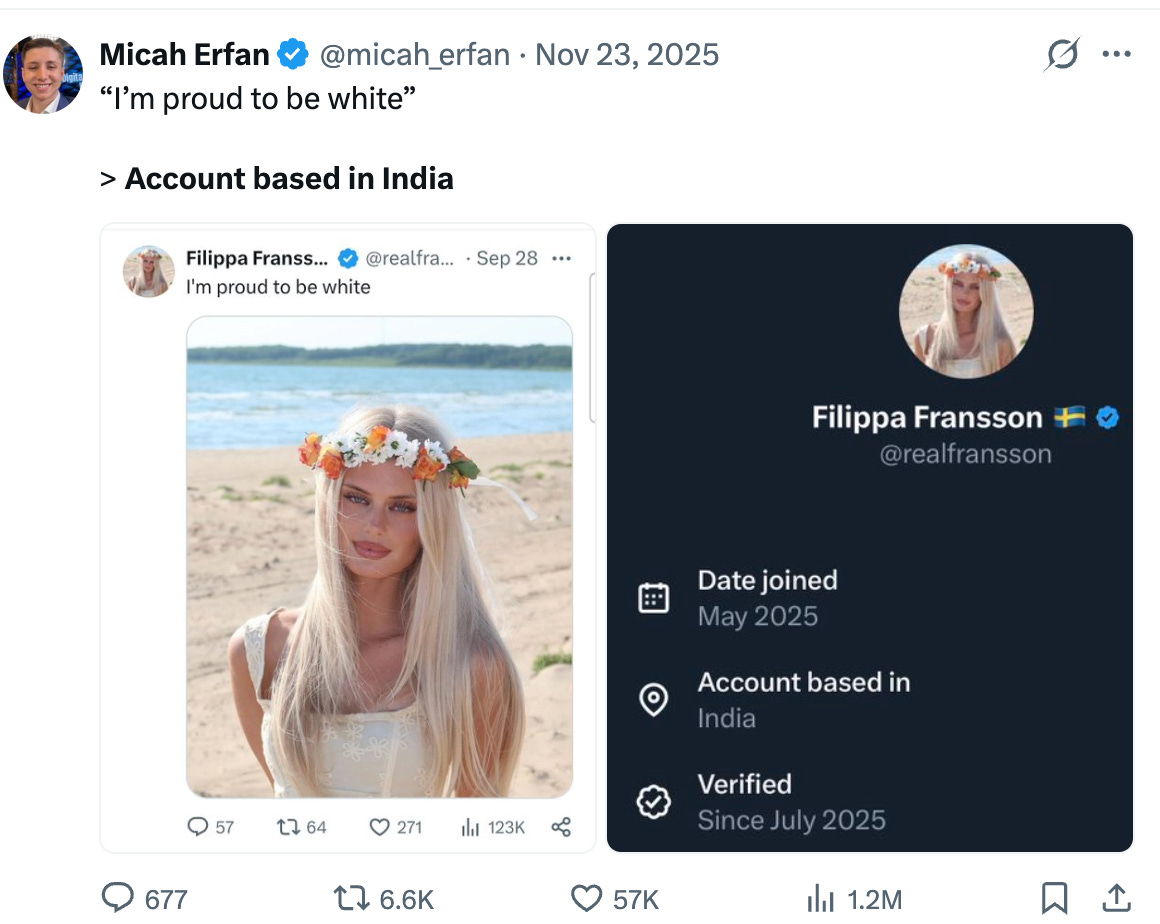
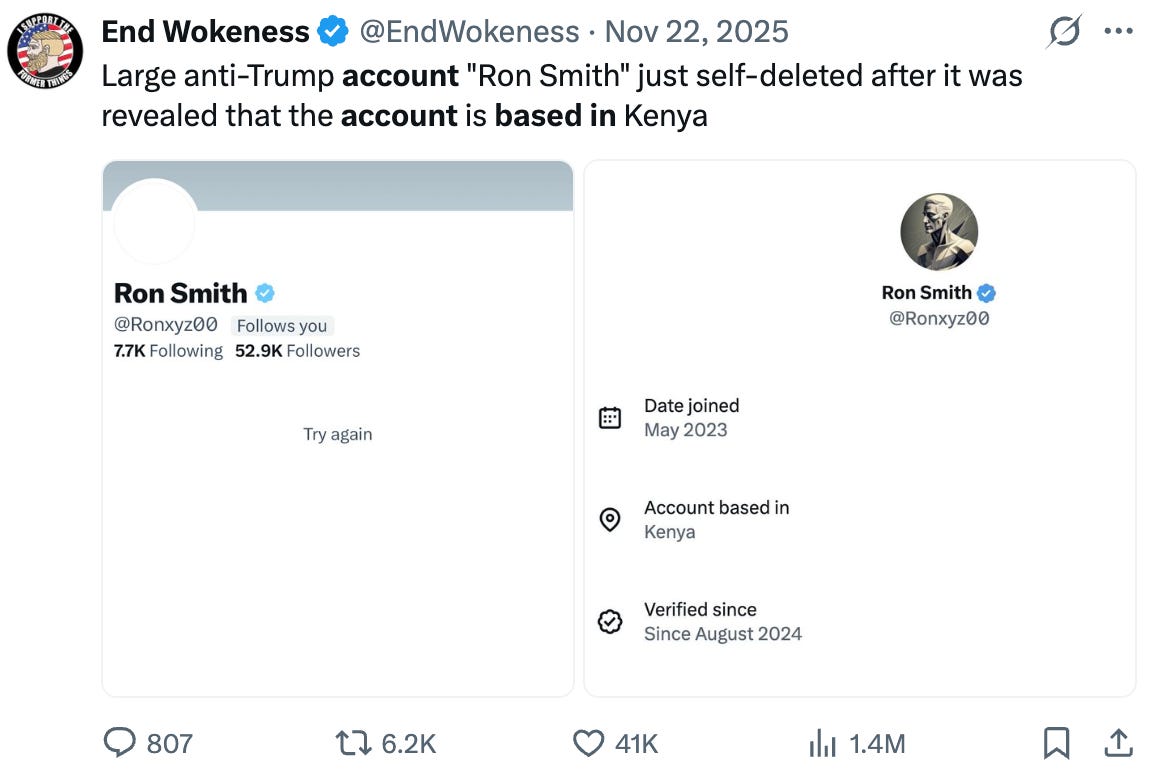

Much as there is an obvious solution to crime (hanging criminals), there is an obvious solution to dealing with various slop-peddlers pushing monetized engagement bait. That solution is to stop countries known for fraud from accessing the monetization program. Indians and Nigerians don’t care deeply about American politics. They’re on the platform to make $5 from posting about Trump or divorce and then live like the King of Calcutta for a week, not to add value for anyone else. They could simply be cut off from doing so with location-based demonetization. That would chase such types off the platform and stop them from ruining it. Notably, X users who enjoy posting and engaging with thoughtful discussion on the app, or just having fun in an environment unpoisoned by Bangladeshis, constantly demand exactly this. It’s not a novel or bespoke solution, but rather the obvious one.
Yet that isn’t what X has done. Instead, it has attempted to algorithmically suppress their monetized slop by tinkering with what sort of content the X algorithm recommends. As a result, the sort of content that gets traction on the app constantly changes, while generally converging to the lowest common denominator. Long-form posts will do well for a bit, and then will be suppressed because the scammers start using them to push slop. The same has happened with videos, threads, short posts, media posts, and every other variation of post one might imagine. The scammers always find a way around the tinkering, and everyone else suffers doubly. Not only do we have to see the Indian slop poster content, but we also have a harder time posting or seeing clever, thoughtful content created by Americans.
As a result, the platform’s usefulness and enjoyability have degraded significantly.
Much as with crime, there is no easy technological fix that obviates the need to discriminate. Worse, the quest to find one despite the evidence that none exists makes the overall experience far worse for everyone else. It also makes it harder to justify investing time in growing accounts on the platform, buying ads on the platform, or doing the other little things that would benefit its owner and make it the digital public square Elon wants it to be. That is a great shame, as he has sacrificed heavily in buying it and defending free speech on it. So, I continue to use it and encourage others to do the same. But his underlings lack his will, and his attention appears to be focused elsewhere, for now (many such cases), and so the problem continues. Hopefully it gets better. In the meantime, it’s a great shame.
There are solutions to our problems. But those solutions involve doing the hard thing ruthlessly and in the face of significant caterwauling, not in finding exquisite or bespoke technological solutions that dodge doing that hard thing. We must relearn that lesson.

Next to China, Britain is the most heavily videoed society in the world, far more so than any other Western country, but also the one with by far the highest rate of violent crime in Western Europe. In Britain, then, Big Brother is watching you, but only as a kind of voyeur.
Theodore Dalrymple
Thinking About Crime, the Broken Window Theory - James Q. Wilson
The synopsis: Lock Them Up.