


Welcome back, and thanks for reading! Before we begin, I have two quick requests. First, I have been devoting many hours of research and work to my Old World Show history videos, such as my recent one on the myth and reality of Virginia’s Cavaliers. If everyone reading this took the five seconds necessary to click on the video, like it, and subscribe to the channel, we could grow it exponentially. I’d really appreciate you taking the couple seconds to do so. Secondly, if you like this article or my work generally, please consider becoming a paid subscriber. Doing so gets you access to paywalled articles like the very popular one on John Brown and the Civil War, ad-free history videos, and access to the audio recordings I do for each article. You can listen to this one below:
![[AUDIO] The Norman Yoke and Rejecting Leftist History](https://substackcdn.com/image/fetch/$s_!hMhN!,w_140,h_140,c_fill,f_webp,q_auto:good,fl_progressive:steep,g_auto/https%3A%2F%2Fsubstack-video.s3.amazonaws.com%2Fvideo_upload%2Fpost%2F194949256%2F8eb678bc-c546-4e4f-bd3e-d38742501c63%2Ftranscoded-1776796078.png)
A recurrent problem on the right is that many insist on the general veracity of leftist tellings of history. This comes up quite frequently, with people of all age groups.
For example, many struggle to take their revisionist and rightist understanding of a specific issue, such as the tragedy of Rhodesia’s murder, and use that to re-examine a much broader subject, such as the post-Great War history of the 20th century generally, or even the Cold War. Instead, there is a general tendency to think “wow, that’s horrible” and then move on with a shrug, one’s general view of history left unimpaired by knowledge that proves it to be a lie.
This often comes up when specific figures are mentioned. Elon Musk, for example, has no issue commenting on the South African farm murders, black crime in America, or the Grooming Gangs in England. He knows the official story to be a lie, and is willing to boldly challenge that narrative. But when Mandela comes up, he nevertheless praises him,1 unable to understand that Mandela was a communist terrorist and is evil for the same reason that the present system of anarchotyranny is evil; the Global Favela in all its forms is rotten, as are its promoters, and must be rejected entirely.
The same is true of many people when Martin Luther King Jr. is brought up. They’re clear-eyed on crime in America, often understand generally what happened to cities like Detroit, and sometimes are even willing to condemn some Civil Rights figures, like the abominable Andy Young. But those same people often find it hard to criticize MLK even though the banner he waved was the same one that destroyed America’s cities by unleashing crime and riots on them, that he was plugged in with the Soviets, and that he supported the destruction of functional colonial states like Rhodesia just as much as did Andy Young.
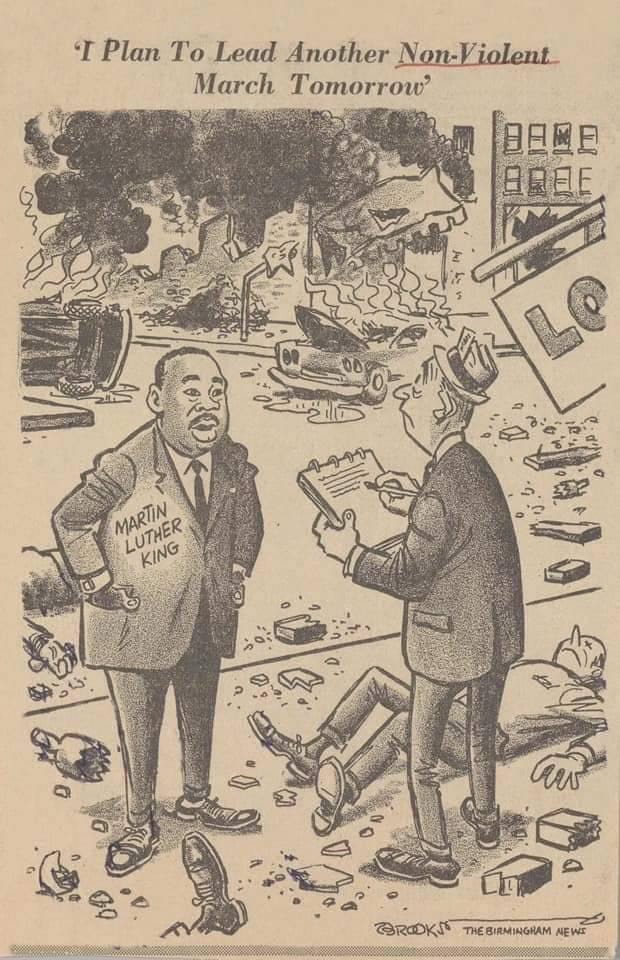
Why?
Because they have drunk deeply of the poison that is Leftist History and have let its general precepts control their understanding of what has happened and is happening.
An offshoot of Whig history and its absurd belief in the gradual triumph of progress over the ages,2 Leftist History is the belief that “oppression”—defined vaguely and generally as the exercise of natural hierarchy in the world—is always wrong and that it is in the end good for it to be overthrown, whatever the tactics used, and bad for it to be defended.
Hence why class time is taken in every American history class to damn Robert E Lee and praise the Civil Rights movement despite the fact that Robert E Lee’s character was an unvarnished pillar of marble and most Civil Rights “leaders” were corrupt hacks whose personal lives were defined by their communist connections and a litany of rapes. But we are told that Eldridge Cleaver and MLK are heroes, and Lee the most evil thug to ever ride across America; his wife inherited some slaves freed within a few years, you see…
Many can reject this in specific scenarios. They’ll defend Lee and Washington, for instance…though making sure to try to align that defense with Leftist History to the extent they can by noting that both were relatively mild masters, all things considered. Or they’ll defend Rhodesia…but never the Belgian Congo! Leopold II was mean….or something (he did a relatively good job, in fact).
Again and again, this comes up: a specific scenario can be addressed with intellectual honesty, but never the overall assumption of Leftist History, which is that “oppression” is always bad and the fruits of it must always be overthrown.
I was reminded of this over the weekend when I made a throwaway comment3 about the leftist nature of the French Revolution—particularly the fact that its main leaders were deformed freaks driven by spite and envy, as Carlyle notes in detail in The French Revolution. Most who saw it agreed, but there was a distinct strain of horror at such a thought articulated by several self-professed rightists who read that post: who could dare compare Marie Antoinette favorably to Marat and Danton, the French monarchs were tyrants! “Tyrants compared to whom?” was the question left unstated by such detractors.
Never did it cross their minds that what was done to the heavily religious Vendee4 by the atheistic proto-Bolsheviks in the Jacobin heart of the Revolution was far worse than anything done by a Bourbon. Nor did they note that the Bourbons were perhaps worse rulers than the Founders or Hanoverians, but also less exacting sovereigns and stauncher defenders of Tradition than many European monarchs of their period. No, what mattered was that the Bourbons “oppressed” someone or other on behalf of Tradition, and so were evil no matter what under the strictures of Leftist History.
Louis XVI was not a good ruler. His regime was not conducive to human flourishing. Had he been overthrown by a regime that was, and that defended Tradition against godless egalitarians like the Jacobins, that would have been a good thing. But, in terms of what should matter to anyone on the right, the Bourbons were far better rulers than the Jacobins. Whatever their faults, they didn’t murder tens of thousands of people for the crime of being successful and normal, nor were they godless atheists. Further, those facts must inform one’s understanding and application of history.
However, that can be difficult to do. All these examples—Civil Rights, decolonization, kings and Revolution—tug on the heartstrings of most, and are things about which we have all imbibed much propaganda, directly or indirectly. There is thus an emotional component that is hard to get past.
So, in this article, I’m going to attack Leftist History from a different angle, one that hopefully gets past those emotional barriers because it is an issue about which few people know: that of the supposed “Norman Yoke” and whether it was a great evil or great benefit to the Anglo-Saxon people. I think this shows Leftist History and how it shapes our worldviews quite clearly, and why moving on from it is important.
The Norman Yoke
When William the Conqueror defeated Harold at Hastings in 1066 and then solidified his rule over the ensuing years, he brought with him not just a new aristocracy from which a few noble families—namely the Percys and Grosvenors—still claim descent, but a whole new method of rule, governance, and land ownership.
Gone would be the system of the Anglo-Saxons, under which common and noble held land in varying amounts but which they owned in fee simple and farmed themselves. Gone too would be the commons, the witan,5 the mead hall, and the other defining features of Anglo-Saxon life from the 7th century on, all of which were relatively egalitarian and communal rather than hierarchical, ritualized, and “oppressive”.
Replacing all of that would be the system of common law, the king as a hereditary sovereign, a titled nobility that held its lands in fee to the crown, and a tenant peasantry that would farm the land for often absent land lords who used the rent of the tenants to fund military campaigns against each other and abroad. The courts were in French, ritualised, and based on Norman common law rather than the customary laws of the Anglo-Saxon peasantry.
Such is the myth of the Norman Yoke, and its most potent physical manifestation was the manor, the form in which all land was held after William distributed every acre of English land to his followers and himself. Replacing the fee simple farms and open-field system of farming of old were “manors”—collections of farms ruled over by a sometimes-fortified manor home and held in fee tail to the king by an alien “peerage” of often absent warrior nobles. These were Norman innovations that set a “seignural” stamp on the landscape that was as alien as it was indelibly hierarchical,6 and much of it lasted until the socialist land reform of the post-World War I era.
Such is the tale of the Norman Yoke, the tale of an alien and tyrannical system cruelly foisted on a formerly free Anglo-Saxon people in what had been a land of liberty and egalitarianism before the Normans arrived with their warhorses, lances, and manors. It is a tale of the evils of hierarchy, the rapaciousness of an “oppressive” aristocracy, and the damnable origins of the great landed estates of England and the gentlemen who ruled over them from ancient manor homes.
Thomas Paine pushed this message seven centuries hence in a passage that quite well summarized the popular conception of the Norman yoke as unjust and oppressive hierarchy imposed on a formerly free people, saying, “A French bastard arriving with armed banditti and establishing himself the King of England against the consent of the natives is in plain terms a very paltry rascally original and certainly has no divinity in it.”7
The Norman Yoke As Leftist History
Never mind that this might not have been true,8 or that by the time of the Plantagenets, the Anglo-Saxons were generally happy enough with the militarized peerage and monarchy’s wars abroad, so long as they were won. It was powerful, captivating, and a way to shake one’s historical fist at the peerage that had remained socio-economically dominant for a millennium.
Further, it was an early form of Leftist History in that it was a way of damning social hierarchy by characterizing the English nobility and gentry as mere descendants of foreign invaders who used the oppressive lance to destroy an Anglo-Saxon golden age of liberty and a relatively level social hierarchy. That, of course, made it a powerful tale to tell the poorer classes in England as the Civil War began, and delegitimized the Cavaliers by painting hierarchy as it then existed as immoral, oppressive, and alien.
For that reason, it was a tale picked up and made popular by the Levellers.9 A sect of the Puritans “lodged within the New Model Army” of Cromwell, the Levellers focused on using the Civil War to achieve an egalitarian revolution in England. They aimed to “place all people on the same social and political level, essentially eliminating the political power of the aristocracy and gentry . . . Levellers at first demanded the extension of suffrage to all Englishmen, basing their claim for near-universal suffrage on ‘natural right’; they also attacked monopolies, the House of Lords, and the monarchy.”10
Similarly, it was a tale attractive to the Diggers.11 The Diggers, also called the “True Levellers”, were an even more radical sect of Puritans who “wanted all land to be held in common,” which is to say they were proto-communists. They were known for declaring that “honour, nobility, [gentility] … would disappear when the new Zion was established” by the overthrow of Charles. “Seeing the common people of England by joynt consent of person and purse have caste out Charles our Norman oppressor, wee have by this victory recovered ourselves from under his Norman yoake,” a prominent Digger declared upon Puritan victory over Charles.
They also claimed that the Norman peerage held the English people captive with the supposed yoke, comparing their plight to that of the Israelites in Babylonian captivity. “The last enslaving Conquest which the Enemy got over Israel, was the Norman over England,” went one popular tract, adding that the Normans “still in pursuit of that victory” are “Imprisoning, Robbing and killing the poor enslaved English Israelites.”12 Their radical belief in communal ownership of land was prompted and legitimized by that belief that the Norman Yoke had enslaved the English people.13
Thus, we see how this tale became Leftist History. There are merits to the Anglo-Saxon system and merits to the Norman system. But in popular memory, the Normans were ruthless oppressors who dragooned the Anglo-Saxons into paying them extortionate rents so that they could squander the money on high living, venality, and sinful wars.
Thus, the peerage and the hierarchy it represented were rotten because they were oppressive, and destroying them would be and was a good thing, regardless of what social ills replaced them.
Carlyle’s Response
This argument is best rebutted by Thomas Carlyle in Volume I of his History of Frederick II, in which he argued against such a Leveller or Digger interpretation of the Normans and understanding of their system as a yoke. Instead, he argued, the hierarchy and manorial system the Normans brought with them should be viewed as a positive because the order and hierarchy it imposed were the catalyst that made the British a great and world-spanning people. He argued:
England itself, in foolish quarters of England, still howls and execrates lamentably over its William Conqueror, and rigorous line of Normans and Plantagenets; but without them, if you will consider well, what had it ever been? A gluttonous race of Jutes and Angles, capable of no grand combinations; lumbering about in potbellied equanimity; not dreaming of heroic toil and silence and endurance, such as leads to the high places of this Universe, and the golden mountaintops where dwell the Spirits of the Dawn. Their very Ballotboxes and suffrages, what they call their 'Liberty,' if these mean 'Liberty,' and are such a road to Heaven, Anglo-Saxon highroad thither--could never have been possible for them on such terms. How could they? Nothing but collision, intolerable interpressure (as of men not perpendicular), and consequent battle often supervening, could have been appointed those undrilled Anglo-Saxons; their potbellied equanimity itself continuing liable to perpetual interruptions, as in the Heptarchy time. An enlightened Public does not reflect on these things, at present; but will again, by and by. Looking with human eyes over the England that now is, and over the America and the Australia, from pole to pole; and then listening to the Constitutional litanies of Dryasdust, and his lamentations on the old Norman and Plantagenet Kings, and his recognition of departed merit and causes of effects, --the mind of man is struck dumb!
Rebutting the Yoke, and Leftist History
Carlyle’s response to the Levellers and Diggers—many of whose views were being repeated by the Chartists of his day—is the perfect rightist rebuttal because it gets to the core of the argument, and the political question that needs to be answered: what is the ultimate good for which we should aim?
Is it equality? If so, then Norman yoke is indeed terrible, oppressive, and all the rest.
Or is it human flourishing and national greatness? If so, then that yoke is what got the Anglo-Saxons to stop belching in their long halls after many long years of decline and instead became the people who conquered and settled everywhere from Australia to Virginia, Alberta to Rhodesia.
Further, Carlyle’s counter-argument shows how complaints about the Normans are all leftist in tone and nature, for they are rooted in the belief that hierarchy is always bad because it must be oppressive, regardless of its fruits.
Without the Normans, the British would never have launched a Crusade like that of Richard the Lionheart. They wouldn’t have colonized India, created civilization out of the woods in Virginia, or done the same thing in Rhodesia. The human capacity was there, but the will was not. Nor, without the manorial system, could the resources have been mustered for them—it was the great lords who funded the East India Company, Virginia, and Rhodesia, for they had the spare capital to do so because of their manorial holdings.
Order and hierarchy matter. Without them, Morris Talapar never could have said, as he did in his The Sociology of Colonial Virginia, “Virginia is a landmark in the history of the Anglo-Saxon people. The Anglo-Saxon people developed towards their position of world domination during the last several hundred years, when they showed an unusual initiative in exploration, discovery, conquest and colonization. As England’s first colony Virginia is the genesis of the British Empire, and as the first Anglo-American colony she is the genesis of the United States of America.”
When he wrote it, that was true. The Anglo-Saxons had done those great things over the preceding centuries. But they had only done so because, as Carlyle noted, the Norman yoke had drilled them into being able to do so. Without that order, their “liberty” would have meant mere licentiousness.
But still complaints abound, most of which stem from the Leveller and Digger tendency—the annoyance that great lords ruled large swathes of land, whether in Virginia or England, rather than all being equals of a sort and different in degree. The mindset inculcated by Leftist History of the Normans and their descendants, men like the Grosvenors in England or Lees in Virginia,14 is that their existence represents unfair and unjust hierarchy.
That idea is deeply set and quite a problem because further leftist tendencies flow from it. Much as the Levellers and Diggers used it to push proto-communism and social egalitarianism in the days of Cromwell, those who think of the Normans in such terms tend to be hostile to hierarchy and its fruits as a result.
To believe the tale of the yoke as told by the Diggers or Thomas Paine belies a tendency to support the politics of envy, to support egalitarian social modes, and to otherwise support that which would hollow out our civilization from within.
It’s no coincidence, after all, that much of Britain’s decline came as a direct result of legislation designed to break the supposed Norman Yoke by breaking up aristocratic landed estates with egalitarian tax legislation and disempowering the Lords with the Parliament Bill. Which is to say, doing what the Levellers and Diggers originally wanted. Such is legacy of the Norman Yoke, and what flowed from a belief in it.
It’s one thing to make a point about inequality and the way in which it can be unjust through the lens of someone like Tiberius Gracchus. The oligarchs in that story were Romans who stole the land of the yeomen, their countrymen, through treachery and guile. They stole the land of brave citizen-soldiers of their own ilk so that it could be engrossed into vast latifundia. That is wrong. But it is wrong because of how it was done and to whom, rather than that engrossment happened—had their estates merely been in conquered Sicily, Gaul, or North Africa, no one would have cared. It was that they stole the land of fellow Romans that made their wealth and the inequality it shows rotten.
But that’s not what happened in England. The Normans won. They defeated the Anglo-Saxons, and the Anglo-Saxons tamely submitted to it, generally. The “exploitation” that occurred came because they were conquered and ruled as a conquered people. That didn’t last forever, nor did the yoke. By the High Middle Ages, they were one with their lords in many ways, and united behind kings like Henry V or Edward III. The yoke had transformed them into a more capable people, and empowered leaders who—like the Northumberlands—routinely led them in battle.15
Yet further, to read too much into the Leveller and Digger attempt to view the Normans and peerage through the lens of what amounts to Leftist History misses much of what worked about British society.
As noted by authors like JV Beckett, the middle class generally liked the traditional aristocracy and wanted much more to become part of it than to replace or destroy it.16 Similarly, as noted by Cannadine in Victorious Century, “the most pronounced social change of [the late 19th century] was the creation of a new sort of working-class culture, which was in many ways profoundly conservative, as would be evidenced by the number of pubs in working-class districts named 'The Earl of Beaconsfield' or 'The Lord Salisbury'.” Whatever their class, those who weren’t social malcontents were more than happy with the generally capable and pro-social aristocracy they had, and had no desire to tear down Chesterton’s fence and replace it in the name of vague ideological goals.
Those bonds between classes that made for a functional society were forged by the supposed yoke. Further, the supposed yoke had threaded the needle and created a people that, when part of a properly ordered traditional society, was not hostile or bitter about the upper classes holding the lion’s share of the land. It was the exactions of traditional society-replacing plutocrats that destroyed that delicate balance and made for a much more unstable and unpleasant order. But it must be remembered they were not the Normans, nor the heirs of the manorial system.
Why Rejecting Leftist History Matters
All of this matters in that it gets to the sorts of myths and systems that create and drive societies. Whatever their faults, the Normans did succeed in creating the sort of society Carlyle describes. By the time their spirit sank into the Anglo-Saxon people, Britain became a land not of myopic belchers, but of a people focused on outward exploration, glory, and achievement, a legacy that redounded to their credit everywhere from Virginia to Sarawak. Without the Normans, very little of that would have happened. The Anglo-Saxons just weren’t a people with broad horizons by 1066.
But there is a certain sort who hates it. This is the sort of person who, like the Levellers of yesteryear, is “on the right” when it comes to social issues and even some political issues, but hates anything that is unequal out of a belief that inequality is indicative of oppression and oppression is invariably bad. So they attack inequality or “oppression” where they see it, something that has become particularly prevalent from the right-wing Third Worldist contingent as of late, and end up pushing what is invariably just leftism arrived at via a circuitous route of muddled Leftist History.
What they argue is a leftist telling of history designed to harm the right by degrading the concept of hierarchy, a narrative that can only harm the right and help the left, as it was designed to do.
That should be rejected, and the myths surrounding the Norman Yoke show why. Inequality is not in itself a bad thing, but rather a natural one. The same is true of hierarchy. The same is true of the imposition of order—including order that is good but alien to a conquered people, like the common law system that was so anathema to the Anglo-Saxons.
Keeping that in mind makes for a more coherent study and understanding of history. Yes, deformed degenerates wreaking bloody havoc in the name of atheism and egalitarianism in both the French and Russian Revolutions was in itself a bad thing, regardless of whether the Bourbons and Tsars had their faults. Yes, Robert E Lee was a great man, and his executorship of the Custis estate—through which he was connected to slavery—is to his credit rather than his detriment because of the honest and capable way in which he handled it. No, Southern civilization doesn’t need to be apologized for, nor does colonialism. On and on it could go. Leftist History must be rejected, as must be the myths that flow from it.
If you found value in this article, please consider liking it using the button below, and upgrading to become a paid subscriber. That subscriber revenue supports the project and aids my attempts to share these important stories, and what they mean for you.
Also, consider checking out my history of the Lewis and Clark Expedition, such as this video on their legacy:


Whig history: https://en.wikipedia.org/wiki/Whig_history
I have been trying to use the Substack notes feature more to send out quick thoughts
As noted in Building Anglo-Saxon England:
If the fifteenth century was an age of loosening bonds and growing individual freedom, the eleventh was an age of rising seigneurial control compounded by militarised invasion and conquest. We should not, however, interpret through hindsight: that trajectory, which was becoming clear by 1050, could scarcely have been predicted in 1000. The Conquest set its seal on the emerging order: if the 'manor' was a Norman bureaucratic invention, the new vocabulary both acknowledged and normalised the recent evolutionary changes, defining them in familiar Continental terms with which modern historians have been happy to work.
Particularly, the open-field system seems to have been mostly made up, as is noted in Building Anglo-Saxon England:
Within a few weeks of Hall's The Open Fields of England, the same publisher issued a book that could hardly be more different. Debbie Banham and Rosamond Faith's Anglo-Saxon Farms and Farming sets out to show that there was much more to Anglo-Saxon farming than open fields, and that 'the Anglo-Saxons valued animals more than plants" For present purposes the most important strand in their approach is its emphasis on change over time. Drawing on the fast-accumulating body of environmental data, they propose a post-Roman 'abatement' in which population and therefore cereal production dropped, followed by a process of 'cerealisation' through the seventh to tenth centuries when bread-flour production increased, the arable component in husbandry grew progressively more important, and the land was made to work harder. They point out that the number of places where open-field furlongs can be proved to have existed before the Norman Conquest is small, and that this mode 'may not even have been the most common way of rearranging arable fields. More widespread must have been some version of the more flexible infield-outfield arrangement.... The land (usually) nearest the settlement is cultivated every year, and manured regularly, while the rest is mainly used as pasture, but parts of it... are taken into cultivation as required, and returned to pasture when fertility declines.'
This perception, though so different in emphasis from Hall's, is not irreconcilable with it. Hall sets out to explain a particular kind of farming landscape, in its fully developed form and in the complex detail that we can only grasp from much later sources. Faith and Banham show that that stage--where it occurred at all—was the culmination of a long-drawn-out process through the mid- to late Anglo-Saxon period and beyond. That is far from incompatible with Hall's idea of an early arable core extended outwards by the ploughing up of commons, though it implies a chronology somewhat later than his. But in evoking a world not dominated by arable farming, Banham and Faith offer different and very convincing priorities for the location of Anglo-Saxon settlements, at least before the tenth...
“The Diggers’ radical aims to alter the contemporary political situation are therefore legitimised through their construction of the past, which uses the ‘Norman Yoke’ myth as a means of explaining why mankind fell from God’s favour.“
As noted by Philip Alexander Bruce in The Virginia Plutarch, Vol. I:
Such were the ancestors of Richard Henry Lee in the direct line, reaching back to the first of the name to plant himself on Virginian soil; and the honorable careers which all of them, one after another, ran there were in harmony with the importance of the family in the social and civic life of England. There the name ascended to the Norman Conquest, and in its transfer to the colony oversea—a land that was new as the mother country was old—it was destined to add greatly to its fame. The future patriot, Richard Henry Lee, aware of the conspicuous part which his great-grandfather, grandfather, and father had played in the history of Virginia, must even in youth have been unconsciously influenced by the tradition of the public service in which they had so prominently and so uprightly taken part.
Similarly, Clifford Dowdey, in The Great Plantation, notes:
Richard Lee I was one of the few dynasty-founders whose English line was established beyond question. He had the right to use the generic arms of Lee of Shropshire, first borne by the Norman Reyner de Lega, or de Le', about the year 1200. His family lived on the estate, or manor, of Nordley Regis, though when Richard Lee was born the unpretentious house and modest holdings had passed to the older brother of Lee's father. Another of Lee's uncles had established himself as a prosperous merchant in London, trading overseas on a large scale. In 1621 John Lee, an older cousin of Richard's, succeeded to the business. As four of Richard Lee's younger cousins went into business with John Lee and as an association was known to exist between Richard and his cousin John, from the nature of his first trading enterprises in the Colony it has been accepted as a reasonable assumption that Richard learned the family business from his older cousin in London and was representing John Lee in the Indian trade when he first came to Virginia. After fifteen years in Virginia, Richard Lee still identified himself (in a petition) as an "English merchant trading in Virginia."

The Aristocracy in England, 1660-1914 by JV Beckett
Defining these peoples also becomes ridiculous at a certain point anyway, because they were all of the same Germanic stock. William was related to the Anglo Saxon kings, and Rollo himself was obviously a Viking. The Normans were a creation of Viking fathers and French mothers, and then many of the Norman lords married local Anglo women. Scotland is even more interesting because its aristocracy has a Norman element, a Norse element, a Hiberno-Norse element, a Scot element and perhaps even a Pictish element.
It always makes me laugh too that the leftist types conveniently ignore that the Anglo Saxons were capable of atrocities above and beyond the Normans, and practised slavery.
Great stuff and I do agree, but as a localist, I do more the replacement of commons and nobles freely farming with the introduction of “feudalism” with manor-estates and serfs who work the land. I do understand that serfs weren’t slaves and did have problems more freedoms than we do in some areas and they were the “stinking dirty” stereotype we’re taught about. Still, I do prefer the local shires and I do like the Magna Carta that limited the king’s powers. Weird, when I was younger, I fantasized about a based king putting nobles in their place, but now I realize, Absolutism is gay modernist crap. Lol!
Keep up the great work. 👍 Peace ✌🏻