


Listen below to the audio version of this article. Also, my friends at WBS Apparel made a 100% American-made, Rhodesia-themed coffee mug for us; if you are in the market for a new coffee mug, get one here.
![[AUDIO] Rhodesia’s Biggest Tactical Victory Was Its Largest Strategic Mistake. We Must Learn from This](https://substackcdn.com/image/fetch/$s_!lg7U!,w_140,h_140,c_fill,f_webp,q_auto:good,fl_progressive:steep,g_auto/https%3A%2F%2Fsubstack-video.s3.amazonaws.com%2Fvideo_upload%2Fpost%2F215569986%2F99345d2f-513c-4447-b6ef-c1abf399be71%2Ftranscoded-1789339188.png)
Of all the incredible feats of arms conducted by Rhodesian security forces during the Bush War, the cross-border operations into Mozambique were the most incredible. Multiple times over, small bands of brave Rhodesian troopers attacked the bases of communist terrorists who had been given sanctuary in Mozambique by FRELIMO after Portugal gave its old colony up, and wreaked havoc while slaying thousands upon thousands of those terrorists.
Of these, Operation Eland was the most incredible, and probably the most tactically successful. Unlike the raids, which generally involved the use of military airpower and large numbers of conventional soldiers paradropped in or helicoptered in, Eland consisted of under one hundred Selous Scouts—white and black Rhodesian special forces talented at infiltration of terrorist groups—raiding and defeating thousands of guerrillas with the aid of just a few armored cars. But it was also Rhodesia’s biggest strategic defeat, as the predictable backlash to it cost Rhodesia the war.
Operation Eland
As I discussed in my podcast on why Rhodesia lost the Bush War, the Bush War changed substantially with the overthrow of the formerly Salazar-led Portuguese government in the Carnation Revolution. Its replacement with a leftist regime uninterested in continuing the colonial project meant that Mozambique fell to the communists in 1975. The Portuguese handed off their centuries-old colony to FRELIMO, a communist group against which they had long fought, and skedaddled.
This was a major problem for Rhodesia and led to Operation Eland in 1976.
Prior to FRELIMO’s takeover of Mozambique, the communist terrorist bases had primarily been confined to Zambia. As the Zambia-Rhodesia border was relatively small and generally defensible, this limited the scope and scale of the Bush War somewhat. Particularly, it meant that relatively few farmers had to contend with attacks on their farmsteads, and that relatively few guerrillas were able to make it into the country and place landmines on the roads while trying to terrorize the Rhodesian blacks in the Tribal Trust Lands (TTLs) into supporting communism. Further, Portugal was an ally, and so its hold on Mozambique meant that Rhodesia could import much-needed oil through the port of Beira.
All of that changed in 1975. When FRELIMO took over, it welcomed in ZANLA, the primarily Shona-supported communist terrorist group led by Robert Mugabe. Joshua Nkomo’s ZIPRA, supported mainly by the Ndebele, primarily stayed in Zambia.
ZANLA operating out of Mozambique changed the war. The border to defend was suddenly about three times as long, and the Mozambique stretch was largely unprotected by natural barriers of the sort that made the Zambian border easily defensible. It was, instead, just a land border and the rebels poured across it. They wreaked bloody havoc as they attacked farms en masse, made roadways unusable by planting mines, and terrorized the TTL inhabitants into supporting the communist cause. If you are interested in this aspect of the war, I wrote about it here:

This expansion of the war began a demographic disaster for Rhodesia: frontline farmers gave up and fled the country. This mass exodus starved the Rhodesian war machine of white recruits and caused increasing problems for the Rhodesian economy, which was already overstretched as it struggled to pay for the costly Bush War. The problem started in 1975, and was in the process of becoming critical by 1976.
As the Rhodesian Central Intelligence Organization put it in mid-1976, ‘….we go from crisis to crisis …. our terrorist threat has developed to the greatest we could possibly expected …1,600 terrorists within Rhodesia, 2,000 under training and possibly 10,000 waiting in the wings for training…. the increased call up for whites has affected the economy….. unless terrorist casualties exceed their present rate of infiltration, no amount of continuous call up will of itself provide a military solution…. Indeed it is doubtful whether any purely military solution (by RSF) is possible…the official CIO assessment is Rhodesia is beginning to lose the war.’1
Two strategies emerged as the Rhodesians sought to get a grip on this threat.
One was the development of Fire Force units: scouts, observation posts, and aerial reconnaissance would identify communist terrorist groups, and Rhodesian light infantry would be immediately paradropped right on top of those “floppies” to close with and destroy them. Backed by airpower and helicopter gunships, these Fire Force units were highly effective and eventually achieved ~60:1 kill-to-death ratios. These hugely effective missions had the advantage of destroying guerrillas within Rhodesia’s borders, so international enemies of Rhodesia could hardly use the tactics against the Rhodesians. However, they had the disadvantage of putting immense strain on very limited numbers of Rhodesian infantrymen and airframes.
Yet worse, to overtaxed and under-threat Rhodesian farmers, it looked like the government was just trying to keep a lid on the terrorist problem rather than close with and destroy it to get the war over with and allow normalcy to resume.
Out of that political pressure came the second part of the strategy: raids on communist terrorist base camps, particularly those in Mozambique. The Rhodesian government hoped that by obliterating large number of communists at a time, it would relieve much of the pressure on farmers while also showing the Rhodesian people that concrete steps were being made to destroy the enemy and win the war.
The first of these raids came in early 1976, and provoked the UN’s Resolution 386,2 which condemned the Rhodesian government—a government already despised by the UN—for sending its security forces over the border.
This freaked out the South Africans. Though there was no love lost between them and the UN, their mid-1970s strategy was one of detente with the rising tide of African nationalist governments in the hope that a somewhat more peaceful Africa would get the UN and its hectoring member states to ignore apartheid and focus on something else.
So, while South Africa had generally supported Rhodesia in the Bush War by providing it with weaponry, defending militarized police units to guard some border areas, supplying it with oil and serving as its export market, it was unwilling to stand with Rhodesia in expanding the Bush War into Mozambique. It made this clear to the Ian Smith-led government, particularly after Resolution 386, that it would not support the Rhodesian war effort if they kept up the cross-border raids.
The Rhodesians were infuriated by this seeming effort on South Africa’s part to make Rhodesia bear the full brunt of atrocity-filled communist assaults as those communist terrorists broke international law by operating out of a third country, all in the name of “detente” that would never actually come. Still, they had to take it into account, as South Africa was their lifeline and it turning on them—as Kissinger had pressed it to do since 1975—would mean certain defeat.
Thus, there were no more attacks for the rest of 1976…until August. Then, after a series of deadly early August attacks on Rhodesian soldiers and civilians from ZANLA rebels operating out of base camps in Mozambique—attacks which led to even more intense criticism of and pressure on the government from frontline farmers and whites tired of trying to negotiate with murderous communists—Rhodesia decided to ignore South Africa and launch a counter-attack that it thought to be well-justified.
Out of that decision came Operation Eland. In the name of deniability, the Selous Scouts would conduct the operation, they would use FRELIMO uniforms, and they would primarily use captured communist weapons, such as AK-47s and 12.7mm heavy machine guns. Working with a ZANLA turncoat who led them to the rebel camp, they would descend upon it in a flying column of heavily armed trucks and armored cars, slaying as many of the enemy as they could, and then beat a hasty retreat before anyone could figure out what was happening.
It went more or less as planned, and Operation Eland was so tactically successful that it has entered the realm of legend. Those 84 Selous Scouts, with the white members of the raiding party wearing blackface to confuse the guerrillas, smashed into a ZANLA encampment in Mozambique and slew over a thousand of the enemy guerrillas. Organized into a flying column of armored cars and light trucks equipped with everything from anti-aircraft cannons to heavy machine guns, the Selous Scouts had the turncoat ZANLA operative with them blow the whistle signifying “come to parade ground”, and then wiped out about a thousand terrorists in a lightning-like blitz on the camp. Zoomer Historian did a great video on the operation, for those interested in learning more.
No Selous Scouts died. A thousand communist terrorists were slain. ZANLA got a bloody nose, Rhodesia got some breathing room, and so the operation was a success. Or so it first appeared, as it was indeed a major success at the tactical level.
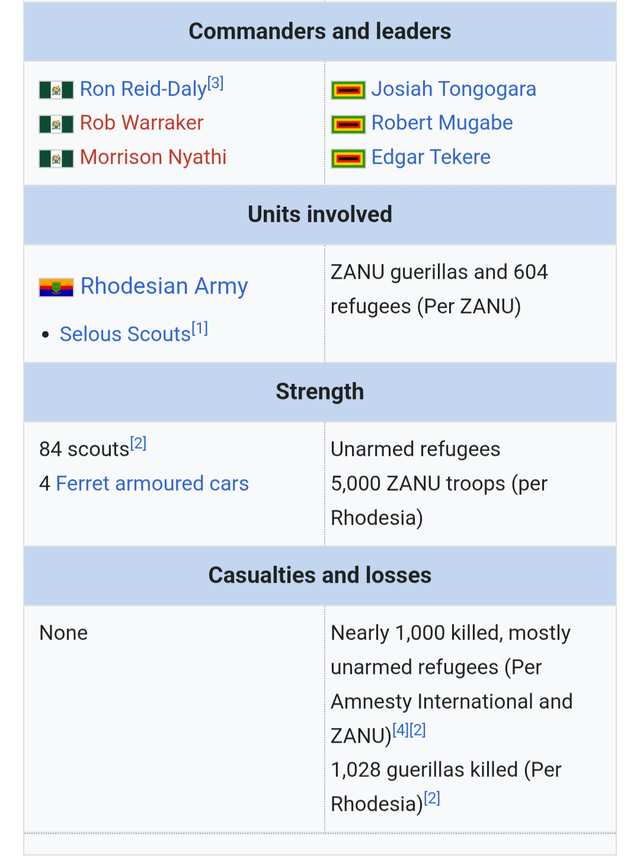
But not at the strategic level. The humiliated communists immediately went into damage control mode, and both played up that the Rhodesians had attacked Mozambique while claiming that it was not really a training camp, but a refugee camp, and the Rhodesians had slaughtered a thousand refugees. Amnesty International led the charge in denouncing the raid, insisting it was "a gross human rights violation and a war crime". Western governments and communist regimes joined in, attacking the Rhodesians for the case of very successful cross-border retaliation.
That would have mattered little if the South Africans were made of sterner stuff, and remained committed to opposing communism in Africa. But they were led by the execrable Prime Minister John Vorster. Left unnotified of Operation Eland, which came despite his insisting to the Rhodesians that they must not launch such cross-border raids because of how those raids would reignite world hostility to Rhodesia, he was furious.
He was so furious, in fact, that he decided to start working more closely with the anti-Rhodesian Kissinger, and to shut off South African military aid to Rhodesia. Almost overnight, Rhodesia lost a significant percentage of its air force support personnel, the militarized police that had been guarding its more peaceful border zones (thus freeing up the Rhodesian security forces for where they were more needed), its source of munitions resupply, and its source of oil. I wrote about this diplomatic disaster here:

Cut off from everything it needed to continue prosecuting the war, Rhodesia buckled. At the behest of Kissinger and the South Africans, Smith signaled his commitment to eventually achieving black majority rule.
At that point, the war was lost. Though fighting continued for years longer, the war became about putting the least awful black government in power rather than holding onto what made Rhodesia so successful—its Responsible Government.
Operation Eland was a tactical masterstroke. At the trifling cost of a bit of machine gun ammunition, a thousand enemies were slain. But it was a horrible strategic defeat, for out of it came the international backlash that led to Rhodesia losing the war…as it had been warned would happen before it planned or launched the raid.
Learning from the Eland Debacle
Prudence is a virtue for a reason.
Rhodesia’s great strength as a nation was its people and its “Responsible Government”. From the beginning, when Rhodes put together the Pioneer Column and sent it north, Rhodesians were distinguished by their personal excellence. They were better educated and more competent than average, and their immigration policy enhanced rather than weakened this. Paired with that was the limited nature of democracy in Rhodesia. Instead of letting just anyone vote, only he who had shown himself to be a steward in his personal life could help steward the fate and hopes of the nation through voting.
The great advantage of that people and system was that it let the Rhodesian government be more prudent than average. While the rest of the once-great West followed the path of egalitarianism-based national disaster, Rhodesia embraced the old values and grew tremendously as a result. It didn’t have a grossly ballooned welfare state, nor was it wracked by out-of-control inflation. It didn’t let Civil Rights-style protests destroy its system without a fight, nor did it go along with voluntary death via decolonization. It remained an exemplar of what the West once was, and still could be. All because it was led by excellent men who could be and were prudent, rather than pushed along by the disastrous tides of mass democracy.
That weakened in 1976. Exhausted by years of bitter warfare, frustrated with the poor treatment it had received at the hands of every nation, staring down the barrel of a long death via demographic decline, Rhodesia abandoned the prudence that otherwise characterized its every move, and flung itself at the guerrillas in Operation Eland. Quality made its superiority over quantity known, and the raid was a great tactical success. But Rhodesia died as a result of that tactical victory, for very predictable reasons. Past Rhodesian governments would have clearly explained the dangers of lashing out to the limited electorate, and used the advantages of the relatively small base of enfranchised voters to stick to a Fire Force-dominated wartime strategy of prudence and long-term commitment rather than rolling the dice on landing a very risky knockout blow. Abandoning prudence for a moment has meant decades of suffering and disaster.
We ought not forget that. America too faces the spectre of demographic disaster as a result of decades of unchecked migration, and treacherous judges, NGOs, business owners, religious charities, and similar sorts who have brought those invaders and their toxic views to our sacred soil. That demographic disaster must be reversed. Similarly, the Dewayne Geld-induced debt disaster is a major problem, as are the continual ravages of race communist disparate impact law, as is inflation making housing out of reach for many Americans.
That various judges and bureaucrats are throwing every roadblock imaginable in the way of the Trump Administration’s efforts to deal with those problems is frustrating, much as the weasel Vorster’s backbiting and hesitance to fully support Rhodesia must have been frustrating.
But we must not lose sight of what matters, which is steadily chipping away at those problems as the immense tailwind of conservative TFR dominance over the left starts to aid us in retaking power more fully.
Rhodesia’s one hope of victory was slaying as many terrorists as possible and weathering the storm until some sane leader rose to power in the West. Ronald Reagan, generally favorable to Rhodesia and apartheid South Africa, probably would have been that guy. Rhodesia almost made it to 1981. But not quite, largely as a result of leaving prudence by the wayside, rolling the die on Operation Eland, and coming up short.
We ought not do the same. Our hope of eventual victory comes from winning the waiting game while notching victories that allow for and accentuate our TFR advantage, namely ever larger numbers of deportations, keeping the border closed, and undoing as much as we can of the high-tax, high-regulation regime under which we currently suffer. There are reasons to suspect we can achieve that, and are on the path to doing so.
It won’t be easy, nor will it scratch the itch of self-gratification that would come from doing something much more radical in the hope that accelerates the victory timeline. But staying the course is important. Remaining prudent is important. Such is the path to victory, and we ought not try to scratch the itch of wanting more dramatic action—whatever the culture war equivalents of cross-border raids rather than Fire Force operations are—and risk throwing away our advantages and ultimately losing quite badly to the forces of race communism.


Of course I didn’t forget to leave some recommended reading as always for Will and his subscribers:
* Further Memoirs of a Bush War Operator: Life in the Rhodesian Light Infantry, Selous Scouts and Beyond by A.J. Baalam
* Mike West: Special Forces Super-Soldier by Hannes Wessels
* Men of War: The Fighting Few Who Took on the World by Hannes Wessels
* The War for Africa: Twelve Months that Transformed a Continent by Fred Bridgland
* South Africa's Border War 1966-89 by Willem Steenkamp
* Nazi Germany: Confronting the Myths by Catherine A. Epstein
* Inside Hitler's Bunker: The Last Days of the Third Reich by Joachim Fest
* With Hitler to the End: The Memoirs of Adolf Hitler's Valet by Heinz Linge
* Hitler's Last Secretary: A Firsthand Account of Life with Hitler by Traudl Junge
* The Boys in the Light: An Extraordinary World War II Story of Survival, Faith, and Brotherhood by Nina Willner
* Forty Autumns: A Powerful Story of Family Separation, Courage, and Life Divided by the Berlin Wall by Nina Willner
* Master of Airpower: General Carl A. Spaatz by David Mets
* Hap Arnold: The General Who Invented the US Air Force by Bill Yenne
* LeMay: The Life and Wars of General Curtis LeMay by Warren Kozak
* The Quiet Warrior: A Biography of Admiral Raymond A. Spruance by Thomas B. Buell
* Master of Seapower: A Biography of Fleet Admiral Ernest J. King by Thomas B. Buell
* Autobiography of Calvin Coolidge: Authorized, Expanded, and Annotated Edition by Calvin Coolidge, Amity Shaels & Matthew Denhart
* The Unexpected President: The Life and Times of Chester A. Arthur by Scott S. Greenberger
* Andrew Johnson: A Biography by Hans L. Trefousse
* Rutherford B. Hayes: Warrior and President by Ari Hoogenboom
* Garfield by Allan Peskin
* 9 Presidents Who Screwed Up America: And Four Who Tried to Save Her by Brion McClanahan
* The Politically Incorrect Guide to Real American Heroes by Brion McClanahan
* George Washington and Benedict Arnold: A Tale of Two Patriots by Dave Richard Palmer
* God Save Benedict Arnold: The True Story of America's Most Hated Man by Jack Kelly
* Band of Giants: The Amateur Soldiers Who Won America's Independence by Jack Kelly
* Waterloo: The History of Four Days, Three Armies, and Three Battles by Bernard Cromwell
* Boomers: The Men and Women Who Promised Freedom and Delivered Disaster by Helen Andrews
* The Empire Project: The Rise and Fall of the British World-System, 1830–1970 by John Darwin
* Churchill's Crusade: The British Invasion of Russia, 1918-1920 by Clifford Kinvig
* Band of Brothers: E Company, 506th Regiment, 101st Airborne from Normandy to Hitler's Eagle's Nest by Stephen E. Ambrose
* Masters of the Air: America's Bomber Boys Who Fought the Air War Against Nazi Germany by Donald L. Miller
* Against All Odds: A True Story of Ultimate Courage and Survival in World War II by Alex Kershaw
* Patton's Prayer: A True Story of Courage, Faith, and Victory in World War II by Alex Kershaw
An excellent and informative article, Will! Operation Eland may have been a huge tactical victory for the Rhodesians but it was an equally huge strategic mistake that doomed Rhodesia to its eventual decline and fall!