


Welcome back, and thanks for reading! Today’s article is back to history, and is on the disaster that is mass democracy. As it is much more about what certain great men thought rather than my personal feelings on the subject—which I have hopefully made abundantly clear—there are somewhat more in-article block quotes than normal. While I know those can be annoying, I think they are useful in this situation, and so have included them. Thanks for reading, and, as always, please make sure to tap the heart at the top or bottom of the page to “like” this article so that others can find it!
![[AUDIO] Saving America Will Require More Restrictions on Voting than the SAVE Act](https://substackcdn.com/image/fetch/$s_!PZob!,w_140,h_140,c_fill,f_webp,q_auto:good,fl_progressive:steep,g_auto/https%3A%2F%2Fsubstack-video.s3.amazonaws.com%2Fvideo_upload%2Fpost%2F190851407%2Fb4662474-a266-4492-98e5-c0a878df9c05%2Ftranscoded-1773418241.png)
The Senate is up to its usual antics, in this case meaning that it is refusing to pass the “SAVE America Act” because doing so would mean that foreigners and incompetents might be blocked from voting. The Senate finds it simply unconscionable that Jorge, an MS-13 gangster with three teardrops to his name, or Lumumba, the second-generation “Congolese-American” who is yet to figure out how to obtain a driver’s license, could be blocked from voting. And so that august body of failed lawyers, real estate developers, and used car salesmen will once again refuse to pass the ridiculously named act because it might help law-abiding, productive citizens rather than the endless hordes of locusts and vagrants that American law currently empowers.
But, helpful as the absurdly named bill might be, it is still far from enough to do much good. After all, there weren’t that many foreigners present or voting when Congress and the Executive rammed through the Civil Rights Act, the spirit-shredding Great Society social safety hammock, the Hart-Celler Act, or any of the rest of it. No, America has been ruined by a profusion of foreigners, but the laws that let them do so were passed by actual Americans who were largely smart enough to figure out how to obtain photo identification.
That they were able to do so was the result of over a century’s worth of liberalization. By the time the great society-shredders were made law in the 1960s—the Civil Rights Act, the Great Society, and Hart-Celler—there were no restrictions on voting left in place, other than the relatively minor ones of age-related voting restrictions, questionably enforced foreigner voting restrictions, and felony disenfranchisement in states bold enough to enact it. Predictably, those few remaining restrictions have remained under attack as well.
What must be remembered is that such was never meant to be the case in America. When the Founders designed the American system, they designed it not “only for a moral and religious People,”1 but also for a property-owning one. The Founders harbored some democratic ideas but were not democrats in any real sense, and indeed the system they designed was meant to put guardrails and restraints on mass democracy rather than to advance it.2
In fact, that collection of genteel, Classical-minded men was almost unanimous in the assumption that mass democracy of the sort that would let a teeming underclass outvote a moral and prosperous citizenry was indefensible and depraved.
Unfortunately, that view was not shared by the following generations.3 Those Americans who came after the Revolution and the Constitution gradually whittled away the restrictions on voting imposed by the Founding Generation, in the name of creating an outright democracy rather than a republic.4 First came limitations on how much property must be held to vote, and what sort of property counted. Then came universal white male suffrage. Then universal male suffrage. Then universal suffrage. Then universal suffrage without Jim Crow-type restrictions. Then the Armageddon of the 1970s.
So, I think it’s worth tracing voting in America back to the beginning, and seeing what those who designed our nation thought of the franchise problem. Particularly, it’s worth understanding what they said about it and how they justified restrictions. Then, I’ll do an in-depth discussion of why that shows how a modified version of what they wanted—something approaching a simplified Rhodesian system of voting—would be appropriate for the 21st century, even if achieving it would be difficult, along with my own thoughts on how such a system would function.
What America’s Founders Thought about Voting Restrictions
While today one will be called “un-American” for thinking voting should be limited, those who built America very much thought otherwise. Particularly, they understood that those who were not of at least somewhat independent financial means—meaning either farm ownership, business ownership, or property ownership large enough to live off of—would not be moral and virtuous voters who could look to the common good, but amplifiers of the views of their employers. In their view, if a slave could not vote, why could he whose employment situation made him little better than one? After all, employees at the time were still called “servants” and their employers “masters,” even if employment was generally a springboard toward becoming a farmer or business owner rather than an eternal state of being.
While such a view was not unanimous—Thomas Paine was famously a proponent of the idea that the poor and rich alike had a right to the franchise5—it was widely held by both the Northern and Southern elements.
John Adams explained this general mindset the best. In his view, men without property lacked the independence of mind necessary to vote, and so had to be excluded from the franchise. He explained this view in a letter to James Sullivan in 1776,6 writing (letter included almost in full, and emphasis added):
It is certain in theory, that the only moral foundation of government is the consent of the people. But to what an extent shall we carry this principle? Shall we say, that every individual of the community, old and young, male and female, as well as rich and poor, must consent, expressly to every act of legislation? No, you will say. This is impossible. How then does the right arise in the majority to govern the minority, against their will? Whence arises the right of the men to govern women, without their consent? Whence the right of the old to bind the young, without theirs?
But let us first suppose, that the whole community of every age, rank, sex, and condition, has a right to vote… But why exclude women? You will say, because their delicacy renders them unfit for practice and experience, in the great business of life, and the hardy enterprises of war, as well as the arduous cares of state. Besides, their attention is so much engaged with the necessary nurture of their children, that nature has made them fittest for domestic cares. And children have not judgment or will of their own. True. But will not these reasons apply to others?
Is it not equally true, that men in general in every society, who are wholly destitute of property, are also too little acquainted with public affairs to form a right judgment, and too dependent upon other men to have a will of their own? If this is a fact, if you give to every man, who has no property, a vote, will you not make a fine encouraging provision for corruption by your fundamental law? Such is the frailty of the human heart, that very few men, who have no property, have any judgment of their own. They talk and vote as they are directed by some man of property, who has attached their minds to his interest…
Harrington has shown that power always follows property. This I believe to be as infallible a maxim, in politics, as that action and reaction are equal is in mechanics… We may advance one step farther and affirm that the balance of power in a society accompanies the balance of property in land. The only possible way then of preserving the balance of power on the side of equal liberty and public virtue, is to make the acquisition of land easy to every member of society: to make a division of the land into small quantities, so that the multitude may be possessed of landed estates…I believe these principles have been felt, if not understood in the Massachusetts Bay, from the beginning…
I would not advise [our people of Massachusetts] to make any alteration in the laws, at present, respecting the qualifications of voters… The same reasoning, which will induce you to admit all men who have no property to vote…, will prove that you ought to admit women and children: for generally speaking, women and children have as good judgment and as independent minds as those men who are wholly destitute of property: these last being to all intents and purposes as much dependent upon others, who will please to feed, clothe, and employ them, as women are upon their husbands, or children on their parents…
Depend upon it, sir, it is dangerous to open so fruitful a source of controversy and altercation, as would be opened by attempting to alter the qualifications of voters. There will be no end of it. New claims will arise. Women will demand a vote. Lads from 12 to 21 will think their rights not enough attended to, and every man, who has not a farthing, will demand an equal voice with any other in all acts of state. It tends to confound and destroy all distinctions, and prostrate all ranks, to one common level.
So it proved. While land did not remain the main basis of power in America past the mid-19th century, thanks to the rise of the industrial economy and vast fortunes accumulated by the great industrialists, the rest of what Adams wrote remained true. Political power largely followed financial power, and the underclass voted not in the Enlightened interest of the nation as a whole but based on the views of those men of power to whom they became indelibly attached.
From the disaster that would have been William Jennings Bryan to the disaster that was FDR and his Red-driven destruction of old America, those who were not independent and not “acquainted with public affairs” gradually helped drive the nation to ruin. That they could do so was because, as Adams warned, the first steps to liberalize the franchise soon led to many others. Yet further, he was largely correct that having a job is an impediment to political independence, as shown by the problem of cancellation and those who have had to hide their political beliefs as a result of it, a problem that is largely not the case with farmers, small business owners, etc.
Importantly, the way to have avoided that dire fate would have been to keep the original restrictions in place. The problem was never the middle class, the yeomen, or the gentry. Those classes generally voted well in a very consistent fashion, and still do.
Rather, it was that a few demagogues could bind the underclass to them by promising “gibs” programs and the like. Had the underclass been prevented from voting, the more conservative and sane middling sorts could have voted down such proposals. Their votes would still have outweighed those of the radical few who attempted disastrous change. But because a few demagogues could unite with the vast bottom against the middle and swamp it with votes, America was driven toward perdition.
The Other Founders
Gouverneur Morris
Most of the other Founders recognized similar issues. Gouverneur Morris, for example, was an “aristocrat to the core” who was integral to the Declaration of Independence, Articles of Confederation, and Constitution. He recognized that if voting were not restricted to property owners, the underclass would sell its votes to malefactors of great wealth much to the ruin of the nation.7 He even warned that without such restrictions, there would be no brake upon the natural tendency of the House to “run into projects of paper money & similar expedients.”8
What he missed because it was incomprehensible to him is that it was not only the wealth elite to be feared, but also those who promise to redistribute the nation’s wealth to pay for votes through welfare. The money printing of which he warned has come about as a result.
Such is what has happened—LBJ infamous rammed through the Great Society to keep blacks voting for the Democratic Party indefinitely,9 as has happened—with all the evils Morris, Adams, and others predicted, including the fiat currency catastrophe under the burdens of which we now struggle.
John Jay
On much the same note, it was a favorite maxim of Constitutional Convention delegate, Federalist author, and diplomat John Jay that “those who own the country ought to govern it.”
As he recognized, those who have property tied to a land—whether that be land or a business enterprise within it—have the most stake in its future and need to steward that future well. If they don’t, what they have will be worthless. The underclass generally has far less of such a tendency, as its stake in the future of a particular place or polity is nearly non-existent other than emotional ties.
Madison and Jefferson
Further, James Madison—disciple of Thomas Jefferson, Federalist author, and drafter of the Constitution—warned that without restrictions on voting, a “landless majority” would eventually use its overwhelming numerical power to outvote the landed and “redistribute” wealth.
Admittedly, both he and Jefferson were more skeptical of restrictions on voting than Adams, Jay, and Morris. However, they also feared the depredations on the body politic that could be inflicted by a propertyless yet voting underclass, and so suggested proposals for how to tailor the laws to reflect the idea that "those who are to be bound by laws, ought to have a voice in making them.”
Jefferson suggested giving away 50 acres of (essentially valueless) Western land to the propertyless—with those who lost it again becoming voteless—and Madison suggested a version of the Senate that represented the landed interest.
George Mason
Mason was, like his fellow Virginians, skeptical of propertied voting. However, in his case, that skepticism came from his belief that merchants and others endowed with much personal property could and would always just flee from poor decisions—such as burdening the state with an excess of debt—and thus that the franchise should be limited to owners of real estate. As he put it, using the common legal parlance for real estate ownership at the time, only those who had shown their "...having sufficient evidence of permanent common interest with, and attachment to, the community" should obtain the franchise.10
Mason was one of the few to argue for a real estate-centric restriction on the franchise; the others were tolerant of real or personal property. He was, however, proven correct: just think of how many “merchants” and stockholders flee from blue states that their preferred policies have ruined to red states that they then set about ruining every year. The founder of Starbucks is doing that right now,11 and all the tech types in California did so at the beginning of the year.12
George Washington
Like Mason, George Washington expressed concern that unless the franchise was limited to those with a “permanent stake in the community”—meaning land—the “ignorant and lower class of people” would be easily led astray by “artful and designing men.”
Washington was not a political theorist, so he wrote and thought about the theoretical issue less than his contemporaries. Still, he was right. Without such restrictions, those “designing men” have led the underclass “astray” and thus led America toward perdition.
Alexander Hamilton
Finally, there is Alexander Hamilton. He was by far the most Anglophilic of the bunch, and as such the most interested in the British system of propertied voting, which was not liberalized at all until the 1830s and did not allow universal white male suffrage until 191813 (though the Third Reform Act of 1884 almost achieved this).14
Hamilton, viewing the strict British system as it existed in his time, argued, "The people are turbulent and changing; they seldom judge or determine right. Give therefore to the first class a distinct, permanent share in the government."15 Further, Hamilton agreed with Adams that he who was an employee was unsuited to the franchise, as an employee or tenant was not economically independent and could be fired for refusing to vote for what his boss wanted.
Ben Franklin’s Jackass Take
The only famous Founder to strongly dissent was Benjamin Franklin, who famously quipped: “Today a man owns a jackass worth fifty dollars and he is entitled to vote; but before the next election the jackass dies. The man in the meantime has become more experienced, his knowledge of the principles of government, and his acquaintance with mankind, are more extensive, and he is therefore better qualified to make a proper selection of rulers—but the jackass is dead and the man cannot vote. Now gentlemen, pray inform me, in whom is the right of suffrage? In the man or in the jackass?”16
The General Belief
Collectively, then, the Founders generally believed that only those of independent means should be able to vote. Those means did not have to be large—the small, 50-acre farm of a poor yeoman would do—but they had to be enough to grant independence. This understanding of economic independence and good government was common in the Anglo-American world of their day.17
Yet further, many also thought the property should in some way tie the man to his community, so he could not just leave if things went astray, whether because he mismanaged them as a leader or because he declined to do his duty to the public and participate in the political process. The way debt was used to build ties that bind (but also weaken independence)18 in the communities of their day complicates this, as does the nature of industrial wealth in ours.
Regardless of that relatively minor disagreement, they generally understood that only he who could vote in what he saw as being the best interests of his community should have the franchise, and that wealth-connected restrictions on voting were the best way to achieve that.
Recreating the Franchise Limitation
A few non-dictatorial states have attempted to maintain larger restrictions on voting than currently exist in America into the late 20th century.
Singapore was long somewhat undemocratic, though this is changing and now the only real restrictions outside those seen in America are that people of “unsound mind” cannot vote, nor can dual citizens or those attempting to become such.19 This solves the community loyalty issue identified by Madison and others, but little else.
Northern Ireland maintained a form of propertied voting into the 1970s by which a property owner had six or more votes, but a renter none.20 Under this system, which was used to keep Catholics away from the ballot, voting rights were based on property ownership. The number of votes to which a man was entitled was based on the value of his property. This limited the feckless underclass issue, but created the problem of the super-rich theoretically being able to outvote the middle by gobbling up more property.
The Rhodesian System
The best modern system of restricting the franchise was that utilized by Rhodesia. There, the state did not want the uneducated or the feckless to vote (it didn’t want them as immigrants either). It also did not want apartheid, and wanted to encourage the black population to gradually better itself into becoming full of competent, educated property owners. So it designed a unique system of propertied voting, the infamous A and B roll voting system that helped start the Bush War.
This system was a sophisticated attempt to create a non-racial and merit-based franchise that would keep “responsible government” intact by only letting those with a stake in society participate in most decisions, while also encouraging those who didn’t qualify to better themselves so that they could eventually qualify. The Rhodesians hoped that the system—which divided voters into the “A” and “B” rolls based on income, property ownership, and education—would allow them to preserve their traditions, prosperity, and good governance in the face of rising democracy via decolonization.
Additionally, by including income as well as property, the system established buy-in from the professional and working classes that were making good livings but had not yet acquired much property, a typical fact of life when starting out in a colony. Yet further, its inclusion of all Rhodesia-based property rather than just land recognized the fact that what form wealth takes had changed significantly since the 18th century.
Under the system, the A Roll commanded most of the seats in the national legislature (50 to the B Roll’s 15), and A and B Roll votes could each influence the other side’s seats up to 25% influence. Income and property counted if they were Rhodesia-based, to ensure voters were tied to their nation. The B Roll system also had a larger say in local elections than in national elections.
It was overly complicated, but its characteristic and highly pro-social characteristic was that it used income, property, and education to restrict the franchise. This meant that the propertied and professionals could generally influence the direction of the country, but also the educated and poor had some buy-in with the government unless totally indigent. As most of the indigent were blacks living on Tribal Trust Land, they were represented and had buy-in through the tribal chiefs, who were included in the national legislature under the system. Here are the requirements and what the approximate inflation-adjusted equivalents are:

And here are the participation rates (about 60,000 blacks, or ~1% of the population, qualified but did not register, driving down their total somewhat):
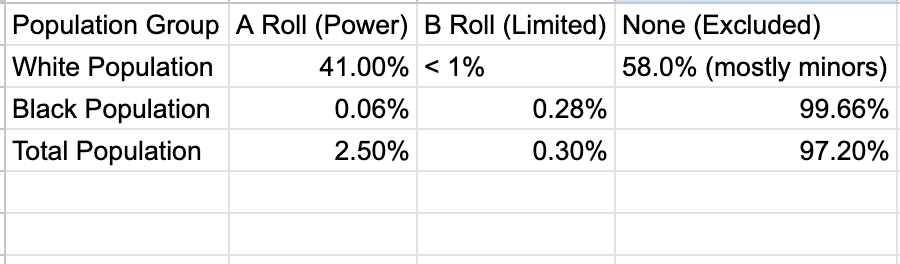
This system largely succeeded in its goal. Only a small number of urban blacks who were left unrepresented by the tribal chiefs joined the revolt until the end stages of the conflict, Rhodesia had an incredibly competent government before and during independence, and the system did not destroy the country. That stood in stark contrast to Mugabe’s one-man, one-vote, one-time mass democracy. That said, its main downsides were that it was overly complicated and allowed dual citizens (as most white Rhodesians were) to vote.
Modifying the Rhodesian System with the Founders In Mind to Save America
Were one to somehow reform the franchise, I think the best basis to use for the long term would be a modification of the Rhodesian system. In such a world, the key ingredients would be:
Ensuring the underclass does not vote so long as it remains indigent, but using incentives to encourage it to improve and obtain property to the point of being able to vote.
Preventing the super-rich from directly buying votes, or impecunious but powerful politicians like LBJ doing so indirectly with welfare schemes
Limiting the wealth included when determining if a given citizen has the franchise to some form of it that is tied to the community rather than being cosmopolitan. Relatedly, dual citizens should be excluded from voting.
Ensuring the requisite amount of wealth for the full franchise is enough to make one “independent”, meaning that one does not have to rely on outside work for a boss to survive, but can instead rely on one’s investments or business
The system should not be too complicated, and should find a way to include the professional and working class so that it is bought into the system, as the Rhodesians did.
Creating the Modified A and B Roll System:
I think those objectives could be achieved with a simplified A-roll and B-roll system that broadly operates in line with the views of the Founders. The basic framework is this:
To begin with, it would establish two separate categories of voting, an A Roll, and a B Roll.
The A Roll would control two-thirds of the national legislature, and half of state and local government. The B Roll would control a third of the national legislature, and half of state and local government. All new laws passed would have to be agreed upon by 70% of the relevant legislature.
A Roll Qualifications:
To qualify for the A Roll, one would have to have enough nation and locality-based property to make one “independent”, meaning exceeding the poverty line in income without having an outside job, and indeed not having an outside job. This would broadly align with the importance of “independence” as recognized by the Founders.
This could mean owning a successful small (or large) business/partnership stake, owning a farm, owning such national and local investments that one needn’t work, or some combination thereof.
If one took on debt to buy those investments or a business, the net income after paying down the debt would be one’s income.
Those who moved to a new state/town/etc. would have to move their property or buy new property to vote within it, but would not lose their national vote if they didn’t do so.
States and localities could make their specific rules regarding whether ownership of stock and bonds in national companies would count for local elections; they would count for national elections, as would municipal and national bonds.
Qualifying for the B Roll
To qualify for the B Roll, one would simply have to have a job the income of which exceeds the poverty line threshold for the household. That job would have to be located in the community in which one is voting, if one wishes to vote in state or local elections, but the company needn’t be headquartered there.
General Requirements and Modifications:
For both the A and B Rolls, each vote would be a household vote determined by household size (so two parents and five kids would have seven total votes, but only the head of the family could vote), but with the poverty line increasing based on the number of children.
Further, all who accessed a state aid program, such as Social Security or Medicaid, would be disallowed from voting while accessing that program.
All with felony records would be prohibited from voting, regardless of their wealth or income, as would be dual citizens, immigrants, or those who lobby for foreigners.
Finally, income derived from work for the government or a non-profit would not count toward the income threshold.
Such a system would meet the basic criteria. Independence-granting property is prioritized, but wage-earners have buy-in while also being encouraged to build independent lives for themselves. Those who mooch off the system, whether by working for it or taking from it, are excluded from voting so that their votes cannot be bought. Those with more of a stake in the future—children—have more votes, so long as they properly care for and invest in those stakes in the future. The social poison of abstract wealth is generally looked down upon, and real-world, locality-based wealth is prioritized so as to encourage community relationships while excluding foreigners or those with foreign ties. Most of all, the feckless are kept from voting without the middle class being penalized or the rich gaining undue control.
That said, all of this is exceedingly unlikely. But it is interesting to think about, and interesting to consider how we might start salami-slicing the end of democracy.
If you found value in this article, please consider liking it using the button below, and upgrading to become a paid subscriber. That subscriber revenue supports the project and aids my attempts to share these important stories, and what they mean for you
As John Adams famously put it in 1798, "Our Constitution was made only for a moral and religious People. It is wholly inadequate to the government of any other,"
As Gordon Wood notes in Empire of Liberty:
The essentially aristocratic world of the Founding Fathers in which gentry leaders stood for election was largely replaced by a very different democratic world, a recognizably modern world of competing professional politicians who ran for office under the banners of modern political parties. Indeed, Americans became so thoroughly democratic that much of the period's political activity, beginning with the Constitution, was devoted to finding means and devices to tame that democracy. Most important perhaps, ordinary Americans developed a keen sense of their own worth —a sense that, living in the freest nation in the world, they were anybody's equal.
As Gordon Wood notes in The Radicalism of the American Revolution:
A new generation of democratic Americans was no longer interested in the revolutionaries’ dream of building a classical republic of elitist virtue out of the inherited materials of the Old World. America, they said, would find its greatness not by emulating the states of classical antiquity, not by copying the fiscal-military powers of modern Europe, and not by producing a few notable geniuses and great-souled men.
Instead, it would discover its greatness by creating a prosperous free society belonging to obscure people with their workaday concerns and their pecuniary pursuits of happiness-common people with their common interests in making money and getting ahead. No doubt the cost that America paid for this democracy was high-with its vulgarity, its materialism, its rootlessness, its anti-intellectualism. But there is no denying the wonder of it and the real earthly benefits it brought to the hitherto neglected and despised masses of common laboring people. The American Revolution created this democracy, and we are living with its consequences still.” (Gordon S. Wood, The Radicalism of the American Revolution)
As Wood notes in Revolutionary Characters:
In the early nineteenth century the voices of ordinary people, at least ordinary white people, began to be heard as never before in history, and they soon overwhelmed the high-minded desires and aims of the revolutionary leaders who had brought them into being.
The founders had succeeded only too well in promoting democracy and equality among ordinary people; indeed, they succeeded in preventing any duplication of themselves.
Read the full thing here: https://founders.archives.gov/documents/Adams/06-04-02-0091
“I’ll have those n*ggers voting Democratic for the next 200 years,” as he put it.
As Gordon Wood notes in Revolutionary Characters:
These independent gentlemen of leisure who were presumed to be free of occupations and the marketplace were expected to supply the necessary leadership in government. Since well-to-do gentry were "exempted from the lower and less honourable employments," wrote the British philosopher Francis Hutcheson, they were "rather more than others obliged to an active life in some service to mankind. The publick has this claim upon them." All the American founders felt the weight of this claim and often agonized and complained about it. The revolutionary leaders were not modern men. They did not conceive of politics as a profession and of officeholding as a career as politicians do today. Like Jefferson, they believed that "in a virtuous government ... public offices are what they should be, burthens to those appointed to them, which it would be wrong to decline, though foreseen to bring with them intense labor, and great private loss." Public office was an obligation required of certain gentlemen because of their talents, independence, and social preeminence."
As Wood notes in The Radicalism of the American Revolution:
This was how men became gentlemen and exerted influence in their communities. In fact, it was often through loans to friends and neighbors that great men were able to build up networks of clients and dependents. The Virginia planters, who were debtors to British investors abroad but creditors within their own communities, knew only too well that "every debtor does in some measure feel the imperiousness of his creditor.'"
Interesting article. Personally, I would just go with a simple, "Does the voter own their own home and do they pay taxes?" But that could be expanded.
P.S. What do you think about the requirement to be married with kids? Fair or too much?
It's a curious thought, isn't it. That so many wise men had established so many nations, only for midwits to plan and ploy and destroy their nations. Giving them too much rope with which to hang everyone, perhaps?
Mao got rid of those "educated youth" by sending them to the countryside to farm. It worked. And frankly, I haven't figured a better approach. People should be farming more and scheming less, and I'd gladly join the farming.