


It’s hard to avoid the sense that America is an open-air insane asylum. From the Halloween decorations that blight our neighborhoods to the vulgarity and volatility on display in our popular media, everyone is crazy, and all the “edges” in society that were once rounded by manners are now sharp and constantly cutting. Conversations are often sharp and short. There’s a tenseness in the air. The assumption is that every interaction is a potential scam, and each party is either a mark, in on it, or both.
And that’s assuming things stay relatively civil. There’s also the omnipresent problem of road rage or like incidents, crazy vagrants preaching nonsense on the streets, subdued vagrants passed out high or drunk on the streets, and the lurking spectre of crime.
Getting a phone call from an Indian scammer as a woman in a suburban stares daggers at you for being in a parking space she wanted while you shuffle unnoticed past a horde of fentanyl zombies on the street corner is a depressingly common way of having to engage with the world.
Listen to the audio version of this article here:

Meanwhile, public and private spaces alike have a tendency to be either painfully sterile—as if a hospital ward—or abominably filthy and chaotic. Gone is the pleasant and warm “Victorian” middle, rooms stuffed with pleasant and inviting lighting and furniture that induces relaxation rather than stress.
This can even be seen in media. Notice how the warm and inviting decoration is gone from Hogwarts in the new rendition of Harry Potter, which couldn’t even faithfully skin suit the aesthetic of a functional civilization in the manner of the original movies; the show has been “Americanized,” and so Hogwarts looks like a hospital ward.
In any case, the overall impression when engaging with society is one of an insane asylum. There are “green zones” that provide a respite from this—namely certain churches and clubs—but the overall environment is bleak, characterized by a dizzying and terrifying mix of neuroticism, trenchancy, asperity, and fraud. Gone is the warmth that once softened interactions, making them more pleasant and productive.
Some of this is stress from a bad economy: years of inflation, an increasingly terrible jobs environment, affordability problems with healthcare and housing reaching crisis levels, and the millstone of consumer debt have put America in a bad way. So too have the creeping tendrils of crime and the inability (or unwillingness) of the government to combat fraud added a dire dose of causticity to our world. Immigration, of course, is a blight of its own that has done much to rot what bonds and good feelings once remained.
But there is more to it than that, I think. There’s also the continual problem of prole drift, and all it brings with it. The habits, preferences, and behaviors of the underclass have become the habits, preferences, and behaviors of almost everyone, from top to bottom. That has brought with it what one might expect: harsh and unpleasant interactions left entirely unsoftened by the sort of refined, ritualistic manners that signal the “fight or flight” reflex can be turned off for a bit. Instead, it’s just the bitter and brutal world of Dr. Dalrymple’s Our Culture, What’s Left Of It: The Mandarins and the Masses at every level of society, all the time.

Manners. Courtesy. They are intended to make more bearable the harshness of life, to reduce its pain. Thoughtfulness is the ultimate act of kindness, and kindness is at the root of regulation, too. There is a need for rules.
-Sophie Burnham, The Landed Gentry
Added on top of that are the bizarre beliefs and obsessions that seem to occupy a significant amount of thought space for the average person, whatever his level in society. Millions listen spellbound as Tucker Carlson insists he was attacked by a demon,1 or insists to Joe Rogan that aliens are really demons.2 Or AI data centers have to be stopped because they are “summoning demons”.3 On and on it goes, to no one’s benefit.
This would be one thing if it just made going to CVS unpleasant. But the utter dominance of prole drift has had a far larger impact than that: the turning of citizens into brutal and brutalized peasants dominated by their superstitions has significant political repercussions. It turns out, superstitious fools crouching in an instinctively 1) venomous, 2) entirely uncurious, and 3) resentful pose does not a good political system make.
Before even considering the midterms, one can see this in the public’s reaction to AI data centers and SpaceX’s incredible feat of catching Starship with robot arms.
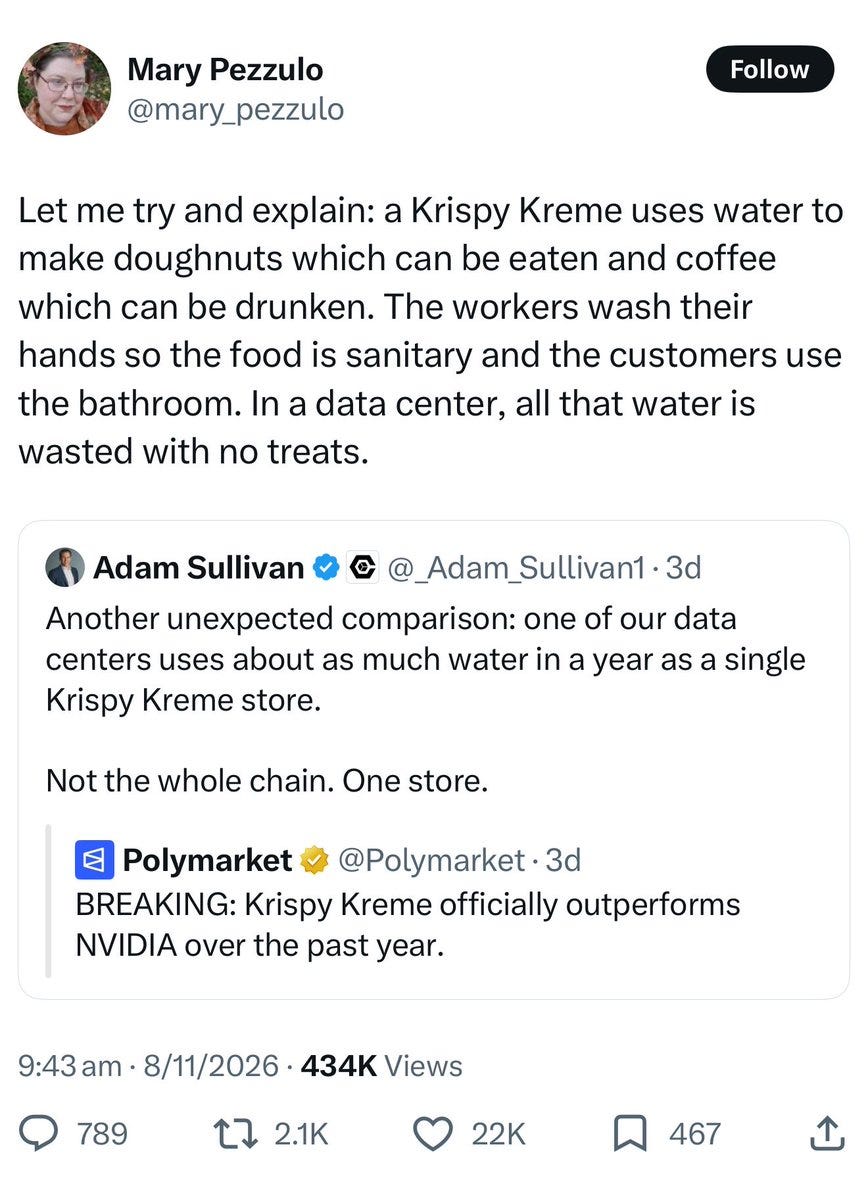
Take AI data centers. The constant claim is that they are using up all the water. They are not using up all the water, as even a cursory glance at what they do shows. Indeed, the massive data center complexes generally use about as much water as one or two fast food restaurants.4 Even when presented with that fact, the venomous average voter insists it is still a bad thing because it doesn’t mean they immediately get a larger stimulus check from the government, or something.
For example, a major data center project was stopped in Maryland, with the owner of a parcel unable to use their property for the purpose they desired because an unemployed, homeless woman who lives nearby decided that the abandoned parking lot could be put to better use as an indoor trampoline park. There is already another trampoline park just minutes away. Nevertheless, she persisted, and the project that would have given her community its one shot at some form of renewal was shot down.




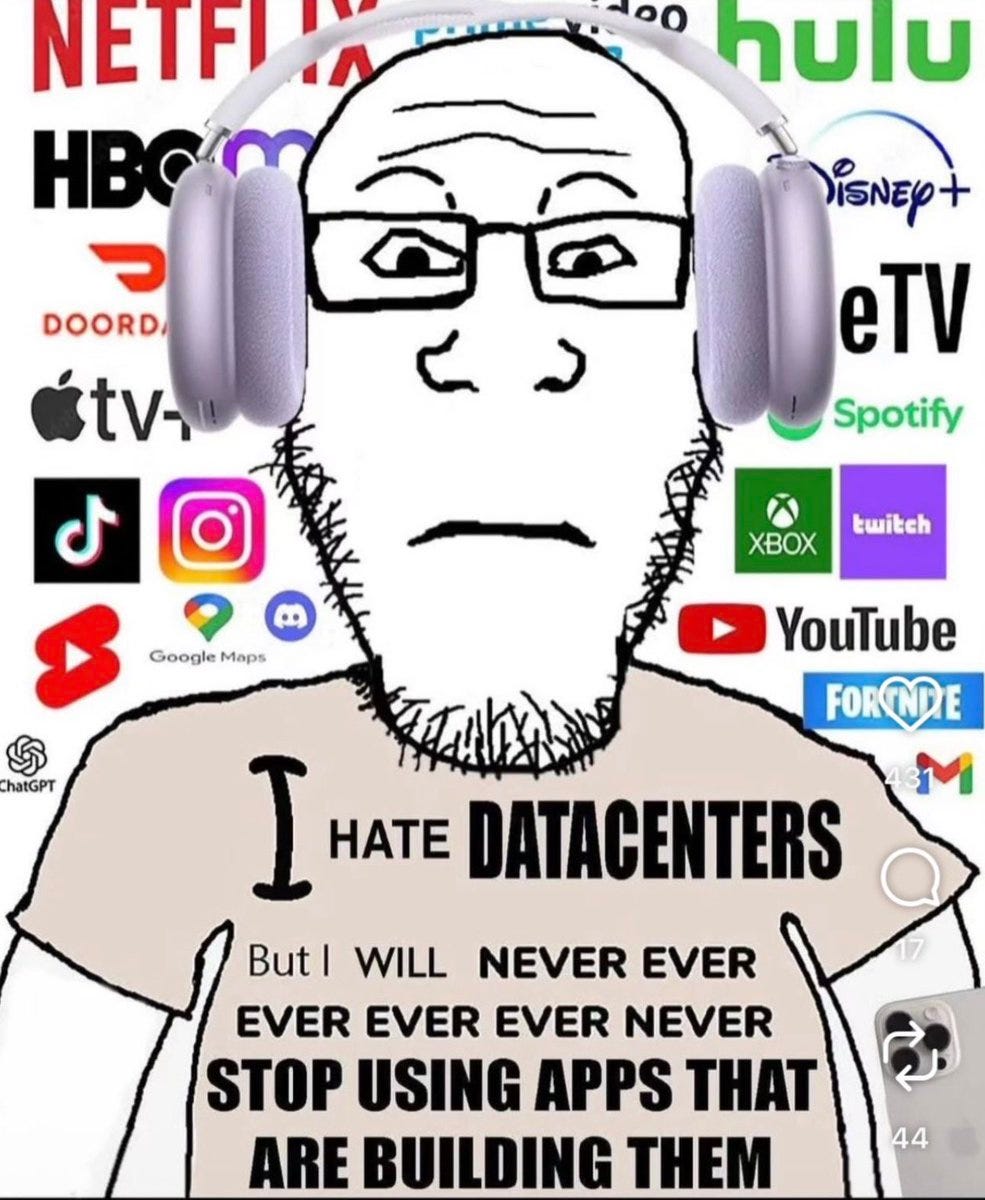
Of course, as the sort of person who is vociferously anti-data centers is generally also entirely uncurious, they have a tendency to be entirely reliant on data centers for every aspect of their personal lives. A suprisingly common view is something along the lines of: “Despite having no real conception of what they do, I hate data centers because they each use an ocean of water and demons live in them, so I am going to use my digital credit card, which I will later pay using a digital transfer from my online bank, to order a t-shirt I saw an ad for thanks to one of the most advanced algorithms in existence, and that t-shirt will be miraculously gotten to me in 24 hours by another algorithm so advanced it seems to be magic, with a van driven by yet another algorithm that would have seemed futuristic even 5 years ago pulling up to my doorstep with that item. Down with Elon Musk!”
The reaction to what SpaceX accomplished shows the same thing.
After years of work and billions invested in the project, SpaceX caught its Starship rocket with a pair of mechanical arms, making a rocket larger than the Apollo Saturn V rockets reliably reusable. That is an incredible accomplishment almost unprecedented in the history of human technological advancement. It makes Mars settlement far more possible. It makes building in space, from data centers to heavy industry, far more possible. It means 100 tons of cargo can be sent anywhere on Earth where we can build a tower with mechanical arms, and it can get there in an hour.
The voter base, crouching in its usual stance of defensive hostility, was not impressed with this titanic accomplishment. Its reaction ranged from confused indifference to being malevolently and spitefully opposed to SpaceX even existing, as going to Mars does not mean “free healthcare for all”.



Naturally, those same people who currently hate SpaceX and insist that what it is doing is impossible will demand that it be taken from Elon in the name of the people as soon as it starts doing this reliably, as that will be considered “too much power for any one man.” Ayn Rand was wrong about much, but she was certainly correct in Atlas Shrugged about how a demoralized and vicious population reacts to great men like Hank Rearden or Elon Musk: first mockery, then expropriation.


This isn’t the first time we have seen this sort of thing. The Apollo program succeeded because of the courage of the astronauts and immense skill of its engineers, and then was destroyed by the ever-growing bureaucracy and the Civil Rights protesters who demanded it be obliterated so that various welfare schemes could be made marginally more generous to the generationally indolent. In fact, the Southern Christian Leadership Conference held a massive protest outside the Kennedy Space Center on the day of the Apollo 11 launch!5

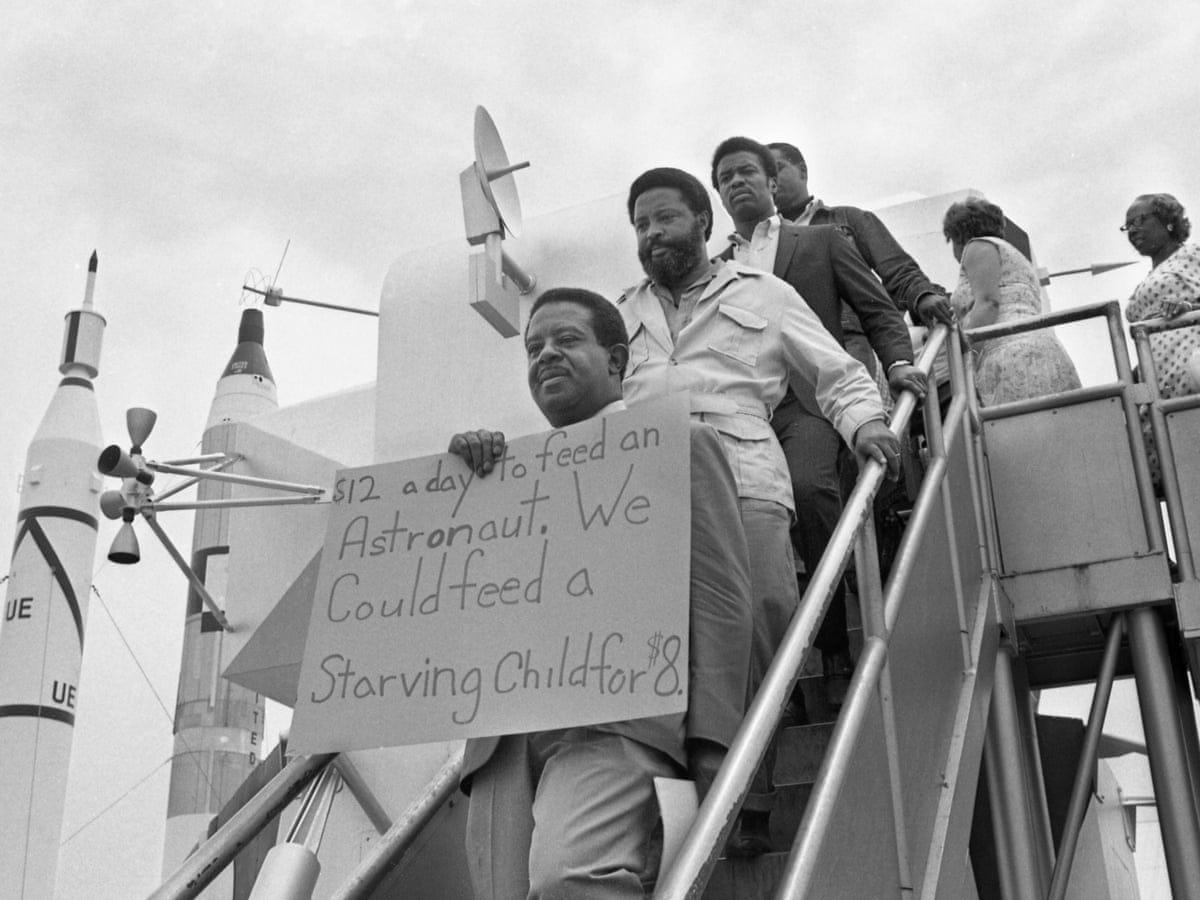
The difference is that in the past, this sort of sullen and surly response to greatness—the one embodied by Gill Scott-Henderson’s protest song “Whitey’s on the Moon”—was confined to the underclass and a few leftist academics.
The prole drift process was only starting to begin in the late 1960s, so the working, middle, and upper classes were largely uncontaminated by this soul-rotting mindset of spiteful Levelling. They were excited about the moon landings and the great leap forward that they represented.
Now? Well, the prole drift process has advanced significantly. A few people watched the Artemis II mission. A few protested it. Most didn’t care. A few more cheered SpaceX’s incredible accomplishment. Some didn’t care. Many opposed it, from the usual cretins—academics and race hustlers—to “ordinary” people who see any advancement as having taken something from them because it could have been spent on shoveling more benefits their way like gruel for a glutton’s consumption. The brain-dead stance of the alternately uncurious and envious underclass has become the average.
Worse, the circle of topics this soul- and mind-destroying attitude encompasses is wider by the day.
For example, we are told that Classical music is not just outmoded, but evil and dull compared to cannibals clacking bones together in the Congo.


Similarly, we are told that Texas turning blue is a good thing because it might make marijuana slightly easier to obtain. Civilization, you see, should be squandered so that Joe Rogan can get high with a modicum less inconvenience.

What’s worse is that Rogan, however much of a buffoon he is, probably represents the average American voter. That average voter did, after all, swing significantly to the left this election. They did so largely because they were transfixed by (and thus made emotional about) “slopulism” conspiracy theorizing regarding everything from Trump to data centers, and were impatient with the pace of economic renewal achieved by the Trump Administration. “Historic” wasn’t good enough for those whose identity is rooted in being unable to pass the marshmallow test, so they voted the race communists into power across the country and now will be upset with the results of doing so.
Was the Iran War a mistake? Yes. Are the Republicans in the Senate generally abominable and fit for little more than dog food? Also yes. On the other hand, has Trump also 1) presided over the largest deportation effort in our history, 2) revived manufacturing jobs/encouraged reindustrialization,6 3) cut taxes and regulation—the only real ways of improving the economic environment other than deportations, which he’s already doing, and 4) started to cut and prosecute the fraud that bloats the budget and thus justifies higher taxes than we should be paying? Indeed. On balance, that’s reasonably good, and the vectors were pointed in the right direction.
But that wasn’t enough for the emotionally volatile and instinctively spiteful, which at this point is much of the electorate, so those who whipped to the right in 2024 whipped back to the left in 2026. Unable to stick with the “reindustrialize America and deport migrants” party because of gas prices, they voted for the “ban fossil fuels and trans the kids while censoring online speech and legalizing crime” party. We’ll see how that goes. Methinks there will be yet more chaos and whipping around in 2028, much as the failure of a complete national renewal to materialize in 18 months cost Republicans dearly. It is unclear, after all, how opening the border and legalizing crime will lower housing costs in much-desired areas with “good schools” and nice amenities, which seems to be one of the chief complaints at present.
There is a reason that America’s Founders were insistent that our republic could only survive so long as the citizenry remained virtuous and “moral”: it is only a moral citizenry that can be self-governing, and thus trusted in its own self-government. They understood, correctly, that when citizens cannot govern their own passions and vices on their own, an authoritarian government will step in to govern those passions and vices for them, and will be tyrannical in how it goes about it. Further, they understood that only a small portion of the population will ever be self-governing, which is why our system was originally designed to only let men of property vote: he who can run a farm or business successfully is probably going to be good enough at regulating his own passions and behaviors to be trusted to participate in governance.
America’s citizenry is now not particularly virtuous or moral. As shown by the pedestal on which types like Rogan put marijuana and the degree of importance they attach to such vices as indolence (welfare) and licentiousness (abortion/porn/etc.), it can’t be trusted to govern itself. Just look at the bastardy rate if you want proof. It’s up and to the right amongst black and white alike, as are a host of other forms of dysfunction, as Charles Murray notes well in Coming Apart.
The reason is prole drift: nearly everyone has become part of the underclass, at least in terms of how they relate to the world, from political thought to personal behavior.
The population has not just been victimized by a rapacious and nasty elite, driving it towards instinctive populism and hostility, but has been lobotomized by the toxic stew that surrounds us all. From top to bottom, brain-rot conspiracies go hand in hand with the demoralizingly unpleasant environment in which we all live, with the end result being a seemingly schizophrenic population that can neither focus nor stick to a set of political preferences and is simultaneously uncurious about and hostile to the world that surrounds it. That is not the basis of a serious or successful political system. It is the basis of becoming Brazil.
This is a problem. Right now, the main hope anyone to the right of center has is that it is really only the religious right that can bring itself to cut through the neuroticism and despair of the present to have kids. Over the next few generations, that will be a major positive, as it will demographically transform the population. But that transformation won’t happen if the border is re-opened, and that transformation will be slowed by such policies as higher taxes and increased regulation that punish the average child-haver couple: moderately to very economically successful Christians who get nothing from government programs.
Keeping an even keel and just voting for as much immigration restriction and economic liberty as is electable is the only way to achieve that and move in the right direction. That takes self-regulation, particularly of one’s emotions in the face of a horrendous set of legislators and occassional terrible decisions from the president. It takes not “crashing out”. It takes not becoming part of the insane asylum. It takes sticking to a general platform through thick and thin, excitement and disappointment alike, for decades.
The American electorate of the recognizably American era could probably have done that. It is unclear that this one can. I have my doubts, particularly after this cycle. It seems instead that we have much turbulence ahead as those who think Trump eats babies with Epstein because they saw a TikTok reel about it unite with those who want to ban data centers so they can build trampoline parks, all in an effort to strip Musk of SpaceX to pay for “free healthcare,” or something.
Such are the politics of base emotion. Such are the politics of decline. Such are the politics of prole drift.

See, for example: https://www.youtube.com/watch?v=oeq0IO0izKw



Weird article. Lots of good points about the actual subject of prole drift, especially on the "micro" level of day to day interactions, along the lines of what's been seen here before. But the sudden turn to glazing the Silicon Valley technocracy as though implying that resource-guzzling data centers and rocket acrobatics is going to be mankind's salvation is, to put it in the lingo of the Kids These Days, rather cringe.
Musk has always struck me as a master of showmanship who knows exactly how to put on a great performance to the applause of Investors and Important People, but the act has been wearing thin for a while now and he seems to be greatly reduced and approaching Sad Clown status. And the point about data center water consumption is largely a straw man; regardless of water, there's no denying the things consume extraordinary amounts of electricity and mineral resources (most notably copper, which is a vital resource set to skyrocket in price as extraction and production challenges mount; obligatory shoutout to @thehonestsorcerer who's covered this in detail) in the vain pursuit of summoning a Shiny Silicon God that will somehow pull us out of the great civilizational pit in which we are now trapped.
These far-fetched, utopian ambitions seem ridiculous to normal people who don't want to see their electricity bills soar when a data center with a footprint of a college campus is built down the road to the exclusive benefit of distant technocratic interests. A couple cherry-picked examples of dumb people reacting to data centers for dumb reasons doesn't tell much of the story at all. The real issue isn't visionaries on the cusp of turning Mankind into a glorious interstellar civilization being held back by drooling troglodytes; it's an industrial, world-spanning consumeristic civilization that has irresponsibly burnt through nonrenewable resources with no care for the consequences of the end of perpetual economic growth.
I don't know if Tucker Carlson was really attacked by a demon or whatever, but these kinds of accounts pull back the curtain of the Modern Enlightened Secular Society of the sort Richard Dawkins and Daniel Dennett would treat as a given. Modern Man has spent a very long time convincing himself that a couple centuries of learning about the natural world and engineering machines has banished the spiritual realm, but as an Orthodox Christian I find the materialist mindset to be little more than metaphysical myopia. I frequently hear anecdotes (in real life, as well) from people experiencing strange and unwelcome spiritual phenomena nowadays, and never heard anything of the sort 15-20 years ago. Sure, there is quackery and superstition out there as well, but it's not hard to get a sense that foul spiritual forces are operating with a greater level of boldness than in quite some time.
On the political front I doubt there are many who "whipped to the right in 2024 [and] whipped back to the left in 2026." The reason for the results of the midterms is not hard to explain: many people who enthusiastically supported Trump felt they had been totally betrayed, and simply stayed home, refusing to vote for candidates who had fooled them many times over promising to serve America and instead serving the agenda of a deranged, manipulative foreign state. On the other hand, the Left was energized and had various candidates they got excited about. The real culprit of this outcome isn't lazy voters on the Right, it's poor leadership and a dearth of compelling candidates.
Finally, I don't claim to be a Harry Potter expert by any means, but I'm struggling to see the hospital ward aesthetic here. The two versions of Hogwarts don't look identical, but I can recognize what it's supposed to be. The poor lighting and cinematography of modern film is much more egregious here than the set design.
Reading this was its own version of doom scrolling. I agreed with most of it though until I got to the defense of the biggest buffoon of them all - Trump. Don’t get me wrong, I voted for no Blue candidates but I would never ever defend him. It’s not so much what he did (in most cases). It’s how and why he did it. Take tariffs. The chaos of “liberation day”. Changing the target of the tariffs and the amount seemingly by the minute. Blowing up long term economic relationships in senseless ways. Or take the Iran war. It’s not like allowing Iran to have nuclear weapons was a good thing. It’s that it seems that he was motivated by his own personal reputation and had no plan to actually win it when he went in. He’s a buffoon.