


Welcome back, and thank you for reading! This one is somewhat personal, based on my personal experience with this issue, so the tone is somewhat different than normal. Hopefully, y’all get something out of it regardless. If you find this article valuable, it would be hugely helpful if you could like it by tapping the heart at the top of the page to like the article; that’s how the Substack algorithm knows to promote it. Thanks again! Listen to the audio version of this article here:
![[AUDIO] You Must Chastise the DEI Collaborators](https://substackcdn.com/image/fetch/$s_!9jEH!,w_140,h_140,c_fill,f_webp,q_auto:good,fl_progressive:steep,g_auto/https%3A%2F%2Fsubstack-video.s3.amazonaws.com%2Fvideo_upload%2Fpost%2F182098141%2F590b0d0a-49ef-47da-bad7-e1a1b8d00259%2Ftranscoded-1766161019.png)
DEI, affirmative action, disparate impact, and the other forms of anti-white discrimination used to keep promising young white men out of careers, drive older whites out of leadership positions, and generally remake American life in a “diverse” (non-white) way are back in the news thanks to Jacob Savage’s The Lost Generation, an article that went viral online, with the original post sharing it racking up about 30 million views.
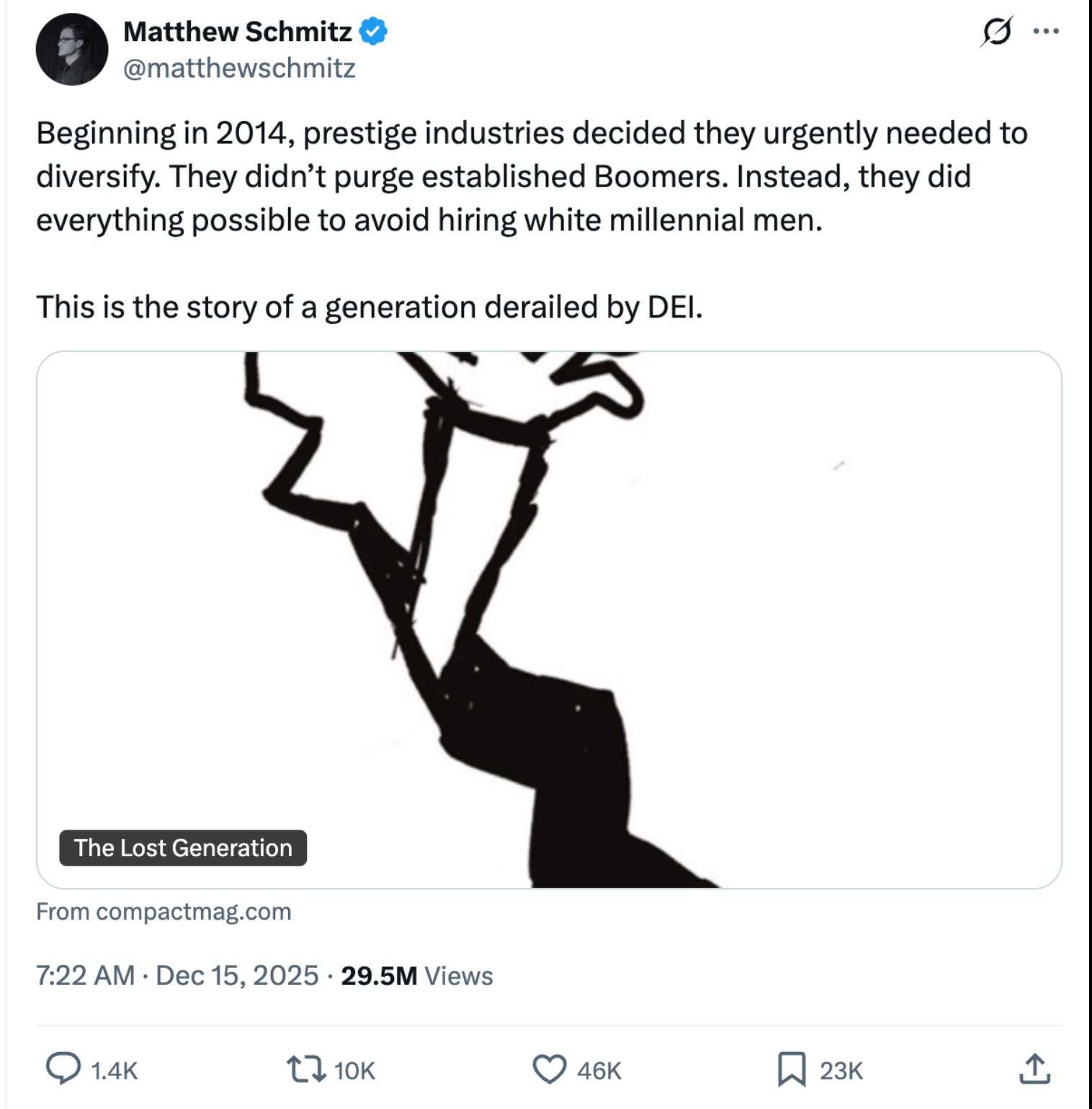
In the lengthy article, which was even shared by Vice President Vance and Elon Musk, Savage shows how the employment landscape has dramatically shifted against white Americans, particularly native-born white men, since 2014. He describes how that demographic has been forced out of and prevented from joining newsrooms, practically any career in Hollywood or the entertainment industry more broadly, academia, or professions like law and medicine. To give but two examples:
The Disney Writing Program, which prides itself on placing nearly all its fellows as staff writers, has awarded 107 writing fellowships and 17 directing fellowships over the past decade—none to white men.
The shift in medicine has been even more dramatic. In 2014, white men were 31 percent of American medical students. By 2025, they were just 20.5 percent—a ten-percentage-point drop in barely over a decade. “At every step there’s some form of selection,” a millennial oncologist told me. “Medical school admissions, residency programs, chief resident positions, fellowships—each stage tilts away from white men or white-adjacent men… The white guy is now the token.”
In many ways, it is a good article. The new research Savage brings to describe the situation is eye-opening, and the emotional pulls of the article have managed to garner it a wider audience than the information would if written from a more analytical, less emotive rightist perspective.
Further, he does a good, if flawed, job of noting that many people, particularly older white men who were already ensconced in some position of authority or responsibility, have gone along with the DEI regime and its dispossession of the next generation despite generally disagreeing with it. They saw it devouring their sons and grandsons, knew that going along with it would make things all the worse for their progeny and country, but shrugged and refused to hire young white guys anyway because that was the easiest way to hold onto a sinecure until retirement. Savage overfits this generationally, and doesn’t really note that DEI has been used to screen out white guys for decades before the dramatic escalation in the mid-2010s. But overall, he does a good job of drawing deserved attention to the despicable DEI collaborators.
So, Mr. Savage has done quite a good thing in bringing a powerful article and rage-inducing, eye-opening data before a wider subset of the population, and should be praised for that.
That said, there are a few major problems with the article, nearly all of which Jeremy Carl addresses quite well in his response to it, which he titled Why “The Lost Generation” is a Lost Opportunity. The most glaring flaw is that Savage seems either unable or unwilling to reach any real conclusions about what must be done from here, as he remains committed to the political left despite it being the source of most of his woes. As Carl notes:
throughout Savage’s piece there is a whiff of the old Internet meme: “‘I never thought leopards would eat MY face,’ sobs woman who voted for the Leopards Eating People’s Faces Party.” Because even now, Savage seems to respect and to some extent even revere the very institutions that have spit on him and his White male millennial comrades.
Relatedly, Savage only really profiles various sorts of liberals and leftists who have been hurt by the anti-white racism in the American employment scene, and they all share his inability to leave the “Leopards Eating People’s Faces Party.” They admit they were discriminated against so that women and minorities could get positions they were then unable to, both in work and academic admissions, admit that such discrimination was intentional, admit that it occasionally drove them to fury, and then end with a wimpy shrug, unwilling to condemn that which destroyed them.
Thus, the tone of the article becomes one of informed helplessness, with soy-enjoying millennial “men” staring their destruction in the face but shying away from what might fix it because that would be “mean” or represent a rejection of the false god of equality. As Carl tells it, “the people Savage interviews [...] are usually just as much part of the problem as part of the solution.” Indeed.
There is one other flaw, one that both Carl and Savage suggest but don’t draw into the open: what we ought do, both as individuals and a political movement, to the DEI collaborators. As most of the other matters were covered by Savage and Carl in the aforementioned articles (both of which you should read), I will focus on that in this article, as it is something new that needs to be said.
Find Your Tar and Feathers
Personal Experience
The DEI collaborator problem is one I’ve noticed since college, and which has infuriated me ever since it first came up.
As I noted in my article on Charlie Kirk, I went to Washington & Lee University during the Years of Floyd, which naturally meant that historical deconstruction and like subjects were omnipresent. The leftist goblins were constantly agitating to change the name because Robert E Lee was “racist,” and were backed by much of the craven student “leadership” body and contemptible faculty in so doing.
Someone needed to stand up to it, and to do so openly instead of in anonymous articles that have little impact. So number of us did, myself included. I’m proud to have helped spearhead parts of the campus pushback for a bit, but there were a number of souls far braver than I, both older and younger, who did much more.
One thing we found was that most of the student body and alumni base disagreed with the goblins. They had shown up to campus knowing who Washington and Lee were, and thinking both men were deserving of respect and emulation. But they were largely unwilling to address the matter, even anonymously. 2019-2021 were the peak years of cancellation, and they preferred staying quiet and hoping someone else fixed things rather than risking their precious internships, careers, or professor relationships on defending that which they knew ought be defended.
The same then became more broadly apparent.
When talking to the few conservative faculty members about why only weirdo professors who were uniformly not white males were being hired despite the fact that most students were interested in business, politics, and history—the fields in which white males are most involved1—they claimed that the school thought the faculty base was too white and male and was trying to change that. But none would go on the record, and so we couldn’t report on it. Thus the issue went unresolved (as far as I know, it still is), and the quality of faculty declined tremendously.
Such was even more true of the hiring market. A few jobs—political internships for conservative groups or politicians—didn’t really seem to discriminate against whites, if only because no minorities applied. Everywhere else did. Investment banking? Nearly impossible unless you knew someone on the inside who could fit you into a diverse intern class; the big banks, after all, use the internship classes to boost their diversity numbers, as that way they can still hire a few competent white men to do the real jobs. The same was true of accounting, of media, of academia; of jobs both dreary and exciting. Even my (white, male) friends in science-related fields had trouble getting internships or jobs, despite being incredibly bright, qualified, and connected. Medical school is even harder, and next to impossible to get into as a white guy who hasn’t already cured cancer (details on that here).
The DEI Collaborators Are Why You Can’t Get a Job
Naturally, one asks around when such a situation presents itself: why can promising young guys with high marks and a bevy of recommendations not get jobs that were possible to get a decade before, generally gotten without overly much worry a generation before, and obtainable with just an alumni connection two generations before?
The answer, nearly universally, was that internal DEI policies, whether at law and medical schools, companies, banks, or anything else, made it impossible to hire more than a couple of white guys. Non-geniuses need not apply; the slots meant for the merely bright and qualified would go to Dontavius, et al.
Further, despite having some leeway in hiring, few inside such places stood up to that. A few might, here and there. Brian Armstrong of Coinbase was particularly brave in resisting the woke tide, if only in a somewhat minor way.2 A few companies and banks were known for hiring for merit rather than to make their employee base look like a shouting match at the United Nations.
But overall, the trend was that a huge number of people, from executives down, were willing to enforce policies with which they disagreed because standing up to said policies could lead to a cry of pain from the woke mob, a sharp glare from the Human Resources division, or something worse. Thus, they aided and abetted organizations that discriminated against white men despite generally seeing such things as abhorrent.
Those were the DEI collaborators. They were the ones who remained lurking in their companies, in their academic sinecures, or in whatever else, and hoped the tiger would stalk on by them as it sniffed for white meat to eat in the name of equality. Quaking with fear, they tossed it young men relying on them, coworkers who made a joke they thought funny, employees they could potentially replace with a semi-competent minority, or whoever else. They aided and abetted what amounts to an economic genocide to avoid having to summon the courage it takes to stand up and fight back.
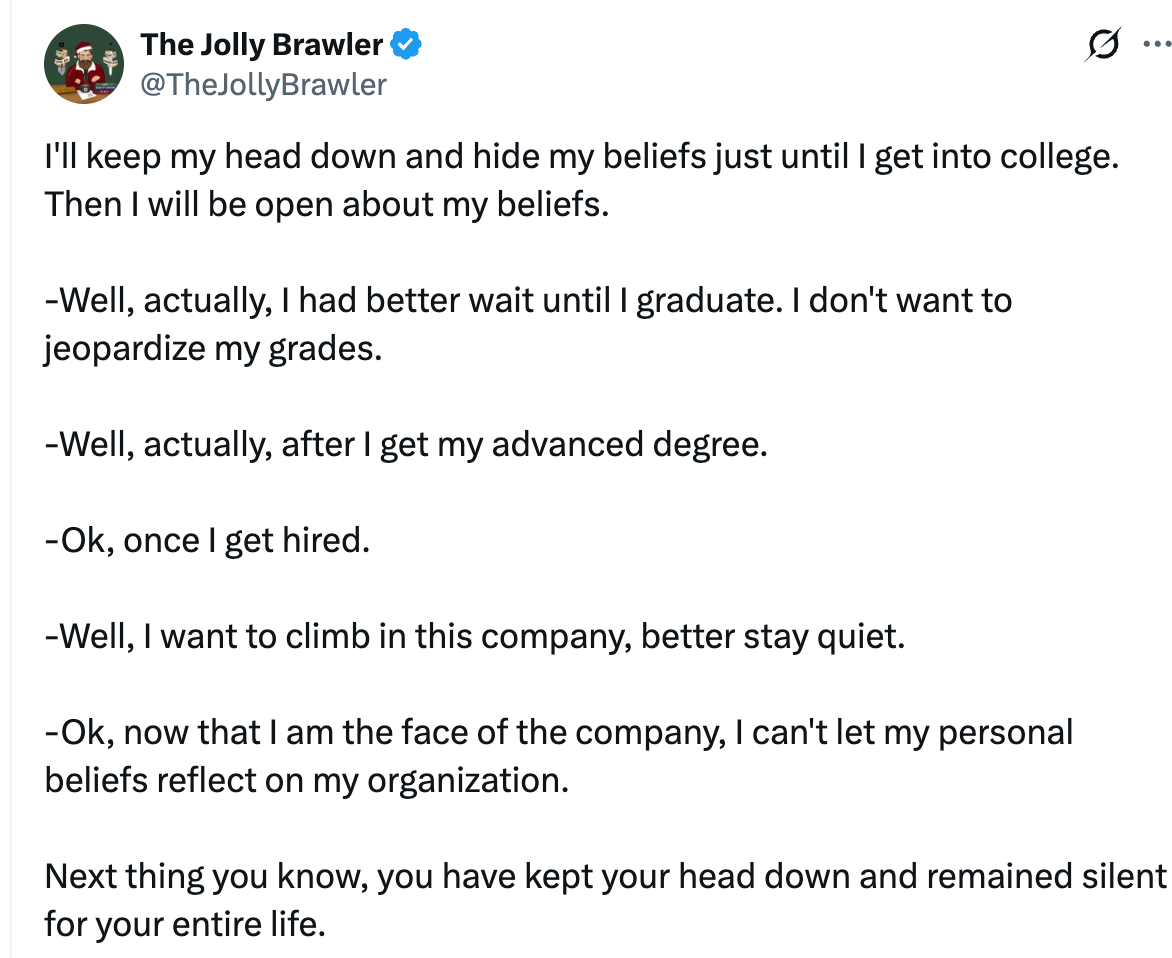
Fortunately, most people who were turned away from the big companies turned out all right. As Savage notes,3 entrepreneurship of some sort, particularly in writing or something else online (like crypto), was the lifeline grasped by many young men over the past decade because merit and competence still matter and are a way to get ahead. Such is, after all, why I am writing this article; starting a business seemed the far better bet than including my pronouns in emails for a big law firm full of DEI hires who hate me.
And make no mistake: the way DEI was inflicted means it is impossible to escape in a prestigious position or a good job.
Take, for example, corporate law. The S&P 100 companies that refuse to hire white people also put such mandates on those with whom they work, such as law firms, contractors, and suppliers. Want to do law for some company like Coca-Cola? Well that means you need to have a certain percentage of racial diversity, have some sodomites or pronoun goblins on the team, and spend your pro bono hours helping George Floyd types escape consequences. With the partners at such firms being white men, that means the vast majority of new hires are going to be diversity types that help them fill the ranks; a few killers, the geniuses of their classes, might get put on the team so it can still function, but everyone else will be a DEI box check. And all the way down, that’s aided and abetted by the collaborators who’d rather get the extra contract at the cost of their children’s future than resist it.
Thus, many were seriously harmed. Numerous acquaintances found it impossible to get into medical school because their MCAT scores were high, but not high enough to outweigh the affirmative action given to unqualified blacks. So they didn’t get to become doctors despite putting in years of effort into serious studies, getting scores higher than those admitted, and doing all the internships, research projects, and other things that should help one get into medical school. They were turned away because they were white and male.
The same is becoming true of those who did what their mentors told them and studied engineering, particularly computer engineering; the H-1B influx means they’re now left out in the cold by companies that would love nothing more than to replace them with some Indian who checks a DEI box and earns only 70% of what they would make.
And, of course, one of the worst scandals in W&L’s history came because no one in the administration would stand up for a white, male student falsely accused of rape4; the innocent deserve no aid if their skin color and gender are that of W&L’s founders and notable alumni.
On and on it would go. A few stood up to the anti-white machine, but most didn’t. Many stayed quiet, out of fear. Others tried to earn brownie points with the machine by scolding me and others like me for calling out anti-white racism, for attacks on our heritage, for the dispossession of our class; the machine ate them anyway.
Overall, life became a split between those who had the courage to stand up (and often did well enough because a few brave alumni respected them for it), and the collaborators who hung their heads in shame and skulked around while collaborating with a machine that wished only for their destruction. Whether in their 20s, 30s, 40s, 50s, 60s, or older, a great many people were in the latter category.
What to Do about the Collaborators
The question then becomes what to do about the collaborators. What can one do with a friend or acquaintance who—particularly as an executive at a company, partner at a law firm, or other position of authority involved in hiring policy—could make a difference but doesn’t? What should be the response to cowardice, cowardice that abets our dispossession and genocide?
A story from the Roman Empire tells us, I think. Arminius5, the German prince who wiped out three legions and forever stopped Roman settlement of Germania, had a brother named Flavus who chose to continue serving the Romans at great personal cost rather than fight for and alongside his fellow Germans. When asked why, he pointed to the little trifles the Romans had given him as tokens of their appreciation. His brother sneered, denigrated the rewards, and turned away, knowing his course was to forever fight his brother. As JB Bury records it in his History of the Roman Empire 27 BC - 180 AD:
Flavus had lost an eye in the service of the Romans, and Arminius, when he had inquired and learned the cause of the disfigurement, asked, “What was thy reward?”. “I received”, said Flavus, “increase of pay, a gold chain and crown, and other military distinctions”. “Vile badges of slavery”, sneered his brother.
It would have been easier to be Flavus, to justify aiding in Rome’s conquest of his people by pointing to the trifles received for good service. But Arminius wasn’t such a coward, and so fought back rather than collaborating like his brother. The result was that Germania remained free, and eventually conquered much of Rome’s empire.
Americans, of course, were more than willing to double down on such an approach as the Revolution came. Tax collectors were tarred and feathered for working with the hated regime to extort their countrymen. The wives of the regime’s agents faced social exclusion and shame. The East India Company saw its tea tossed in the harbor as patriots refused to submit to the yoke of a state-approved monopoly. Massachusetts Governor Thomas Hutchinson was a gentleman but not a patriot, and so his home was broken into by a rage-filled mob when he signaled he would work with the British regime to impose the hated Stamp Tax.6
In short, men were held personally responsible for their actions—including their cowardice—and faced everything from social exclusion to being covered with scalding tar as their house was ransacked and ill-gained “badges of slavery” destroyed.
Now, I would never advocate doing anything illegal. Please don’t do to Larry Fink’s house or your HR manager’s house what the Patriots did to Hutchinson’s.
But the lesson still holds. Those who aid the regime—whether by foisting DEI upon every publicly traded company, as BlackRock and all its fund managers did7, by shirking their duties as a corporate leader and letting it happen inside their company, or by otherwise collaborating with a regime that hates them and those like them—should at the very least face social exclusion if they refuse to reform.
“Vile badges of slavery,” the fruits of those jobs, whether they be an ATV or a McMansion, should be sneered at rather than praised. Don’t invite them over for dinner, don’t arrange playdates with their kids and yours, don’t chat with them after church, don’t donate to their pet causes (or your alma mater, if it is woke), and so on. Until they reform, they should be treated as what they are: collaborators with an enemy regime that seeks our dispossession and genocide.
Of course, that’s impossible to the maximalist extent. We all must interact with scummy people frequently. But “must” is the operative word, and that must be the end of it. Gratuitous involvement with the DEI collaborators is tantamount to fraternizing with the enemy, and should be treated like it.
The sad fact is that there are a great many people who are not naturally our enemies, but whose cowardice has made them so. Glenn Youngkin, the Governor of Virginia, is a good example. He is an outgoing governor with just a month left in office, and what does he do? He helps black activists who will always hate him and people like him tear down the statue of Robert E Lee in the US Capitol,8 clapping like a trained seal as the beloved heritage of his state was destroyed by the civil rights types, the spiritual acolytes of Robert Mugabe. That is unacceptable. He is an enemy for having done that, and forever will be. So are those who support him in it.
The personal is the political when a political loss means our eradication, and must be treated like it.
On the other side of things, those who resist the Great Satan of DEI and its acolytes should be praised and aided. Alex Petkas left the university system rather than aid and abet the DEI regime; subscribe to his Substack and listen to his podcast! Jeremy Carl did the same thing, and led the charge against anti-white racism with his The Unprotected Class; buy his book! Matthew Lohmeier destroyed his military career and risked a military tribunal rather than go along with the US military’s DEI regime, publishing Irresistible Revolution: Marxism’s Goal of Conquest & the Unmaking of the American Military to expose what was happening; buy his book! So too with others who help teach resistance, like John Carter, Yuri Bezmenov, and Aribtrage Andy.
On and on it could go. A great many people have made personal sacrifices to resist the great evil enveloping our world, and you should support them with as much fervor as you deride and exclude the collaborators. Such grassroots patronage is the only way forward, as it is the only way to stimulate further resistance.
So, praise all those fellows, share their work, help reward them for resisting the evil DEI regime. And do the opposite to their mirror images, the cowardly collaborators who fought for evil despite knowing what they were doing because they were too craven to resist their own genocide.
People have agency. We are not automatons, but rather make our own decisions and are responsible for our actions. All should be treated like that. By their own fruits, reward and recognize those who used their agency to resist evil and those who used it to promote evil.
That is doubly true of those who are wealthy, who are in leadership positions, who are in a spot where they can resist or advance the banner of DEI. With great privilege comes great duty, and those in positions of privilege ought be praised or chastised according to how well they follow in the footsteps of great men like Robert E Lee and live up to that duty.
“If ye love wealth better than liberty, the tranquility of servitude better than the animating contest of freedom, go home from us in peace. We ask not your counsels or arms. Crouch down and lick the hands which feed you. May your chains set lightly upon you, and may posterity forget that ye were our countrymen.” -Samuel Adams
Featured image credit: Tony Webster, CC BY 2.0 <https://creativecommons.org/licenses/by/2.0>, via Wikimedia Commons
If you found value in this article, please consider liking it using the button below, and upgrading to become a paid subscriber. That subscriber revenue supports the project and aids my attempts to share these important stories, such as the recent one on Civil War, and what they mean for you.
Savage notes this in his article:
Hanging over it all was an invisible curriculum, the political assumptions about what should and should not be studied. James recalled a fellow graduate student he met at Yale, a white man oblivious to the latest academic orthodoxies. “He went on this long, passionate monologue about military history. He knew all sorts of details of Roman military history, he really wanted to study it. And I just thought you are hopeless, there is no way anyone is going to hire you… He almost wasn’t schooled properly. If he had been—without anyone ever needing to tell him—he would just drop all that about military history, because he’d know that’s white and European and male and dead.”
“The refuges that young white men did find—crypto, podcasting, Substack—were refuges precisely because institutional barriers to entry didn’t exist.”
Yes, you and Carl are right about cowardly behavior but you don't seem to want to know why white men became such cowards in the first place. They certainly weren't before WWII. You might want to look into the Civil Rights Movement of the 50s and 60s, women's liberation, the Cold War (please read Frances Stoner Saunders', The Cultural Cold War: The CIA and the World of Arts and Letters), and the rise of the sacred victim, entitled parasite culture™.
Another point. I'm surprised neither you nor Carl mention America First Legal, an organization (founded by Stephen Miller currently working at the White House and who has to live at an army base because of threats to his family) that has been suing institutions for race-based, un-Constitutional bias. They could use some money.
If you enforce a policy, you make that policy yours more fully than the people who authored the policy.
I don't care if you are an airline employee or a cop or a soldier or a DEI NAZI in a corporation.
When you enforce it, YOU are responsible.
All collaborators must hang. Fed employees like TSA, who violate 4th Amendment Rights of millions of citizens each month, or DEI NAZIs at a university or the HR Bitches... if you push the policy, you make it yours and YOU MUST PAY THE PRICE FOR YOUR EVIL.