


Welcome back, and thanks for reading. Today’s article is a continuation of something I started doing in January: a monthly roundup of everything I read the month before, whether for research or pleasure, and what I thought of each work. Many of these works are related to research for my new YouTube channel, The Old World Show. Please check it out! And as always, please tap the heart to “like” this article if you get something out of it, as that is how Substack knows to promote it. Here’s the audio version:

The Romans: A 2,000-Year History by Edward J. Watts
Once again, I started off the month by reading an absolutely awful book. That was The Romans: A 2,000-Year History by Edward Watts. In it, Watts attempts to tell what he sees as the complete history of Rome, from the Iron Age founding of the city to the sack of Constantinople in the Fourth Crusade. Instead, his main accomplishment is to somehow make the greatest and most exciting tale of Classical Antiquity and beyond utterly boring. The Gracchi, Julius Caesar, Augustus Caesar, and all the other great moments of Roman history are included…but in fashion that is boring beyond belief.
Particularly, the prose is dull. Incredibly dull, in fact. So dull that I fell asleep multiple times while trying to read it, which I rarely do. Trying to read through Watts is like reading a textbook, which is made all the worse by the fact that it is painfully surface-level and thus even less interesting. That lack of detail makes sense: it took Gibbon six volumes to tell just half of this tale, yet Watts attempts to tell the full story of Rome in a mere 600 pages. He fails utterly. Not only is it even more superficial and cursory than most introductory works, but Watts randomly tries to delve into details at times, which makes it a frustrating and muddled mix of random anecdotes that add little to the story and vague generalities. His need to then make up time in a short number of pages means broad swathes of history, history that is often much more interesting than those few areas on which he chooses to focus, are jumped over with barely a mention. It’s a mess of a book that is painful, boring, and pointless to read.
Adding to that is the general awfulness of Watts’s theory, which is that “the source of Rome’s enduring strength was the diverse range of people who all called themselves Romans.” In short, he claims that diversity was Rome’s strength, even when the barbarians were sacking the city. It’s a ridiculous theory, particularly given how the decline of Rome’s traditional ruling classes spelled its eventual death via dysfunction. Given that he rarely goes beyond the most superficial telling of history, it’s also a theory he rarely even bothers trying to prove, other than by verbally gesturing toward vague and broad generalities.
Finally, the end date Watts chooses is odd. The Western sack of Constantinople was a tragedy and a debacle that destroyed much of the city’s cultural heritage, but the Eastern Romans did hold on for about two centuries longer, some of it in a state of independence from the West and the Ottomans. The sack of Constantinople wasn’t until 1453, after all. Yet Watts ends the story before the tale was truly over, which was a mistake that makes an already unenjoyable and unsatisfactory work all the worse.
Orania: Building a Nation by Jonas Nilsson
Of all the ongoing projects that aim to try and salvage some of what remains of the West, Orania—the Afrikaner-only South African town that has managed to grow and succeed while the rest of South Africa falls apart—is one of the most interesting, and is best carried out. So, it was a pleasure when Jonas Nilsson sent me his Orania: Building a Nation, which is a concise and well-done history of the town of Orania and how it has succeeded where other such projects have failed miserably.
Adding to the excellence of the content is that Nilsson has filled it with dozens of pictures of the town and its environs, which really adds to the work and helps bring color to the descriptions of what life is like in it. These pictures help significantly in showing what the town is like, how it is growing, what life looks like in what is essentially a thriving and modern frontier town, and what sort of life can be built when one isn’t shackled by equity.
All in all, Nilsson does a commendable job of showing why Orania has succeeded and doing so in a work that is digestible, concise, and a pleasure to read. Check out my full review and thoughts on this book’s applicability to Americans here:

Lord Randolph Churchill, Vols I and II by Winston Churchill
Much as his political reputation is inflated, Winston Churchill’s literary reputation is incredibly inflated. Some of his books—A History of the English-Speaking Peoples and The River War—are reasonably good. One of his works—Marlborough: His Life and Times—is quite good. Most of the others are awful. Namely, his The World Crisis and The Second World War are absolutely awful, being generally uninformative, boring, and unpleasant to read.
What makes them so bad is that, while Churchill has a penchant for excellent prose, his neurotic focus on trying to “correct” the record to prove that he made the right decisions makes those books nearly unreadable. This is particularly true because he packs them full of letters and telegrams meant to prove that he did the right thing, or was correct in his opinions and impressions, and the profusion of them is just miserable to get through.
Unfortunately, that is particularly true of Churchill’s biography of his father, Lord Randolph Churchill. A younger son of the Duke of Marlborough, Lord Randolph was a syphilitic remarkable primarily for his record of impulsive and terrible decision making over a short political career that was ruined by his own propensity for imploding in periods of difficulty. He had occasional flashes of brilliance, such as the taking of Burma, but generally managed to make an immense mess of things, and eventually resigned as part of a bizarre fight over a minor issue with Lord Salisbury in what was one of the greatest examples ever of profound political miscalculation. He then died young from syphilis, leaving his wife and children almost penniless because he was a reckless spendthrift. He was regarded as such by both his political allies—what few of them there were—and enemies, during and after his own life.
Naturally, his loving son tried to correct the record and try to show that Lord Randolph had been a genius whose “Tory Democracy” concept saved conservatism in Britain. In reality, Tory Democracy was a mess, as is evident throughout even Winston’s book. The reasons for that are clear; as Yarvin notes: “The basic method of Tory democracy is to appeal to the masses to support a non-democratic, i.e., reactionary, form of government. The basic problem of Tory democracy is that the masses suck.” Indeed, and even Churchill couldn’t cover it up, though he refused to admit to it. Yet further, the rest of Lord Randolph’s political life was similarly disastrous, as can’t help but be garnered even by his loving son’s laudatory work.
But try to prove that impression wrong Winston does, primarily by filling both volumes of his biography of his father with innumerable multi-page letters that he claims vindicate his father. They don’t, failing utterly to prove his point and generally showing that those who tried to beat some caution or sense into his father were in the right, a lesson from which both Lord Randolph and Winston failed to learn. Altogether, the immense collection of block quotes from letters embedded in the work makes it very tedious and tiresome to read.
Yet worse, next to none of Lord Randolph’s private life or times are included in the work—quite unlike Winson’s history of the first duke of Marlborough—which is what would have made the book interesting. Instead of being an interesting look at a man and his fascinating times, which could have salvaged it, Winston’s biography of Lord Randolph is just a long list of his political failures, punctuated frequently by crises brought on by his personal shortcomings, all of which is told in a painfully laudatory tone.
Among Boers and Britons: A Swedish Volunteer’s Memoir from the Second Boer War by Hjalmar P. Janek, edited by Jonas Nilsson
Also sent to me by Jonas Nilsson, Among Boers and Britons: A Swedish Volunteer’s Memoir from the Second Boer War is a fascinating tale about a particularly underknown part of an already underknown period of history. It is the story of a Swedish volunteer who, as part of an all-Scandinavian unit, fought alongside the Boers in the Second Anglo-Boer War.
It is a fun adventure tale, a story of escaping from a POW camp, outfoxing British officers, and fighting to the bitter end in apocalyptic battles. It’s not a full history of the conflict, or even Scandinavian involvement in it, but doesn’t purport to be. It’s just a fun read, and will leave you with a much more colorful view of a conflict that was a painful mixture of Old World chivalry and the horrors of modern war.
When Migration Becomes Conflict: Political Group Dynamics by Jonas Nilsson
Mr. Nilsson also sent me his When Migration Becomes Conflict. It is a collection of political essays on mass migration, political stability, and identity. Particularly, Nilsson uses both data and anecdotes to show how replacement-level migration is making life far worse, more dangerous, and more insecure in Western nations, and why we need to recover a sense of identity and in-group preference to overcome those crises.
The book is, like his others, concise and well-written. It is probably one that would be more helpful for someone just getting into such subjects to read, but it was one I nevertheless found interesting and enjoyable despite having been interested in these subjects for many years.
Tobacco Culture: The Mentality of the Great Tidewater Planters on the Eve of Revolution by T.H. Breen
After I finish the story of Lewis and Clark, the next era to which I will be turning in my The Old World Show is the Old Dominion. Particularly, I am going to tell the tale of how Virginia became the aristocratic republic that flourished into an incredible Golden Age, and use that setting to tell the tales of its great, leading families—those famed First Families of Virginia.
As such, I have started reading a great deal about Virginia from its founding to the War Between the States, and have much more such research planned. Tobacco Culture by Breen is one of the better works on the subject, as it does a good job of showing what it was about the growing of tobacco that made the Virginians the way they were. They were very different from both the British landed elite and the sugar and rice planters of the Caribbean and Carolina Lowcountry, despite having very similar origins and cultural ties to both groups. Tobacco Culture explains why, using the nature of tobacco and the farming process required to successfully and profitably grow it to explain the unique culture of Virginia. Breen further shows how their political development flowed out of that economic situation and the crop that undergirded it.
From their somewhat strange attachment to radical Whig principles to their hatred of debt, their intense focus on personal honor (including the quality of their tobacco) to their penchant for incredible hospitality, much of it stems from the nature of tobacco and the nature of Virginia, and Breen does a superb job of showing as much. Stay tuned for future videos and articles on this!
This Side of Paradise by F. Scott Fitzgerald
Of all F. Scott Fitzgerald’s novels, This Side of Paradise is by far my favorite. Though it is depressing and sad, as are most of his works, it is an absolute pleasure to read. It is by far the most complete of any of his novels. The pacing and prose are better in it than in any of his other works. And in it, Fitzgerald does an incredible job of showing the nature of WASP high society before and after the Great War, with its virtues and vices on full display.
As I mentioned in January, I think Fitzgerald is, along with Tom Wolfe, one of the greatest American novelists. This Side of Paradise, his first full novel and the one that is based on his time at Princeton and so has the most emotion woven into the story, is the best of his many great works. I really recommend reading it, and I think you will quite enjoy it.
The German Empire, 1871–1918 by Roger Chickering
The Prussians are a fascinating people. In many ways, they were quite like Britain after the Norman Conquest, with a military aristocracy and monarchy ruling a constantly-growing state for centuries and eventually leading it in its transition from a poor agrarian nation into an industrial behemoth powered by a massive rail infrastructure buildout. There are many ways in which the two are different, of course, from the militarism of Prussian society to the much more global aspirations of the English for most of their history. But, still, the Prussians are close enough to my favorite historical subject—English high civilization and the ways in which it flowered—to be of deep and abiding interest to me, and the differences accentuate rather than dull that interest.
So, it was with that general interest in mind—one stirred by having read all six volumes of Carlyle’s History of Frederick II, Also Called The Great, last year—that I turned to Chickering’s The German Empire, 1871-1918. It is a fine, but not great, book.
Chickering—a longtime professor of Prussian and German history—is obviously well informed. Every chapter in the book is very well-researched, well-organized, and informative. His dedication to and knowledge of the subject he spent a lifetime studying is evident, and shines through on every page. However, it has problems, namely that the prose is exceedingly dull throughout, with the work reading more like a textbook than a history, and the content selection is both puzzling and frustrating.
What made Prussia so exceptional over the last third of the 19th century and the first two decades of the 20th century was its immense military strength and industrial development. Bismarck’s machinations, Wilhelm II’s indiscretions, labour agitation, and all the rest are somewhat interesting, but pale in comparison to the military the Prussian government built and the industrial sector that largely paid for it.
While Chickering doesn’t ignore those subjects completely, he doesn’t include anywhere near enough information on them. Each gets only about a chapter and a half of a lengthy book. The rest is taken up by discussions of women’s rights, the socialist political effort (of which Chickering seems fond), workers’ rights, and the like. It’s very tedious, very boring, and not the content that most readers will buy a book on the German Empire to learn about.
So, this book is fine. It’s tolerable enough if you want a very broad survey of German history during this period. But it is far from being an exceptional book, and is lacking in enough respects to be one that I cannot recommend. That is too bad, as Chickering is well-informed and seemed to have put an immense amount of effort and research into writing it. But it is nevertheless the case.
The First Gentlemen of Virginia: Intellectual Qualities of the Early Colonial Ruling Class by Louis B. Wright
The First Gentlemen of Virginia is another superb book on Virginia. In it, Wright discusses the early cultural development of colonial Virginia, describing the Virginia gentry’s general attempt to recreate the civilization of the British gentry in the New World. He then goes through several individuals from the more important first families, such as the Fitzhughs, Wormeleys, and Byrds, to show what books were in their libraries, why they read what they read, and how their reading selections are indicative of the political climate in Golden Age Virginia.
Yet further, Wright uses that information to show the intellectual qualities of the Virginian governing class, and how that led it to govern and lead in the way that it eventually became known for doing. Altogether, this does a great deal to flesh out the nature of Virginia as it developed and once it reached its peak, which is fascinating and helps explain much that was unique and interesting about the colony, particularly the cultivation and self-conscious gentility of its leading men. If you are interested in Virginia, this is another must-read book.
Tales from the Jazz Age by F. Scott Fitzgerald
Tales from the Jazz Age is a fun collection of some of F. Scott Fitzgerald’s best short stories. While he is today remembered best as a novelist, his strongest works were his short stories. These were published in leading papers and journals, such as H.L. Mencken’s American Mercury, and they are for what he was best known in his life. It is largely because of them, along with This Side of Paradise, that he became famous.
His tales in this collection are all about the post-war South and the changing WASP elite of the North, and are everything from realistic stories like The Rich Boy to fantastic ones like Benjamin Button or The Diamond as Big as a Mountain. All of them are fun, punchy, sharp, and a delight to read. Additionally, all show different aspects of what the old America was like, and how we are now living in its ruins.
New Rome: The Empire in the East by Paul Stephenson
Another day, another absolutely awful book about Rome. In this case, that is New Rome by Stephenson, one which came highly recommended, yet is nevertheless absolutely terrible and remarkable only for its exceeding dullness.
That is a shame, as New Rome could have been quite interesting. Stephenson includes a great deal of archeological and scientific information of the sort that is rarely included in narrative histories of this sort. That could have made for a fabulously fascinating book that shed new light on what happened and why in Late Imperial and Early Byzantine Rome, the period Stephenson covers. As the changing climate, horrible plagues, and similar issues were major factors in what happened over these three centuries, that information really could have made for a great book.
But it does not. Stephenson’s writing is boring beyond belief, the anecdotes chosen are tedious and random, the new data he brings forward is neither well-integrated nor well-explained, and the book is just an overall snooze-fest. Despite its immense potential, it’s not even particularly informative. The content is, in reality, far less ambitious than Stephenson tries to indicate, and the whole thing is very poorly put together. That’s too bad, but it is nevertheless the case and makes this a book to avoid rather than read.
The Sociology of Colonial Virginia by Morris Talapar
The Sociology of Colonial Virginia is fascinating, providing a novel look at the nature of early Virginia and what resulted from the clash between Puritan and Cavalier in the first decades of Virginia’s history. In it, Talapar digs into the split between the early settlers of Virginia who were sent there by the Virginia Company—an organization that was financially backed largely by the merchants of London and thus connected to the Puritan faction—and the tobacco planting Cavalier grandees who arrived somewhat later, when Virginia became a royal colony.
Using that basic difference as a foundation, he then shows how there was a fierce struggle waged for the nature of Virginia between a collection of yeomen and merchant-minded types on one side, and grandees who believed in the “no land without a lord” view of the Cavaliers on the other. That is a fascinating split that is well-supported by the sources Talapar brings, and does much to explain why Virginia changed so significantly as Gov. Berkeley and others gradually but inexorably changed the land laws, and culture of the state with them.
Talapar then shows, step by step, how the cavalier desire for great plantations eventually defeated the “Puritan” view that was epitomized by the “Hundred” system1 of homesteads and fee simple landownership amongst smallholders. Yet better, Talapar uses that shift and what practical results came from it to show how it turned Virginia into the aristocratic republic as which it was long known and why that couldn’t have happened had the Puritan “Hundred” system won out.
It is a fascinating work that does much to explain why Virginia developed as it did, and what intentional policy choices enabled or encouraged its development in that fashion. It also explains the enduring myth of the Virginia cavaliers—that it was the Cavalier view of land and spirit regarding it that shaped the colony, not any great influx of actual Cavalier lords—and how that outlook, rather than individuals, is what led to the "cavalier” spirit of Virginia.
Class by Paul Fussell
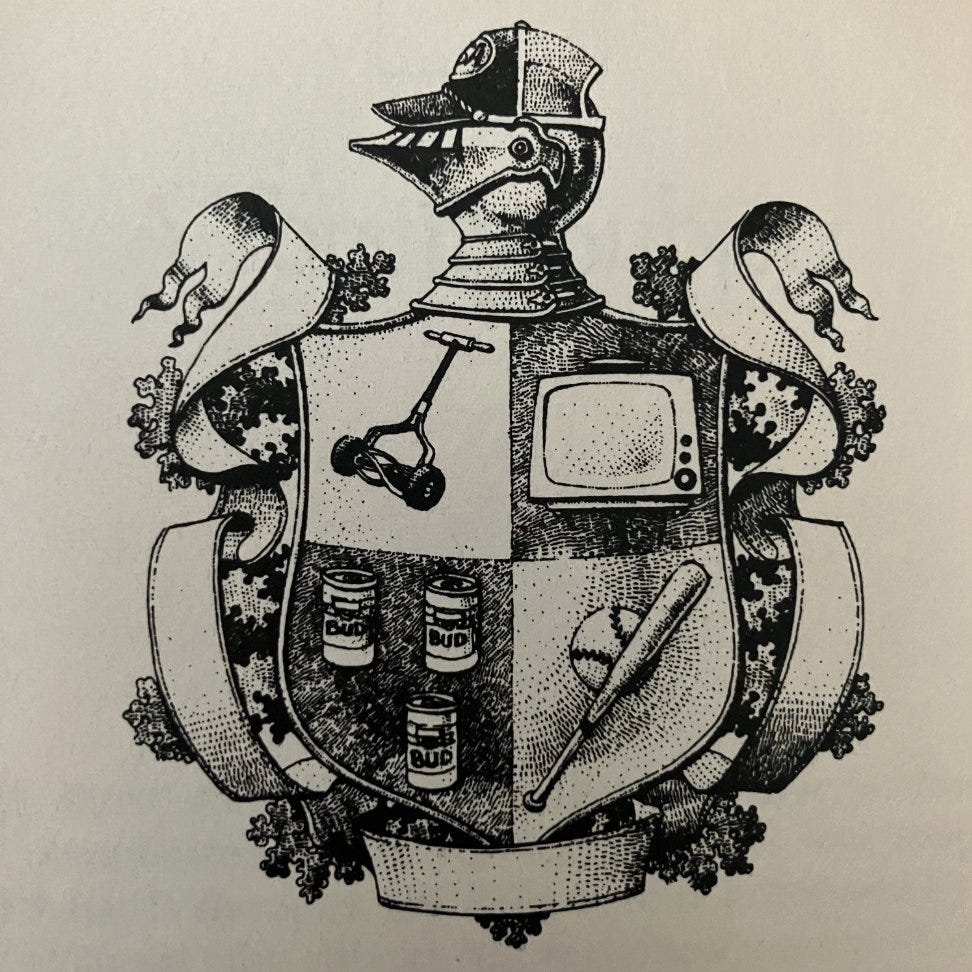
Class: A Guide Through the American Status System is hilarious. It is a fascinating and penetrating work on the nature of class in America, and it shows what about our social classes is revealed by what we do, how we act, how we dress, and what we eat. While much of that might seem obvious, the slight differences and distinctions that Fussell identifies add a great deal of color and end up being much more nuanced than one might initially think.
Further, Fussell’s use of funny illustrations to prove his point helps color his claims and highlight the seemingly small things that make all the difference in the world once they are packaged together. Additionally, his description of the upper class moving out of the public’s sight because of extortionate death and income taxes is a fabulous point that I have yet to see any author make as well.
Yet further, what Fussell really shows, looking back, is how much we have degraded. The concept of prole drift that he identifies—the tendency of American culture, tastes, and products to move downward in quality, refinement, and sophistication to appeal to the “proletarian” level—was indubitably real at the time and is far more advanced now, and the result is that we increasingly seem to be living in a decaying world. The refinement and cultivation that once characterized at least parts of American society are now largely gone, and our world is defined by the ill effects of prole drift. The world is more gaudy, less restrained, less civilized, and more unpleasant as a result of it.
Fussell identifies, in entertaining and concise fashion, why that was already occurring decades ago, how it was getting worse, and what old traditions and civilizational forms we would have to rebuild and restrengthen to reverse that hugely deleterious trend.
The Decline and Fall of the British Aristocracy by Cannadine
For those who are interested in the British Aristocracy, there are two introductory works I always recommend. The first is JV Beckett’s The Aristocracy in England, 1660-1914, which explains the rebuilding of the British landed elite into a role of rule and prominence after the Wars of the Roses and Civil War, and David Cannadine’s The Decline and Fall of the British Aristocracy. In my preparations for my lengthy article on the decline of the British landed elite last month, I reread Cannadine’s superb work, and liked it even more than I remembered.
What makes it so great is that Cannadine brings an interesting mix of healthy skepticism, hard data, and evident admiration for much of what the British upper class created. This leads to a penetrating work that explains much of what happened to the landed elite and why, with both its own sins and the unjust exactions of government exposed in stark detail, with a great deal of well-integrated data and a great many fascinating and perfectly-selected anecdotes brought to support his claims.
All in all, that means Cannadine wrote a superb work that nearly perfectly describes the practical reasons for why the British landed elite went from atop Olympus as the most powerful class in the most powerful empire the world had ever seen to a nearly dead class composed mainly of caretakers of decaying houses in an island smaller than Michigan, all over the course of just a few generations. I really can’t recommend it highly enough, however sad and painful it is to read at times.

Aspects of Aristocracy by David Cannadine
Aspects of Aristocracy by David Cannadine does much the same thing as Decline and Fall, showing the decline of the British aristocracy over time, but does so primarily through anecdotes rather than data and a grand narrative. It is a more fun read, as it’s full of fascinating characters—and has a very good, well-balanced discussion of why Winston Churchill was the way he was and whether he was a failure or a great leader—but is also less complete and less informative because it is a collection of stories rather than a grand and well-supported narrative. That means it is excellent as a companion work to the larger study, which is what Cannadine intended it to be.
Undaunted Courage: Meriwether Lewis, Thomas Jefferson, and the Opening of the American West by Stephen Ambrose
To prepare for my new The Old World Show series on Lewis and Clark’s Expedition, which I think is one of the greatest American adventure stories, I re-read Stephen Ambrose’s Undaunted Courage. It is a fantastic tale of the Lewis and Clark Expedition, from its origins and preparation to what the great journey of the Corps of Discovery was like and Lewis’s sad end after his days of glory. Ambrose is a great writer who does a wonderful job of making it an engrossing and informative story, and manages to pack a great many facts into a thrilling narrative.
Further, his setting of the story in the context of the Virginian desire for ever more land, the Virginia backgrounds of Lewis, Clark, and Jefferson, and the Jeffersonian dream of a continental empire of yeomen united with the West by a Northwest Passage, adds a great deal to the narrative and helps explain Jefferson’s western fascination. All in all, it is a great read and one I quite recommend. If you are looking for journals of Lewis and Clark to read as well, I quite liked The Essential Lewis and Clark.
Myths and Realities: Societies of the Colonial South by Bridenbaugh
My research into early Virginia continued with Bridenbaugh’s Myths and Realities: Societies of the Colonial South, an interesting but ultimately unsatisfactory look into the three main colonial societies of the South—the Tidewater Chesapeake, the Carolina Lowcountry, and the frontier Backcountry. The Chesapeake was a genteel land of tobacco plantations, the Lowcountry a land of Charleston townhomes and vast rice plantations, and the backcountry a land of rough and tumble frontier life. The first two were dominated by aspirationally genteel Anglos of generally mercantile backgrounds, the last of tough Scots-Irish frontiersmen much more interested in bettering themselves than in gentility.
Overall, what Bridenbaugh does well is prove his point that there was not one unified Southern culture before the Revolution, but rather a collection of those three main cultures that had similarities and differences, and were anything but unified. Each chapter is short, to the point, and well-researched. It’s also well-written and fun to read.
However, it is nevertheless unsatisfactory because it is so short: each of the three sections is only 50 to 60 pages, and, as such, doesn’t contain enough detail or support for Bridenbaugh’s bolder claims. For example, at one point, Bridenbaugh claims that the Chesapeake was dominated by an elite that was guided by feelings of noblesse oblige. That may well have been true, and other authors prove it. Bridenbaugh does not. He merely states it and then moves on to other such bold claims that are similarly unsupported, which is frustrating and unsatisfactory because it would be helpful to review why he thinks that, what supports it, and how extensive it was. Bridenbaugh is believable, but needed to support those claims with more detail, rather than just brief overviews.
That doesn’t mean Myths and Realities is necessarily a bad book, but it is a disappointing and frustratingly brief one.
The Shaping of Colonial Virginia by Thomas Wertenbaker
Finally, the last book I got through in February was Thomas Wertenbaker’s The Shaping of Colonial Virginia, a reprinted collection of three short works he had written decades before—Patrician and Plebeian in Virginia, The Planters of Colonial Virginia, Virginia Under the Stuarts, 1607-1688.
All three works are fine, not great. They are good in that Wertenbaker is a solid writer, and his works are well-researched and well-cited. Unlike Bridenbaugh, his claims aren’t just made as floating castles, existing without needed support. So that is good, and lends credence and credibility to his claims, making each work a good reference that shows how Virginia became an aristocratic republic dominated by cavaliers rather than the collection of small yeoman farms as it began. Wertenbaker does an admirable job using probate data, revenue estimates, and like information to show and explain those trends.
However, together the three are exceedingly repetitive, which makes the collection of all of them somewhat tiresome to read. The periods, history, trends, personalities, and so on that are covered in each work are broadly similar, and Wertenbaker’s analysis is broadly similar across each of the three books. In fact, where the same incident is covered in the different books, Wertenbaker often just copied and pasted the same exact language, which is annoying to come across.
So, these aren’t bad books, and are individually well done and probably worth reading. But reading all three of them is a waste of time, as they are exceedingly repetitive and that is very frustrating. I thoughtVirginia Under the Stuarts is by far the weakest of the three, while Patrician and Plebeian in Virginia is probably the best, being the most original and most interesting.
Thanks for reading! If you liked this post, please consider becoming a paid subscriber so that I can continue affording all these books!
And check out my video show series on Sir James Brooke:
I read Paul Fussell's Class back in the mid-'80s. It was fun to read then, and the nuances he highlights were eye-opening to me. Though I'm not sure how much of it applies today. IIRC, he writes:
"Given enough time and money, any man can be made to feel ill at ease in anything but a Brooks Brothers suit."
Since very few men wear suits nowadays (to our great detriment), this is a very dated view. Still, I think the book is worth the time.
Thanks for these, enjoy these
Undaunted Courage is excellent and if you travel around the west, you begin to see the true distances they covered. You can also go to Pompey's Pillar near Billings Montana and see where they carved their names into the stone. It's the only actual physical evidence of their journey. Worth the 30 minutes.