


Welcome back, everybody!
As some of you already know, I am moving. While I love Virginia, a big life opportunity came up. So, I am moving to Tennessee. This Thursday, in fact. I’ll be closer to family, which will be nice, and not having a state income tax will be tremendous. In any case, because I am moving, my time has been somewhat limited. That has meant Old World Show videos have mainly been reformatted versions of old, relevant articles, and that I have had less time to do my research reading than normal. So this list is a good bit shorter than I would have hoped. I just haven’t had as much time for research and reading…dozens upon dozens of boxes of books would not move themselves, regrettably.
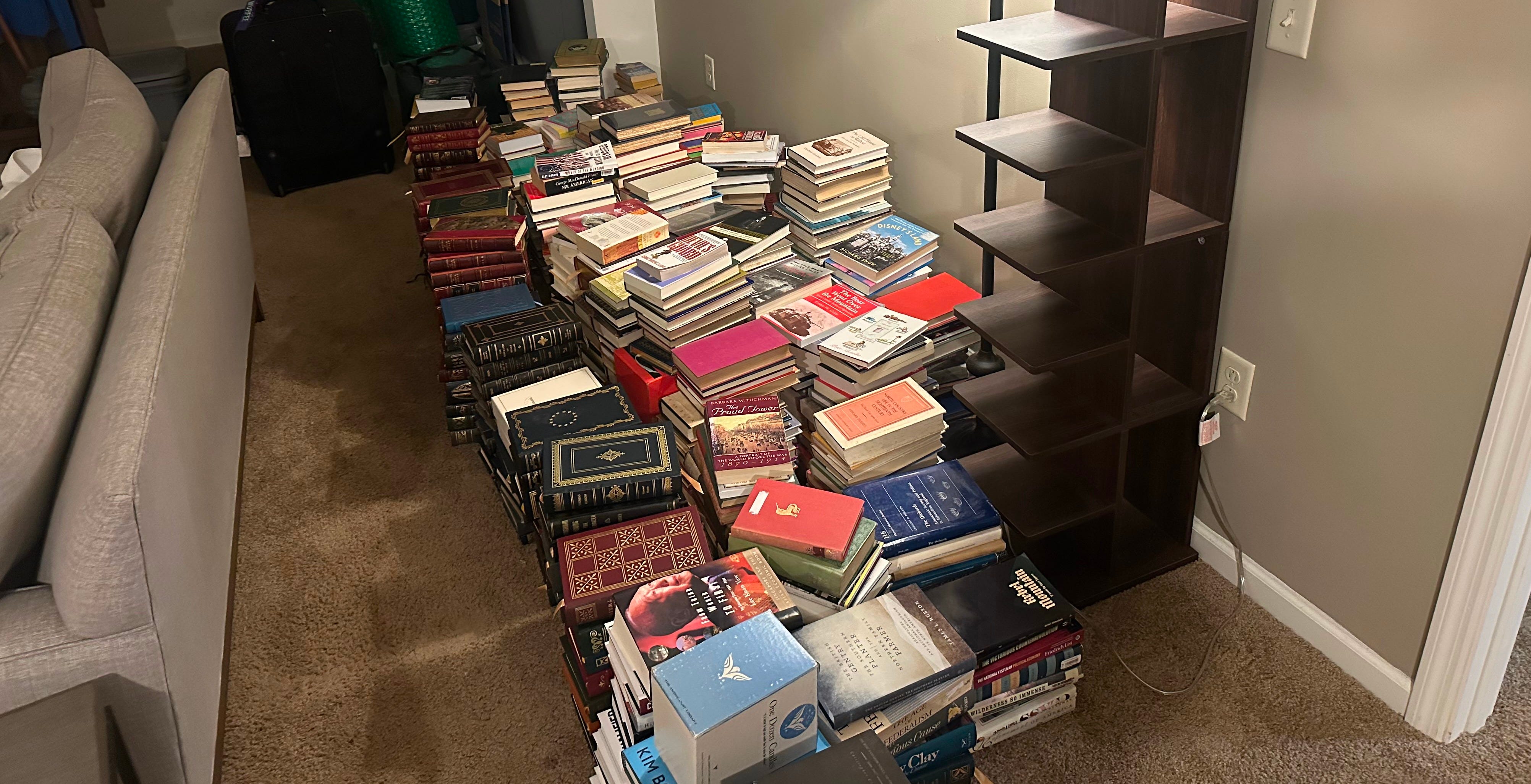
So, a few things.
First off, this list is shorter. I think you’ll probably still enjoy these, but just know it’s not because I got lazy and didn’t feel like writing; I just read less this month.
Second, I will have a new, much more aesthetically pleasing home office at the new house! As a result, I think I will be able to record more videos of me talking, rather than just a dark screen. Right now, my plan is to do short videos on books, outtakes from the podcast with me talking, and perhaps some other content on that front. If you have any suggestions, please leave a comment and let me know. That will not get in the way of the written content, which I know is what you are here for.
Third, moving is expensive, as is buying a house with interest rates back to historically average levels. If you are not yet a paid subscriber, and would like to help me and support my work, please consider parting with just eight of your hard-earned dollars a month, or a discounted $80 a year. I know times are tough for many right now, and not everyone can afford it (if you’re a consistent reader and can’t afford to upgrade, please just reach out), but if you can afford it, I would really appreciate it.
Fourth, and finally, I will now no longer be living atop a mountain in the woods, and so can travel more easily. A few subscribers have reached out asking if I am up for doing private speaking events. I am! The first couple of those will be happening this fall, which I am quite excited about. If you are a paid subscriber and are interested in that, please just shoot me a message, and we can work something out. I never mentioned this before because “why don’t you hire me as a speaker for your event” seemed exceedingly pretentious, but since a half-dozen people have asked in the past few months, now seems like the time to mention it.
Thank you all very much, and now on to the article! Listen to the audio version here:
![[AUDIO] Will’s September Reading Roundup, and A Big Life Update](https://substackcdn.com/image/fetch/$s_!VVo5!,w_140,h_140,c_fill,f_webp,q_auto:good,fl_progressive:steep,g_auto/https%3A%2F%2Fsubstack-video.s3.amazonaws.com%2Fvideo_upload%2Fpost%2F218065124%2F00ad0e9e-e2a8-41c4-8e5e-1bd818e55384%2Ftranscoded-1790710238.png)
1. The Death of James Forrestal by Cornell Simpson
I began the month by reading The Death of James Forrestal, an early Cold War Era book about America’s refusal to deal with the communism problem, which was recently republished by the John Birch Society. It’s a great book with one notable flaw.
First, the good: the majority of the book details the horrible crimes committed by the communists that the US government, particularly under FDR and Truman, let them get away with. These crimes included everything from assassinating and torturing Americans to seizing swathes of European territory that the United States ought not have given up. Many of the crimes articulated here, particularly ones that occurred on United States soil, are horrible...yet mostly unknown outside the pages of this book. This information is fascinating, and something I will be researching much more thoroughly. This section comprises roughly the middle two-thirds of the book.
Second, the bad: the book opens with a lengthy recitation of the hospital’s mishandling of Forrestal’s internement in it, and the suspicious nature of his death. As it is, this comes across as somewhat odd and out of place, as it is not immediately obvious why such a (supposed) suicide should matter. The rest of the book then makes that clear, but as written it is somewhat awkward and feels out of place. The ending then returns to the hospital matter, which is irritating because it has already been covered in such depth.
On the whole, the nominal subject of the book—the death of Forrestal—isn’t handled particularly well. It bounces around, is far too detailed, comes out of nowhere, and isn’t overly convincing. However, the sections on communist subversion of America, American tolerance for Soviet crimes, the nature of Soviet aggression, how Truman and Marshall sided with the Soviets, and so on are very good. For that reason, I recommend reading it.
2. Moralia by Plutarch
I’ve said before that I simply can’t stand reading philosophy. I find it dry, boring, and generally unhelpful compared to reading biographies of great men. That said, I finally read my two-volume set of Plutarch’s Moralia at the beginning of this month, and really enjoyed it.
The two volumes are quite different. One is mostly on mythology, particularly Egyptian mythology. It is interesting enough, if somewhat hard to get through, as it is very dense and full of generally foreign concepts.
The other volume, which I found far more interesting, other than a bizarre and lengthy section on pederasty that took up the middle of it, contains his thoughts on ethics, politics, and training good citizens. One thing I was struck by is the emphasis he places on the education of young men as being the key ingredient for their being good citizens, and how different his view of education is from ours.
He begins, for example, by noting, “Come let us consider what one might say on the education of free children, and by what training they would become good citizens.” He soon notes that the proper education of a citizen is not just the accumulation of facts, but development in excellence: “To speak generally, what we are wont to say about the arts and sciences is also true of moral excellence, for to its perfect development three things must meet together, natural ability, theory, and practice. By theory I mean training, and by practice working at one’s craft. Now the foundation must be laid in training, and practice gives facility, but perfection is attained only by the junction of all three. For if any one of these elements be wanting, excellence must be so far deficient.”
That’s not all. Plutarch also notes that those with whom they are in contact over the course of their education must be those who are of good character, as exposure to the rotten sort might make them rotten: “Attention also must be given to this point, that the lads that are to wait upon and be with young people must be first and foremost of good morals, and able to speak Greek distinctly and idiomatically, that they may not by contact with foreigners of loose morals contract any of their viciousness. For as those who are fond of quoting proverbs say not amiss, ‘If you live with a lame man, you will learn to halt.’”
Noting that the same is particularly true of those who are in charge of their day-to-day education, he writes, “The schoolmasters we ought to select for our boys should be of blameless life, of pure character, and of great experience. For a good training is the source and root of gentlemanly behaviour.” Emphasizing this point yet further, Plutarch writes, “And as I advise parents to think nothing more important than the education of their children, so I maintain that it must be a sound and healthy education, and that our sons must be kept as far as possible from vulgar twaddle.”
And, again, what is the ultimate purpose of all this? To teach moral excellence, not mere facts and figures. Slaves can be trained in math, free men ought be trained in greatness: “So that it was no bad remark of the Lacedæmonian tutor, that he would make the boy entrusted to his charge pleased with what was good and displeased with what was bad, for a higher or nobler aim cannot be proposed in the education fit for a freeborn lad”.
Think how different that is from “education” today, which largely consists of trying to get good grades on recitations of facts and figures while the moral element is not just ignored, but actively subverted through attacks upon it by teachers and the forcing of everyone—particularly in the public school system—to associate with the “vulgar twaddle”. No wonder we are increasingly failing to produce good citizens. We no longer aim to produce them.
If you’d like to learn more about Plutarch’s Moralia, Evan Amato has been doing a series on them recently. Check it out!
3. Inside the Great House: Planter Family Life in Eighteenth-Century Chesapeake Society by Daniel Blake Smith
Inside the Great House by Smith is a fabulous book that anyone interested in colonial Virginia and the sort of culture that built the Virginia gentry, and thus the most important of the Founders, must read.
It discusses everything from architecture to marriage, but the most interesting section is the one on how the Virginians raised their children and developed in them the “habit of command” that characterized their leading men in the 18th and 19th centuries.
To do so, Smith shows the unusual mixture of indulgence and strictness with which the children were treated, with parents letting them do much and roam freely, but also making them learn virtue and a sense of both duty and self-restraint. This encouraged them to be proud, domineering and swaggering, but also to know how to control themselves and lead with courage, skill, and bravery. It made them that odd mix of well-read and active, men who seemed almost like the Romans of Classical days brought back to life.
It’s a very interesting book that is well worth reading. I got a great deal out of it, and finished it wishing that I had read it much earlier in my research process.
4. The Mansions of Virginia, 1706-1776 by Thomas Waterman
I hoped that Waterman’s The Mansions of Virginia would be a book like Mark Girourd’s The Victorian Country House: a delightful, fascinating mixture of social and architectural history that does deep dives into representative great houses while also explaining the lives and culture of those within them.
It is not that. It is, rather, an exceedingly dense architectural history of Virginia’s plantation homes, discussing most of the famous houses built over the 1706-1776 period in excruciating detail, going over everything from the philosophical roots of why they were built as they were to the English houses on which they were modeled, discussing exterior design, interior layout, interior decoration, and the building materials for each house in great depth.
It was a good bit above my general level of interest and knowledge about architecture, but parts of it were nevertheless interesting. The discussion of how and why the architecture changed over time was particularly so, as were the incredible number of interior and exterior pictures that are included. These were nearly all pictures that I had not seen before, many of which showed the interior and exterior of houses that have since burned down, and so are a very valuable historic resource for showing what these houses used to look like.
That said, this book is very, very dense and somewhat sleepiness-inducing to read unless you are deeply interested in architecture.
5. Manors of Virginia in Colonial Times by Edith Tunis Sale
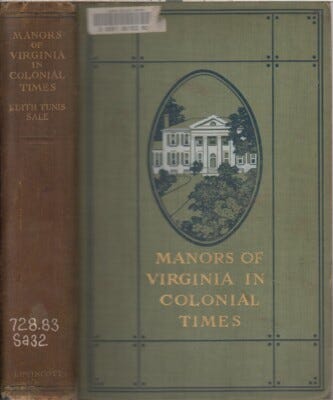
Manors of Virginia in Colonial Times is a delightful book, with one of the best covers I have ever seen. It's a superb architectural and social history of Virginia, focusing on the manor homes built throughout the state—particularly, but not exclusively, the Tidewater—during the colonial period.
Best is how Sale focuses heavily on two things, in addition to what might be expected in such a history: the heritage of the families involved and whether they managed to hold onto the house and estate attached to it or not. In fact, Sale almost always takes time to describe the (supposed) origins of each family, focusing in particular on its Norman roots (such as that of the Lees), if indeed it had any. Further, Sale always notes whether the family had managed to retain the house at the point this book was written (1909), and if so, if it had also held on to much of the estate. Very few did, though it was interesting reading about them. Most were less famous ones, who did a better job of getting back to the business of farming after the war.
So, while a few families did hold on not just to the manor house but the estate, none of them are famous. I think that will be fun to explore in the future, and will be a way of figuring out what made certain families survive as most failed. I also found the architectural variety of the houses discussed fascinating, as very few of them looked alike or even very conventional.
6. Old Virginia Houses Along the James by Emmie F Farrar
When I started Old Virginia Houses Along the James, I hoped that it would be an interesting book about some more Old Dominion plantation houses than the usual ones that are brought up in most histories of the colony or its great Golden Age period around the Revolution. These are houses like Stratford, Mount Vernon, Gunston Hall, and so on that most know the names of.
To some extent, it does that. It has a number of interesting pictures and descriptions of gorgeous old plantation houses that have been unfortunately forgotten. But there just aren’t that many of them, and so most are just farmhouses that aren’t particularly attractive or interesting, and the book tends to focus heavily on them rather than on their more monumental peers. That makes it less interesting than it could have been.
Additionally, it does very little of the sort of mixed architectural and cultural history that I enjoy, so that was disappointing. It is, instead, a near-purely architectural history about houses that generally aren’t particularly interesting or even all that notable. That makes it one to avoid.
7. William Byrd of Westover by Richmond Croom Beatty
If you are interested in the mid-colonial period in Virginia history, William Byrd of Westover by Beatty is a fantastic one that covers one of the most interesting men of Virginia’s aristocratic period: William Byrd II, the builder of Westover who thought of himself as, and was seen as, an “ornament” of Virginia. He was one of the richest, and probably the most cultured, of his class, while also being a notable political leader, explorer, writer, and land speculator.
Byrd’s life was particularly interesting in that he was always torn between being an English gentleman about town in London and a Virginian, and so torn between his life in the Metropol and as one of the great planters of the Old Dominion. As such, he eventually had to choose, and chose Virginia after much feuding with Gov. Spotswood, dissipation in London, and chaos in his life.
What makes Beatty’s book superb is how he shows this, and shows how Byrd developed as a man and Virginian over the years, before eventually coming into his own in middle age and becoming one of the great Virginians of his age. That took him making a conscious decision to leave his life in London behind and become a fully fledged member of his colony, and Beatty shows well how big of a decision that was and how it impacted his life, while also helping him shape the colony for the better. Further, it does all this while providing a useful glimpse into what life was like in Virginia in the early and mid-18th century, a period often ignored in favor of the early colonial days and Revolutionary period, but which is nevertheless a terrifically interesting one.
8. William Byrd of Westover, 1674-1744 by Pierre Marambaud
William Byrd of Westover, 1674-1744 by Marambaud is another really fantastic biography of William Byrd II of Westover. Particularly, it is one that does a superb job of providing a biography of the interesting man that integrates quite well with a study of his times. To do so, Marambaud shows how Byrd fit into the aristocratic age in Virginia as both a writer and leader, and what that meant for the history of the state.
Further, Marambaud shows not only how the reality of life in Byrd’s Virginia changed so much over the years, but how the myth of the Virginia Cavaliers that Byrd represents so well played out in reality, and how it was shaped by men like Byrd well after the fact.
Overall, it is a really enjoyable read that does an excellent job of concisely painting a picture of life in colonial Virginia for men of Byrd’s social station and showing how he in particular, ornament that he was, helped shape that life and lifestyle.
9. The Diary, and Life, of William Byrd II of Virginia, 1674-1744 by Kenneth A. Lockridge
Lockbridge’s The Diary, and Life, of William Byrd II of Virginia is a poorly titled and passably written book about one of the most influential men in Virginia colonial history: William Byrd II of Westover.
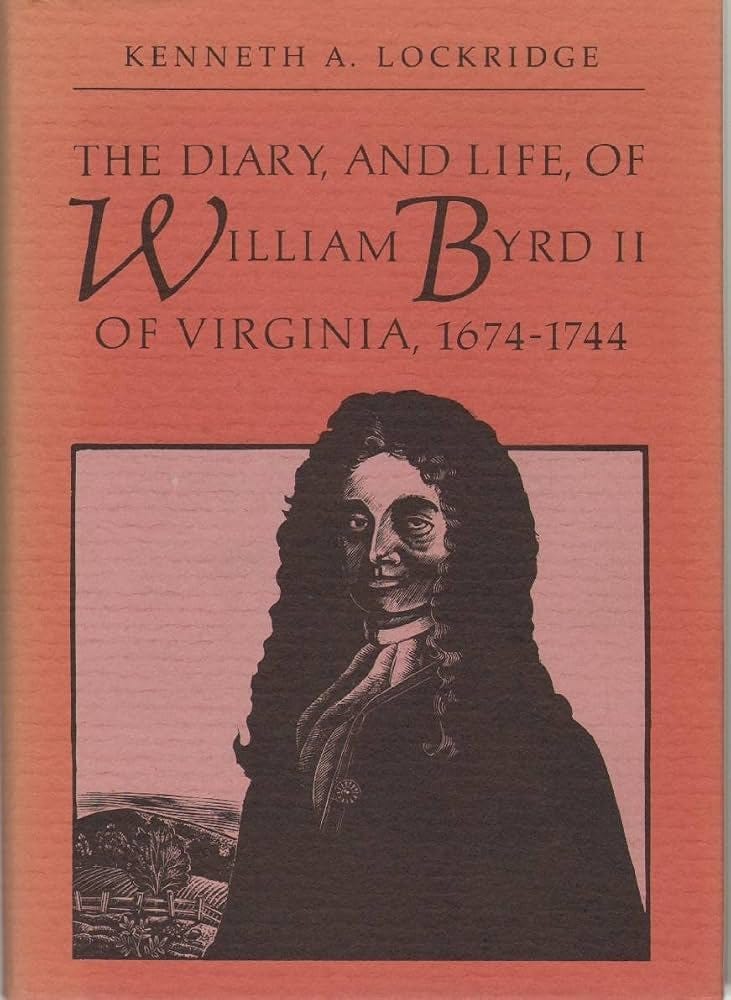
Of the three books about William Byrd II that I read to prepare for a future series on him and his family, this one is by far the weakest. And not just because it has one of the worst and most off-putting covers that I have ever seen, making Byrd look like a creepy clown.
Namely, it’s weak in that it is ostensibly about his numerous “secret” diaries—which would be an interesting subject, as he kept them at various points throughout his life and they reveal much about him—but ends up just being another short and generally superficial biography of him that includes very brief diary excerpts and some descriptions of what was happening in his life when the various diaries were written. It has its moments, to be sure, but it isn’t particularly good or worth reading. And the cover is very off-putting. Why they chose this horrific design is beyond me.
10. Explorer: The Life of Richard E. Byrd by Lisle A. Rose
As I prepare for my next series in the First Families of Virginia episodes I am doing for the Old World Show, I am researching the Byrd family. This series will be much shorter than the Lee series, as there are fewer Byrds who were particularly notable. In any case, the most famous of the Byrds is William Byrd II. His son, William Byrd III, is the most notorious, as he lost almost the entire estate in the run-up to the revolution, and then committed suicide while being hounded for being a suspected Tory and general rogue. The dynasty did persist, though it moved West, and in the 20th century, two Byrds were famous: Richard E. Byrd and Harry Byrd. Richard was an explorer, Harry an apple orchard baron and politician.
I keep hoping that I will find Richard interesting, but just haven’t been able to. His Arctic and Antarctic expeditions should be exciting to me, but as there was little there other than ice, I just don’t have the same emotional attachment to them as stories about Stanley and Livingstone in the Congo, or James Brooke in Sarawak; adventure and exploration is only really interesting to me when there is “man versus man” in addition to “man versus nature”. Risking one’s life on the ice, however brave, is decidedly less so.
That was my general impression of Explorer: The Life of Richard E. Byrd by Lisle A. Rose. It’s actually a very good biography about a man who did much that ought be remembered; he was the first to fly over the North and South Poles, he advanced Antarctic exploration tremendously, he advanced flight tremendously, and he did much else besides. The book covers him well, and provides about the right level of detail regarding his life and the general times in which he lived. That said, I just found it somewhat boring because I find his exploits less interesting. I am much more excited to research Harry Byrd this October, as I find him generally more interesting. Still, you might find it more interesting than I did. If you like this sort of thing, it’s a very good biography.
I hope you enjoyed those book reviews. They are always fun to write, and most of the books are fun to read. If you have made it this far, and are not yet a paid subscriber, I would really appreciate you upgrading your subscription. These books are quite expensive, and your subscriptions on here enable me to continue reading and reviewing works like these, all while producing new content that you find interesting. Thank you!
👏👏👏 An excellent September reading list and best of luck to you in Tennessee sir! It is a great state, one of the best in the union I think! I agree, that book cover for William Byrd II’s biography is horrific! This is a biography of a Virginia politician, not Stephen King’s It! As always here are some future book recommendations for Will:
• Mussolini: The Rise and Fall of Il Duce by Christopher Hibbert
• Mussolini's Italy: Life Under the Fascist Dictatorship, 1915-1945 by R.J.B. Bosworth
• Mussolini’s Eastern Crusade: The Italian Expeditionary Corps In Operation Barbarossa by Marek Sobski
• Apocalypse On The Steppe: The Struggle And The Bitter End Of The Italian Army In Russia, 1942-1943 by Marek Sobski
• To the End of the Earth: The US Army and the Downfall of Japan, 1945 by John C. McManus
• Cloudbuster Nine: The Untold Story of Ted Williams and the Baseball Team That Helped Win World War II by Anne R. Keene
• The Spy and the Traitor: The Greatest Espionage Story of the Cold War by Ben Macintyre
• The Man Who Would Be King: The First American in Afghanistan by Ben Macintyre
• Forgotten Fatherland: The True Story of Nietzsche's Sister and Her Lost Aryan Colony by Ben Macintyre
• Paris Reborn: Napoléon III, Baron Haussmann, and the Quest to Build a Modern City by Stephane Kirkland
• The Shadow Emperor: A Biography of Napoleon III by Alan Schom
• Napoleon and His Marshals: Victory, Rivalry, Betrayal by Andrew Roberts
• Napoleon: A Life by Andrew Roberts
• Hannibal: Rome's Greatest Enemy by Philip Freeman
• Scipio Africanus: Greater Than Napoleon by B.H. Liddell Hart
• Carthage Must Be Destroyed: The Rise and Fall of an Ancient Civilization by Richard Miles
• The Storm Before the Storm: The Beginning of the End of the Roman Republic by Mike Duncan
• Lawrence in Arabia: War, Deceit, Imperial Folly and the Making of the Modern Middle East by Scott Anderson
• The Winter Fortress: The Epic Mission to Sabotage Hitler's Atomic Bomb by Neal Bascomb
• We Die Alone: A WWII Epic Of Escape And Endurance by David Howarth
• The Shetland Bus: A WWII Epic Of Courage, Endurance, and Survival by David Howarth
• Sky Warriors: The Sunday Times Bestselling History of the British Airborne Forces in the Second World War by Saul David
• White Guilt: How Blacks and Whites Together Destroyed the Promise of the Civil Rights Era by Shelby Steele
• A Dream Deferred: The Second Betrayal of Black Freedom in America by Shelby Steele
• Maverick: A Biography of Thomas Sowell by Jason L. Riley
• Please Stop Helping Us: How Liberals Make It Harder for Blacks to Succeed by Jason L. Riley
• A Personal Odyssey by Thomas Sowell
• The Hispanic Republican: The Shaping of an American Political Identity, from Nixon to Trump by Geraldo Cadava