


I have, out of both personal interest and a desire for greater and better research for my Old World Show history episodes, been reading a great deal about colonization as of late.
One lesson that I think has special relevance for Americans, particularly those in “the bad things map” area of the country, stood out across those works: whatever the era, whatever the ideology of the politicians in charge, those domestic politicians never understand the situation and have a terrible tendency to side against vengeful settlers and with savage natives out of a deluded belief in their humanity. They think the myth of the noble savage real, and apply it to policy.


Naturally, the same tendency applies to police handling of “Crime committing Americans” today—pitbull Americans, if you will.
Those who live near tigers know why they should be shot. He who sees them at the zoo, or on TV, thinks of them as being cute, cuddly, and redeemable. Such a dichotomy played out across imperial history, as I’ll discuss here.
NOTE: Most of the footnotes are multi-paragraph stories from four books: The Rise and Fall of the British Empire by Lawrence James, The Savage Wars by Lawrence James, Savage Kingdom by Benjamin Woolley, and Rhodesia: A Complete History by Peter Baxter. All four books are “fine”—Savage Kingdom is the best of the bunch—but the stories I have selected them are really fantastic and show this well. I’ve included them as footnotes because the article would otherwise be overly long, but I really recommend you read them. I found them quite enlightening. You can listen to the audio version of this post here:
![[AUDIO] The Enemies of Civilization Live At Home](https://substackcdn.com/image/fetch/$s_!PbJo!,w_140,h_140,c_fill,f_webp,q_auto:good,fl_progressive:steep,g_auto/https%3A%2F%2Fsubstack-video.s3.amazonaws.com%2Fvideo_upload%2Fpost%2F198834502%2F7932be9a-f8e9-44e3-978f-b23a5abe87eb%2Ftranscoded-1779457752.png)
“Oh, How Cute”: The Last Phrase Your Civilization Hears, From Jamestown to Bulawayo
Rhodesia’s War of World Opinion
Some of the most glaring examples of this tendency for domestic governments to demand that settlers let the tiger in the gate because it looks cute and cuddly come from Bush War-era Rhodesia, during which every Western government sided with murderous terrorists rather than the settlers trying to fend them off.
As Peter Baxter notes1 in his Rhodesia: A Complete History, for example, the Catholic Church was more than willing to openly side with murderous, atheistic communist terrorists over the Rhodesian civilians and soldiers fighting for an openly Christian civilization. In fact, the Catholic Church was perfectly fine praising the terrorists who were documented raping and torturing nuns!2 It did so despite well-documented evidence3 that the “terrs” were murderous gangsters bent on rapine, claiming that the Rhodesians were simply engaging in the “pernicious heresy” of racism in fighting rather than bowing before such rebels. The other organized Christian churches were little better, with the Archbishop of Canterbury being notoriously anti-Rhodesian.
This was true throughout the war. When the ZAPU terrs shot down two civilian airliners and bayoneted the survivors to death, Nkomo laughed about the butchery during an interview on the BBC. He faced not a word of official condemnation in America, Britain, or anywhere else for that.4 But when Rhodesia responded to the horrific atrocity with Operation Vanity, a bombing campaign against terrorist training camps, it was of course condemned by the world.5 “You must let the tiger eat you if it wants. It is its nature to be hungry, you see…”
In case after case, governments across the Western world were more than willing to look the other way when black terrorists engaged in unspeakable barbarity against Rhodesian civilians, black and white alike. Whether it was cutting the lips and ears of blacks who worked with Rhodesian forces, raping white women to death, murdering entire families, cutting open pregnant women, or anything else…the world was perfectly fine with it, so long as ZAPU or ZANU were behind it. But when the Rhodesian security forces responded to such horrors with well-planned, well-executed military operations targeting exclusively military targets? Well, then the howls of protest rose!6 Such sneak attacks were against the rules of war, the Rhodesians were told! Nevermind that it was the terrs, not the Rhodies, attacking civilians. All Western governments cared about was the idea that the precious black communists must never be harmed.
And what was true of the war was doubly true of the political crisis. Rhodesia long and accurately argued that it was interested only in “Responsible Government”, which meant keeping the country out of the hands of those who would turn it to communism. Those, like the Duke of Montrose, who emigrated to Rhodesia quickly saw the wisdom of such a decision.7 It made perfect sense: giving the franchise to those who would obviously be intimidated into voting for communism would be a disaster that would destroy the country.8 But the politicians back home didn’t care. They wanted mass democracy, come what may. They were siding with the savages and sticking to that decision.
But while this attitude was particularly detestable and open during the Bush War, it was not a new phenomenon. No, it existed throughout the colonial and imperial era, and was just as much an issue when Rhodesia was being founded as when it was dying. In fact, it’s an attitude that went all the way back to Jamestown.
Jamestown
One might think that the British of the Stuart era were made of sterner stuff than their gelded descendants of the Harold Wilson era. Perhaps many were. John Smith certainly was; one doesn’t earn a coat of arms with three Turks’ heads on it via peaceful means.
But, regrettably, the London-based leadership was just as ridiculously pro-savage as Wilson’s regime three and a half centuries later, as shown by Jamestown’s experience in dealing with the savages they found.
This was the case from the beginning, as the book Savage Kingdom by Benjamin Woolley inadvertently shows.
For example, when the settlers landed in the Chesapeake, they were under strict orders to avoid antagonizing or fighting with the Indians because churchmen back home wanted to ensure that their souls could be saved. This meant, when it came to following the London Company’s instructions that flowed from such a hopeful policy, avoiding building fortifications, avoiding responding violently to attacks as much as possible, and otherwise being magnanimous in the face of Indian attacks, atrocities, and treachery.
Unlike the Rhodesians, the first Virginians mostly followed these strictures from churchmen and capitalists back home in London, safe and snug in their abbeys and The City of London as the settlers they had consigned to death tried to carve civilization out of the New World. In fact, upon the expedition’s landing at Jamestown, President Wingfield overruled Captain John Smith and initially refused to even let the settlers build a palisaded fort in which to live, or to prepare most of their weapons for active service. He thought that such decisions would antagonize the Indians. This immediately set up a near-disaster, as the Indians were not welcoming and used this absurd weakness of the settlers to attack them and almost wipe out the colony before it had even properly begun. Only a desperate, last-minute cannon shot from a ship that conveniently returned managed to save the fledgling colony from being completely overrun and the settlers massacred.9
While Wingfield then let Smith build his fort, the pro-savage policy otherwise generally remained in place. Smith was often reprimanded for engaging in his more “robust” form of Indian relations when attacked,10 and otherwise the English suffered humiliations, indignities, and repeated assaults because of the London-based directors and churchmen wanting to maximize the chance of saving savage souls and keeping relations peaceful. That relations with those whose land they were engrossing would never be peaceful, in the end, does not seem to have crossed their minds.
This remained true even when the Indians tortured captive Englishmen to death in some of the most painful and horrific ways imaginable.11 Peace was the policy foisted on the English by those back home, and they only broke it in times of utmost necessity.
It didn’t matter that the Indians were treacherous, and did things like torture Ratcliffe to death after luring him in with false claims of parlay and corn sales.12 No, the orders remained the same. The settlers eventually started breaking them out of a desire for vengeance,13 but the rules remained in effect.
Or at least they did until March of 1622. That is when the Indians, after years of peace in which they pretended to be friends of the settlers and affected a desire to learn of Christianity, took advantage of the opportunity to strike and so did so with a vengeance. In a single day, they wiped out somewhere between a quarter and a third of the colony. More died in the starvation and disease-ridden aftermath. Pretending to be friends, pretending to be interested in Christianity, they massacred men, women, and children alike.
Naturally, the Virginians were incensed. This attack set back the precarious prosperity and stability they had finally built after years of labor. It led to the murder of their friends. It was abominable, atrocious, and launched as a ruthless and ignominious sneak attack. So, they responded in like terms to savage aggression, and were damned for it by the pearl clutchers back home. As Woolley notes:
[A] group led by Captain William Tucker took twelve men up the Potomac to collect some English held by the Indians, 'and withal in colour to conclude a peace with the great King' Opechancanough. Terms were agreed, and concluded upon the banks of the river with speeches at which Tucker proposed a toast to peace. Several of the assembled Indians drank the toast, and were killed by a poison specially prepared by the colony's physician, a Dr John Potts. A battle ensued, during which the English claimed to shoot forty or fifty Indians, including, Tucker mistakenly believed, Opechancanough himself.
When news of this action reached England, there was disapproval of the underhand manner of the attack, and calls for Dr Potts to be disciplined for supplying the poison.
Those back home would discipline the settlers for responding aggressively to treachery! They’d let the colony be wiped out rather than see the settlers defend themselves in extremis! Such was to be a repeated attitude throughout colonial history: the savages are savage and expected to act like it, but to treat them like it is something that ought not be tolerated!
Fortunately for Virginia, the settlers did not let such criticism and chastisement rankle them. “In Virginia, however, such qualms were swept aside. ‘Whereas we are advised by you to observe rules of justice with these barbarous, perfidious enemies, we hold nothing unjust that may tend to their ruin,’ Governor Wyatt told the Virginia Company in London,” Woolley notes. In fact, this was the defining moment of their identity.
Henceforth, the frontier would be a place of near-constant race war as they steadily pushed the Indians back, treating them as the enemies they had shown themselves to be. No longer would the prattling on about teaching them the love of Jesus be tolerated. They had shown themselves to be irredeemable, perfidious, and dangerous, and so whatever London said, the Virginians would treat them as such.14 Eventually, Nathaniel Bacon crushed the Indian menace nearly entirely, and it did not resume until the French and Indian War.
But it must be noted: that victory came because of what the Virginians did. They learned they had to do it themselves, and so did so. Having grown up as a civilization near the tiger, they knew to treat it like one, rather than to try to pet it. As a result, they could build a new civilization. Had they listened to the whining liberals and churchmen in London, all that would be left would be a charred church and school for the savages.
Elsewhere
The same story was true elsewhere in the empire as the imperial experiment ground on over the ages.
Sarawak
Take, for example, Sir James Brooke. He was the perfect and quintessential Victorian hero. Rakish and handsome, a talented adventurer, uncommonly brave, and quite capable at rule, he had become rajah, as Professor Bruce Gilley notes, of the “chaotic province of Sarawak in 1841. Order and prosperity expanded to such an extent that even once a British protectorate was established in 1888, the Sultan preferred to leave it under Brooke family control until 1946.”
He did so by fighting countless wars against headhunters, local pirates, and even massive pirate fleets sailing from the Philippines. He had brought order and stability to what had been a blighted land, spending his fortune and expending his life force upon his little patch of mud and jungle, largely for the benefit of the natives, foregoing riches gained through corruption or exploitation of the natives as he did so.15 It was a humane, even liberal, program of rule he established.16
The response of Liberals in London? To criticize him for it. To berate him for killing too many pirates, much as the Virginians were earlier damned for defending themselves too successfully, or the Rhodesians later browbeaten for counter-attacking with too much skill. Detractors of Brooke in Parliament relentlessly attacked and browbeat him and his Royal Navy allies for their success in utterly crushing the pirate scourge.
In fact, after he and the Royal Navy defeated a massive pirate armada and waged a steady campaign against the pirates that finally broke their power after centuries of them terrorizing the waters and people around Sarawak, it was Brooke who was accused of acting like a pirate!
As Spencer St. John records in his The Life of James Brooke, one MP even claimed, "Sir James Brooke seized upon a territory as large as Yorkshire, and then drove out the natives, and subsequently sent for our fleet and men to massacre them." Then, when Sir James rebutted the charge, he was attacked for it! As St. John notes, “The insolence and ignorance here displayed are about equal, and yet Sir James is censured for resenting the accusation of having massacred the peaceful inhabitants of his own country.”
Brooke was even investigated by the Liberal British government for his victories. Though he was vindicated, in the end, it was an embittering experience that left him skeptical of the British government, and showed just how much those tender-hearted Liberal politicians who put the rights of savages ahead of the rights of the peaceable and law-abiding either didn’t understand the situation on the ground, or didn’t care about it. In their eyes, the white man and his allies were always in the wrong, and the costumed barbarian with a lace of trophy heads around his neck always in the right.
For those interested, I tell this part of the story of Sir James here, in this episode of The Old World Show:
The Rest of Empire
I don’t wish to belabor the point, but this was the case across the rest of empire as well.
In case after case, those on the ground—particularly Tory military men, whether the aristocratic officers or their rougher enlisted men—knew what needed to be done to keep the natives in check, and so did it. Never were they particularly upset about it. Generally, even when they faced the risk of great personal harm, they found such actions quite enlivening and sporting. But the Liberals back home—and the various members of that political coalition, namely Radicals, Unitarians, and like specimens of equality-minded brain rot—were furious about it.
There was Col. Frederick Burnaby, killed on active duty after horrifying the tender-hearted by “potting Dervishes” (shooting Muslim warriors of the sort who had killed Gen. Chinese Gordon and doing so easily, as if they were pheasants).17 Kitchener, similarly, was damned by the tender-hearted for “desecrating” the bones and tomb of the murderous Mahdi, despite his doing so having successfully stopped the tomb from becoming a religious shrine with which radical Islamists could further destabilize the Empire.18
Similarly, the British South Africa Company was repeatedly attacked by Liberals in Parliament for responding aggressively to a revolt launched by the Matabele—a Stone Age tribe known for treating cattle better than their captives, whom they turned into maltreated slaves.19 The settlers in Natal faced similar criticism for defeating the notoriously bloodthirsty Zulus.20
Nevermind that the Matabele rebels against whom the BSAC fought had, in the words of one trooper, “gone beyond their own etiquette of war, and have killed our women and children”.21 Nevermind that they had slaughtered civilians. The Liberals were upset that the reprisals were harsh!22 Meanwhile, those on the ground, much like the Virginians of an earlier date, knew what needed to be done, and so did it. As Lawrence James records in The Savage Wars:
A professional soldier who came across the bodies of murdered settlers felt this wild spirit: 'I left the laager that day holding staunchly the opinions of Mr Labouchere and his supporters, condemnatory of the slaughter of the blackman; but a quarter of an hour among such sights as these sufficed to convert me into a zealous advocate for their prompt extermination.’
That such opinions might be at least somewhat justified, given the risks at play and horrors seen, never seems to have crossed the minds of the Liberals. They, instead, remained upset that such reprisals had been engaged in regardless of whether they were justified or necessary.
Much as in Jamestown centuries earlier, never do the murdered settlers whose families were tortured to death by the rampaging savages seem to have crossed their minds. And so, as Peter Baxter notes, “from the evangelicals and Fabians could be heard a steady drumbeat of condemnation”. This infuriated the settlers. As Baxter tells it:
To those steeped in moderation and fair play, and secure under the rule of law, criticism of this nature might have appeared justified, but to those on the frontline, it was not. When in Rome we do as the Romans do, and conditions of African violence often invited the same in kind. When living beyond the pale, rules of conduct are necessarily less defined. The settlers believed that their sacrifices were for Queen and Empire, and for that, they were owed a debt of gratitude, not disapprobation.
And it was not just in Africa that this played out in the later imperial era. When the British conquered the Maori cannibals, for instance, the Tories—gentry-born officers and enlisted soldiery alike—realized such types couldn’t be helped, and wanted to crush them. Meanwhile, the usual collection of malcontents who “tended to be Nonconformists, middle-class, and Liberal or Radical in their politics” formed “a powerful body of Christian philanthropists who believed that these races could be raised to standards of education and conduct which would place them alongside Europeans.”23 Remember, that tender-heartedness was for the benefit of literal cannibals.
Much the same came when the military had to restore order in Jamaica in an incident remembered as the “Eyre” scandal. When the military shot down black rioters, domestic Liberals went utterly berserk, prompting exasperation from those tasked with maintaining order. As James records:
The significance of the Eyre scandal lay in the fact that it revealed a substantial body of intellectually respectable opinion which believed that large proportion of the empire's subjects were impervious to improvement and needed a firm hand to keep them in order. Humanitarians had misjudged the 'savage': he was a fickle creature whose capacity for moral and intellectual elevation was limited. For some, his role within the empire was that of a permanent underdog. Nevertheless, the fuss that had been made about Eyre acted as a brake on others of like mind. In 1879, General Sir Garnet Wolseley, commander-in-chief in South Africa, had reluctantly to abandon a plan to unleash the Swazis against the Zulus. He wrote:
’I have to think of the howling Societies at home who have sympathy with all black men whilst they care nothing for the miseries inflicted on their own kith and kin who have the misfortune to be located near these interesting n-ggers.’
Such sentiments echoed through the empire, and remained consistent over the centuries. A certain sort of liberal-minded types, particularly those who mixed religion with their liberal views, never could stomach what had to be done to maintain order and civilization in the colonies. And so they nearly always sided with the savages against the settlers out of the deluded belief that the noble savage was being maltreated. In reality, he was nearly always just being treated on his terms, in response to his barbaric behavior, and if anything those sent to establish or restore order were quite sparing in the use of much-justified force.
The End Of Empire
Gradually, that Liberal mind rot overtook more and more of the populace, and so by the post-World War II era, even the supposed “far-right” in Britain was incapable of understanding what had to be done, then doing it.
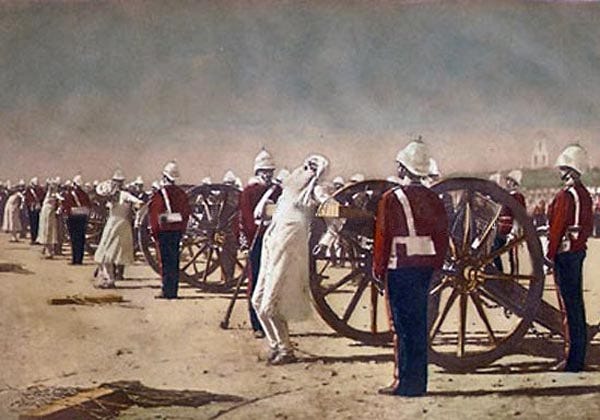
Worrisome signs of this had cropped up during the interwar period. For example, even those domestic conservatives desirous of holding onto the Raj were made queasy by tactics of the sort displayed at Amritsar,24 which were necessary for the holding onto of it. What a far cry from what they had been cheering on during the Sepoy Mutiny and its aftermath!
After the war, Labour and Conservative cheered as the Empire became the “Commonwealth”, which consisted of a motley collection of decolonized states run by thugs who were dependent on handouts from British taxpayers.25
Successive governments were unwilling to use force to crush disorder, much less dissent, and so the empire was riven into little pieces of land soaked by the blood of innocents as the worst tyrants and scoundrels imaginable took over, often with the aid of British authorities. The settlers were left to suffer or forced to flee as the government that had never been fully on their side as they attempted to treat the savages as they ought be treated finally abandoned them entirely to those savages.26
And so, as one soldier stationed in India put it, “as things are nowadays, these bloody wogs only have to open their mouths and dribble, and everyone in the world's on their side against us. No one wants to know the truth of it. They're just for the wogs and against us—and so are half our own people, come to that.”27
Indeed. Even Enoch Powell, today remembered as quite the rightist, responded to rumors of harsh tactics being used against the evil and bloodthirsty Mau Mau rebels by saying:
“We cannot say, ‘We will have African standards in Africa, Asian standards in Asia and perhaps British standards here at home.’ We must be consistent with ourselves everywhere. We cannot, we dare not, in Africa of all places, fall below our own highest standards in the acceptance of responsibility”.
Such is not the stern stuff of which civilization is built; it is the weakness that rots civilization.
This Still Matters
This remains relevant and matters a great deal, even beyond the obvious examples of America’s cities being crime-ridden hellholes.
Why were the members of the Weather Underground, Black Panthers, and Black Liberation Army never hanged? Because the liberal regime was on their side, and the conservatives were entirely unwilling to do what needed to be done to restore order.
And why was that the case? For much the same reason as why the British became unwilling to use force in India, Enoch Powell lost his stomach at the thought of restoring order in Kenya, and the Rhodesians were damned for bombing ZANU: “What the underground movement was truly about—what it was always about—was the plight of black Americans,” as Bryan Burrough puts it in Days of Rage.28 Such made them untouchable, for to use force against them would be to unjustly insist upon imposing order upon the noble savage. By the 1970s, such a thought had become unspeakable.
And so Eldridge Cleaver could write his book about raping white women as a fun form of racial revenge29 while Nkomo laughed about bayoneting pregnant women to death, and no one in the mainstream said a word about it. Well, some words were said. Andy Young and Jimmy Carter praised Nkomo, and Cleaver’s book was a much-praised NYT bestseller. The fate of their victims was conveniently forgotten.
The theory of the noble savage has been applied to everything, from rebels in Kenya to skyscraper bombers in New York, from terrorists in Rhodesia to cop-ambushing criminals in Oakland. It’s all the same thing to those who lack the stomach to put it down, and who in any case can ignore the issue because it’s not part of their lives.
From the clean and comfortable halls of Whitehall, to pronounce that the Mahdi’s Tomb should have been respected, that Sir James was wrong to slay pirates, that settlers at Jamestown ought fight the perfidious Indians fair and square, or that cannibals in New Zealand should be patted on the head and taught the bright light of Christ carries no cost. It is a mere phantasm, a creation of the mind that makes them feel cheery inside. The tiger is without their wall, and so they can consider the beautiful pattern of its coat without fear of its claws or fangs.
Not so with those who must deal with the issue. Why do cops in Ferguson and BSAC mounted rangers hold similar opinions about the nature of man? Why did the Tory officers and their men always understand the reality of the situation, but scolding schoolmarms and their henpecked husbands back in London always side with the enemy?
The lie of equality. The myth of the noble savage. The belief that those who have never risen beyond the Stone Age will willingly do so if exposed to the correct collection of trinkets, or that those who have been criminals for generations will be otherwise if only EBT is tweaked upwards by some certain percentage. The thought that the prattling sermon of some Puritan priest can convert cannibals who wish you dead never worked, yet it is no different from what most believe now—whether Enoch Powell’s ramblings about Kenya or the London Company demanding Jamestown not build walls because doing so might offend the savages.
We, after all, have our own contingent that is quite against walls…well, walls other than those that gate their neighborhoods.
Such lies and delusions can be believed when one lives far away from the tiger, as the proponents of these deluded ideas always do. Never ask a Civil Rights supporter why his second home is in Vermont rather than Memphis, after all.
But they cannot be believed when the problem draws near. As Virginia’s 1622 experience shows, such is the path to disaster. Such is why we must relentlessly press home the message that all men are not equal, most criminals are not redeemable, and the stern authority of the Maxim gun and he who wields it might be harsh, but is far preferable than the anarchy wrought by those on the other side of it, wherever we may be.
If you found value in this article, please consider liking it using the button below, and upgrading to become a paid subscriber. That subscriber revenue supports the project and aids my attempts to share these important stories, and what they mean for you.
Also, consider checking out my history channel, such as this video on Captain John Smith, the first great American adventurer, and one who understood how the Indians needed to be treated:
He provides:
With all this going on, white farmers, soldiers and the Government were not impressed when the Catholic Church raised its voice to comment on the rising incidence of Security Force violence against black civilians. Bishop of Umtali, Donal Lamont, aggravated an already chary white parish by describing the racism in Rhodesia as a 'pernicious heresy'. The Catholic Commission for Justice and Peace alleged torture, assaults and destruction of property, charges that were forcefully denied by the Government, as were calls for an independent inquiry because those injured by such action had full recourse to the law.
The Government also claimed, with some justification, that Catholic exposure of violence in the northeast was one-sided, and neglected to mention the regular and horrendous acts of political torture and terrorism that were daily perpetrated by the guerrilla factions against their own people.
Such is noted by Ron Morkel in his Rhodesia: From Beginning to End:
Britain, the United States, and the world press seemed to turn a blind eye to the atrocities committed by Mugabe and Nkomo's men. Murdering and raping women and children while their men were away was an effective tactic they used to great advantage. Even white missionaries and nuns were murdered and raped.
Baby Natasha Glenny, not even a year old, was savagely bayoneted to death by Mugabe terrorists on the Glenny farm in the Eastern Highlands. Wal and Joy Glenny were my brother Tony's foster parents. Natasha was Wal's granddaughter.
Contrary to popular perception, the whites were not at war with the majority of the black population...
As Don Shift notes in his Lessons from the Bush War
The Rhodesians, for all their flaws, generally adhered to these norms, especially within the Security Forces. Civilians who were uncooperative but not directly involved in combat were rarely subjected to torture or summary execution. While captured guerrillas might be interrogated harshly, Special Branch was known to use torture and kill recalcitrant captured terrorists by throwing them down mine shafts, noncombatants were typically spared such treatment. It was a line the Rhodesians, at least officially, tried not to cross.
The problem was, the enemy had no such line. The nationalist guerrillas relied on fear, and it worked. They terrorized villages into silence with mutilations, executions, and reprisals that left no room for neutrality. If a villager was suspected of aiding the government, they might lose their tongue, their family, or their life. As BSAP officer Ivan Smith admitted, "my own inclination was to beat information out of someone; that was not done but should have been. Terror can be fought with terror but was not done." Terrorists could stomach what the policemen and soldiers couldn't.
Again according to Baxter:
Nkomo laughed nervously, claiming that the Viscount was a valid military target since the aircrew and most of the male passengers on board were territorial reservists who were themselves guilty of murder. The British Government said nothing at all, and Nkomo walked away from that infamous interview without a breath of censure.
In the white Commonwealth, and in Britain itself, there was much sympathy expressed for Rhodesia by the general public, but this did not alter the fact that governments, global Christian organisations and charitable bodies were noticeably reserved in their criticism of ZAPU.
Noted in this article: https://grokipedia.com/page/operation_vanity
As Baxter notes:
The political fallout of the Nyadzonia Raid, however, was much more severe.
Condemnation was universal, and not surprisingly so because such grotesquely lopsided casualty figures made it impossible for the operation to be seen internationally as anything other than a genocidal attack. Be it refugees, women, children, guerrillas, trained or untrained, armed or otherwise, it hardly mattered. It was a propaganda coup for ZANU, and sympathy was ruthlessly milked worldwide.
Almost incidental to this was the massive cost in human life, as both sides bickered over who between them was the worst, the most inhuman and degraded in a war increasingly without rules, and probably no different from any other war.
White Rhodesians at that point could scarcely have given a damn what the outside world thought about its revised tactics. Europeans, with their self-loathing and bloated consciences, had no business expressing opinions on their kith and kin who were battling for survival on the dark side. International support for the liberation agenda of the black nations of Africa reeked of hypocrisy.
As Lawrence James notes in his Empires in the Sun:
While the administration of Nyasaland was crying wolf, the 7th Duke of Montrose was explaining to the House of Lords why the white population there and elsewhere in the Federation were so fearful.
He had settled as a farmer in Rhodesia after the war and he began his speech by declaring himself to be a Rhodesian. His experiences, he imagined, had given him a 'pretty good insight' into the black mind and he assured his listeners that Africans were loyal, trustworthy creatures at heart, but 'sitting ducks' for agitators. With the right amount of beer, the right amount of tom-tom beating, the right amount of witchcraft and intimidation, the right amount of inflammatory speech', these otherwise contented people could be 'whipped up to committing acts of violence'. After the bloodshed, they would return to their normal passivity.
In Empires in the Sun, James also notes:
In Britain, one-man-one-vote represented natural justice; for most Rhodesians it was anathema that would overturn their world, jeopardise their land and jobs and place their lives in the hands of Communist demagogues. The Congo crisis and the steady growth of the African National Congress added to white apprehensions.
As Woolley notes:
[Captain Newport] arrived back on 27 May, to find the settlement in chaos. It transpired that the day before, two hundred Indian warriors had mounted a sustained attack. Following his meeting with Newport, Opechancanough had evidently decided the English presence must be eliminated, before it became permanent.
At the time of the attack, the settlers had been planting corn in the newly cleared fields. Most of their weapons were still packed in 'dryfats', waterproof storage casks, so they only had a few pistols and swords to defend themselves. As the ranks of Indian warriors descended upon them, they had been forced to run for cover, to few finding shelter behind the island's single defensive bulwark. Led by President Wingfield, all five council members apparently put up a fight with hand weapons, but were forced to retreat. In the ensuing skirmish, which 'endured hot about an hour', one boy was slain and as many as seventeen labourers wounded. Every single member of the council sustained injuries, except Wingfield, who had a miraculous escape from an arrow which passed through his beard. According to later reports, the entire company would have been slain, had not the sailors loaded one of the ships' cannons with a 'crossbar' (round shot with a spike embedded in it), and fired it towards the Indian position.
The projectile had hit a tree, bringing down one of its branches, which apparently fell among the attacking Indians and 'caused them to retire'. 'Hereupon the president was contented the fort should be palisaded,' Smith noted dryly
An entertaining passage on Smith’s form of diplomacy:
Smith thought it was Okeus, the most powerful god of the Powhatan pantheon, who another English observer noted could look 'into all men's actions and, examining the same according to the severe scale of justice, punisheth them with sicknesses, beats them, and strikes their ripe corn with blastings, storms, and thunderclaps, stirs up war, and makes their women false unto them'. If it was Okeus, his appearance in such a manner, before the Otasantasuwak, the wearer of leg coverings, was unprecedented. This god, the English were later told, had prophesied their coming to Virginia, and his appearance now must have been designed to stage a momentous confrontation: to frighten the invaders off, perhaps, or possibly the opposite: to lure them in, integrate them into the Powhatan world, to see what havoc they would wreak.
Smith at this moment had little interest in spiritual speculations, and ordered his men to attack the oncoming parade 'with their muskets loaden with pistol shot' until 'down fell their god, and divers lay sprawling on the ground'. Smith snatched the idol, and the Indians disappeared into the woods. Presently, a priest approached offering peace for the return of the okee. Smith told them if six of them came unarmed and loaded his boat, he would 'not only be their friend, but restore them their okee, and give them beads, copper'. This the Kecoughtans did, according to Smith, loading his boat with venison, turkeys, wildfowl and corn, while 'singing and dancing in sign of friendship'.
Smith set off back for Jamestown, congratulating himself that his more robust approach to Indian relations was already paying dividends. En route, he stopped off at Warraskoyack, a few miles upstream of Kecoughtan, on the opposite bank of the river. There he managed to extract some more corn, a total, he claimed, of thirty bushels, getting on for a ton.
For example (not for those with stomachs that get upset easily):
Casson had little more to add, other than pathetic appeals for clemency, and the name of the captain: John Smith. This information extracted, he was stripped of his clothes until he stood naked before the gathering assembly of men, women and children, his front frozen by the winter chill, his back heated by the crackling fire. Two wooden stakes were driven into the ground either side of him, to which his ankles and wrists were bound.
Opechancanough continued to interrogate the terrified captive about this captain’s intentions. A warrior or priest then approached, brandishing mussel shells and reeds. Using the edges of the shells as blades, and the reeds as cheese-wires, the executioner systematically set about cutting through the flesh and sinews of Casson’s joints, stretched out between the staves. As each of his limbs was removed, it was cast upon the fire, until only his head and trunk were left, writhing helplessly on the blood-soaked ground.
Turning the torso over, so Casson faced the ground, the executioner carefully cut a slit around the neck, then slipped a mussel shell beneath the skin. He proceeded to ease off the scalp, and, turning the body back over again, gently unpeeled Casson’s face from the skull. He then slit open Casson’s abdomen, and pulled out his stomach and bowels, which steamed in the cold winter air. Casson’s remains then joined the rest of his body to burn on the fire, until only his dried bones were left, which, according to White, were gathered and deposited in a ‘by-room’ in one of the tents.
Again, not for those who are easily upset:
As the barge approached Powhatan's royal enclosure, Ratcliffe was greeted by servants offering gifts of venison and bread from the mamanatowick, and the captain sent copper and beads in thanks. Ratcliffe and his crew were then escorted inland through a large cornfield to a house near Powhatan's enclosure, where they were told they could stay for the duration of the visit. Powhatan's children, meanwhile, returned to their father.
That evening, Powhatan came in person to greet the visitors, bringing with him Spelman and Thomas Savage, together with a Dutch boy named Samwell, who had been left with the Indians since Smith's debacle with the Dutch sent to work at Werowocomoco. Powhatan greeted his guests, and returned to his own quarters.
The following morning, the emperor came with Spelman and 'a company of savages', including several women, to escort Ratcliffe and his party to a nearby storehouse. There the Englishmen were shown a collection of huge baskets brimming with corn, which through Spelman Powhatan announced he was willing to trade. A price was agreed, and the captain handed over 'pieces of copper and beads and other things according to the proportion of the baskets of corn which they [had] bought'.
Powhatan took his leave, the women and Spelman following. The English soldiers, relishing the resumption of decent rations, began to carry the corn the half-mile or so to the barge. However, they quickly discovered from the weight of the baskets that they had false bottoms, and were almost empty.
The English began to complain loudly of being cheated, 'whereat a great number of Indians, that lay lurking in the woods and corn about' began shouting 'with an oulis and whoopubb', as Spelman described it. The English made a run for the barge, carrying what corn they could. But within sight of their boat, they were ambushed by Indian warriors lying in a neighbouring cornfield. Just two of the English soldiers managed to escape the ensuing onslaught by running off into the woods.
Captain Ratcliffe was seized and brought before Powhatan at his enclosure. There was no sign of Spelman, Savage or Samwell, who, 'fearing the worst', had fled. According to Smith, Spelman had been tipped off by Pocahontas that he would be in peril if he stayed. One of the English soldiers who had managed to escape the Indians' attack was hiding in the nearby undergrowth, and it was he who later reported to Percy what happened to Ratcliffe.
A fire was kindled at the foot of a tree. Ratcliffe was stripped of his clothes, and tied to the tree. Several women then approached the naked captain. They began to flay his skin with the sharp edges of mussel shells, gently teasing it away from the flesh. They then sliced through the muscle and sinews to remove the limbs and organs from his body, which were 'before his face thrown into the fire; and so for want of circumspection [he] miserably perished'.
For example:
The earl was 'joyful of our safe return'. But, according to Davies, he felt discontent because the queen was spared'. It was suggested that, being a pagan, she should be burned like a witch. Percy replied that 'having seen so much bloodshed that day, now in my cold blood I desired to see no more'. He turned his back upon Davies, who with two soldiers took her ashore, and killed her with their swords. Percy recorded the details of these horrific events in an account written two years later for his brother, the Earl of Northumberland.
They are in a manuscript intended to vindicate his period as the settlement's president, in response to John Smith's very public and trenchant criticisms of Percy's role as governor. He makes no effort to disguise the savagery that took place that night under his command, even though he knew the treatment of the captive Indian queen and her children to be a violation of the 'law of arms' - a war crime, in more modern terms. Rather, he indicates how, in the aftermath of the Starving Time, relations with the Indians passed a threshold.
A struggle for territory had become a clash of civilizations, a presumption of cohabitation had become a need for domination. Nothing more was said of the incident, which was quickly submerged by more pressing concerns.
For example, Woolley notes:
There followed a series of coordinated assaults aimed at clearing the Indians off the land surrounding that 'goodliest river' the James. The campaign began in the autumn, following the Indians' harvest, with Bennett, under Tucker's command, attacking Warraskoyack, the territory surrounding Bennett's Welcome. He took the Indians' corn and destroyed their houses. By the following spring, he had re-established the plantation, and settled thirty-three men there.
For example, Nigel Barley notes in White Rajah:
‘I will become no party to a bubble, James raged. He would sell off his antimony monopoly, or the right to trade in opium, but no more. For him speculators divided into two groups - ‘the doers and the done’. ‘Slow, cautious, gradual’ were his watchwords, and above all it was the interests of locals that must be paramount. Never for a moment did he doubt his ability to know what those interests were, and there was always the suspicion that another’s profit was a theft from them. He would never have permitted the ruthless asset-stripping of Sarawak’s natural resources that followed on from independence.
As Nigel Barley notes in White Rajah:
Unfortunately, despite his own liberal and humanitarian programme, James’s military conquests naturally attracted the support of just the sort of reactionary Queen-and-country Conservatives he abhorred - which, in turn, further inflamed the Liberals
As noted by Lawrence James in The Rise and Fall of the British Empire:
Among the dead was Colonel Frederick Burnaby of the Blues, whose famous portrait by Tissot represents him as the embodiment of the elegant and devil-may-care insouciance which was the distinguishing mark of a perfect British officer. He would doubtless have approved of colleagues who remarked after the battle that it would have been awful to have been killed without knowing the results of the Derby. Burnaby had taken part in the fighting near Suakin a year before, when newspaper reports of his ‘potting’ Dervishes as if they had been partridges shocked left-wing Liberals and humanitarians. That Burnaby was also a Tory candidate for parliament probably added to their indignation
As Lawrence James notes in The Savage Wars:
in 1898 Kitchener had the captured Mahmud dragged in chains through the streets of Berber, and after Omdurman had the Mahdi’s bones exhumed. For a short time he considered having the skull sent to a museum in London, no doubt as quid pro quo for the Mahdi’s use of Gordon’s skull as an inkpot, but then, in the face of criticism at home, he had it thrown in the Nile. His justification was to prevent the bones becoming religious relics
As Baxter notes:
Contemporary observations give us a reasonably clear idea of how the subjugation of the maShona went. The amaNdebele economy was uncomplicated and based on the husbandry of cattle and any neighbours less warlike than themselves. The striking difference between these two systems of stock management was that cattle were nurtured and humanely treated, while human chattel was used and butchered in the most cynical and inhumane manner imaginable.
As noted in Empires in the Sun by Lawrence James
During a Commons debate on the First Matabele War, a radical Liberal MP, William Byles, contrasted the outlook of the missionaries in Bechuanaland with that of the British South Africa Company. The former 'taught the people the use of the plough and other implements of civilisation' while the latter quarrelled with the natives and used 'the Maxim gun to destroy them'. This remark goaded one Tory, who praised Rhodes's troops as 'gallant Englishmen' who were defending the 'interests of their country'. During a 1906 debate on the horrors of the Congo, another Liberal MP reminded Members of his own country's blemished record. He called the recent massacres of Zulu rebels by the settler militia in Natal a sequence of 'inglorious slaughters - too much like rook shooting to be glorious'.
As Lawrence James notes in The Savage Wars:
The same purblind, harsh anger infected the troops who fought against the Mashona and Matabele in 1896. The native rebels had 'gone beyond their own etiquette of war, and have killed our women and children', and this, in turn, had generated a spirit of revenge which had not been felt by British troops since the suppression of the Indian Mutiny nearly forty years before. What F. C. Selous identified as 'the latent ferocity of the civilised race' ran riot on and off the battlefield.
As noted by Lawrence James in The Rise and Fall of the British Empire:
Details of this nature shocked Liberals and Radicals at home, and there were some sharp exchanges in the Commons between Chamberlain and the company's critics. Henry Labouchere questioned him on Rhodes's stated intention of 'thoroughly thrashing the natives and giving them an everlasting lesson', executions without trial and village-burning. The last, Chamberlain insisted, was 'according to the usages of South African warfare', which must have puzzled those who believed that the advance of Anglo-Saxon civilisation in Africa would bring an end to such practices.
The full quote from Lawrence James in The Rise and Fall of the British Empire:
There were, however, profound differences of opinion as to whether the Maoris and other races possessed a ‘better nature’, and how it could be cultivated. On one side there were the pragmatists, who were for the most part soldiers, sailors and administrators (often former servicemen), colonists and their adherents in Britain who were sceptical about the capacity of native peoples for advancement. On the other hand there was a powerful body of Christian philanthropists who believed that these races could be raised to standards of education and conduct which would place them alongside Europeans. Members of this group tended to be Nonconformists, middle-class, and Liberal or Radical in their politics. Their opponents were largely Anglicans with aristocratic or gentry backgrounds and Whig or Tory sympathies, although this was a period when party labels mattered far less than they did later.
The full quote from Lawrence James in The Rise and Fall of the British Empire:
After 1950, the virtues and value of the Commonwealth became part of that centrist British political consensus which accepted unquestioningly the virtues of the mixed economy and the welfare state. Senior Labour and Conservative politicians were committed to perpetuation of the Commonwealth, and publicly proclaimed it as a manifestation of Britain's residual influence in the world. It was, according to one defender, 'a logical outcome of our own development', the heir-general, as it were, of the empire and, in moral terms, infinitely preferable. The conventional, bipartisan wisdom was expressed by Queen Elizabeth II during her visit to one of its newest members, Ghana, in November 1961. She defined the body of which she was head as: 'A group of equals, a family of likeminded peoples whatever their differences of religion, political systems, circumstances and races, all eager to work together for the peace, freedom and prosperity of mankind.' What was needed for the Commonwealth to flourish was an act of 'faith' by all its members. This must have been an extremely difficult speech to deliver, and harder still to believe in, for her host, Dr Nkrumah, was currently arresting and locking up opposition politicians.
As noted by Lawrence James in The Rise and Fall of the British Empire:
For white settlers in Britain's African colonies, Macmillan and Macleod were a pair of Judases whose words and actions added up to a form of treason. 'We've been thoroughly betrayed by a lousy British government, complained one Kenyan farmer in 1962. 'We'll throw in our allegiance with somebody who's not always prepared to pull the bloody flag down.' He had first come to the country in 1938, secured a 999-year lease on his crown land farm, and had been officially encouraged to see himself as partsquire part-schoolmaster when dealing with the blacks: 'I'm not a missionary, I hate the sight of the bastards. But I came here to farm, and look after these fellows. They look up to you as their mother and father; they come to you with their trials and tribulations. Now, Kenya's future prime minister and president, Kenyatta, was saying that any white Kenyan who still wanted 'to be called "Bwana" should pack up and go'. This form of address, and the deference it implied, mattered greatly to some; Kenya's white population fell from 60,000 in 1959 to 41,000 in 1965...
The full quote from Lawrence James in The Rise and Fall of the British Empire:
Officials and soldiers whose job it was to keep order were also aware of an illdefined but strong public hostility to the application of the iron fist. It was described by an NCO in Simon Raven's Sound the Retreat (1974) which was set in India in 1946:
'Doesn't matter,' said Cruxtable with sombre relish; 'as things are nowadays, these bloody wogs only have to open their mouths and dribble, and everyone in the world's on their side against us. No one wants to know the truth of it. They're just for the wogs and against us against us - and so are half our own people, come to that.'
Variously expressed, the same complaint was heard many times during the final years of the empire.
Rather than ruthlessly crush dissent, the British government chose to embrace and, so to speak, smother it. By accelerating the Gold Coast's passage to self-government, Britain imagined it had rescued the colony from possible Communist subversion and won the goodwill and gratitude of local political leaders. The conditions of the Cold War had wiped out the chances of a leisurely, measured progress from colonial tutelage to responsible government. Henceforward, British policy would concentrate on the cultivation of the most influential native politicians, who could be trusted to take over the reins of government in the empire's successor states. It was an answer to the problems of decolonisation which dismayed many, who foretold that it would create as many problems as it solved.
The full quote:
What the underground movement was truly about-what it was always about-was the plight of black Americans. Every single underground group of the 1970s, with the notable exception of the Puerto Rican FALN, was concerned first and foremost with the struggle of blacks against police brutality, racism, and government repression. While late in the decade several groups expanded their worldview to protest events in South Africa and Central America, the black cause remained the core motivation of almost every significant radical who engaged in violent activities during the 1970s. "Help-ing out the blacks, fighting alongside them, that was the whole kit and caboodle," says Machtinger. "That was all we were about."


Too many Christians believe that the Old Testament is not relevant to them. And as a result, too many of them forget that God (the Father and the Son and the Holy Spirit) is the same throughout the whole Bible. In the New Testament, Revelation more than any other book makes that especially clear, which is another book that most Christians avoid.
*Note I'm talking about actual Christians, not those who claim to be while supporting homosexuality, abortion, never-ending appeasement. Not to mention denying the Trinity. For those, Revelation is very clear what will happen to them.
My grandmother in New Zealand was quarter Maori and she had a huge chip on her shoulder and was always creating disorder and being violent in public. The whole Maori side of my family were freaks, criminals and thugs. Most my life I didn't realise the underlying cause of this primitive behaviour until I became a race realist.