


So, an update from Tuesday’s article: all worked out, and we got the house! And today we are moving in. So that has been exciting.

In all the excitement, I’ve had less time to write than I hoped. So, given how much people liked the recent story about General Taylor’s response to the German 48er general, I figured you might enjoy this short story about Ian Fleming and notorious Brutalist architect Erno Goldfinger.
Listen to this article here:
![[AUDIO] That Time James Bond Defeated Brutalist Architecture](https://substackcdn.com/image/fetch/$s_!Arpf!,w_140,h_140,c_fill,f_webp,q_auto:good,fl_progressive:steep,g_auto/https%3A%2F%2Fsubstack-video.s3.amazonaws.com%2Fvideo_upload%2Fpost%2F218495390%2F9bbfce72-a18c-4dbe-b9ec-94a0981e2f2b%2Ftranscoded-1790945696.png)
The Architect So Terrible He Became a Bond Villain
The story is, I suppose, a relatively simple one: a clash of old and new, great and dismal, beautiful and ugly. The post-World War II years were about as calamitous for London, and indeed for Britain generally, as could be imagined. The city had been brutalized by bombs, cruise missiles, and rockets. The Exchequer was empty. The empire was not yet lost, but the Raj was not long for this world, and the remainder was increasingly untenable. The population was discontented on many levels: it was poor, hungry, tired of rationing, tired of war, and generally socialistic.
These were the years in the Wilderness for Britain. It was adrift, without much purpose or much energy. It lacked that great swaggering confidence that had so defined the imperial era, and such was self-evident in everything about life within it. The country houses were being torn down, not built up. Capital was fleeing the country, not entering it. The colonists across the far-flung empire were departing what their ancestors had built or digging in to fight it out, not exploring and building the world anew any longer.
Into this dire and toxic stew of socialistic opinions and tax policies to match was a man who defined the age, in all its drab grimness: Erno Goldfinger.
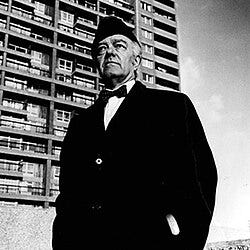
Born in Hungary, Goldfinger was an architect. Or, at least, what passed for an architect in the years after civilization fell to pieces. You see, he was a “modernist”. A Brutalist, actually. And he despised anything that normal, functional, mentally healthy people would recognize as beauty. What he preferred was the work of notorious modernist architect Le Corbusier, author of Vers une architecture. Indeed, Goldfinger was entranced by the ideas of Le Corbusier’s former mentor, Auguste Perret.
Perret was not an architect in the way that Sir Edwin Lutyens or Sir John Vanbrugh were architects. He had no sense of beauty, nor of dignity and refinement in those horrid structures he raised. Rather, he was an expert in designing reinforced concrete structures.
Goldfinger took Perret’s ideas and ran with them. Instead of building pleasant structures that are pleasing to the eye, flowing with natural beauty and grace, he would design such structures as could only be made with modern materials, namely reinforced concrete. Testing this out in the 1930s, he built 1–3 Willow Road in Hampstead, North London. His own home was 2 Willow Road. Some other poor and gullible souls bought the “houses” on either side of him.
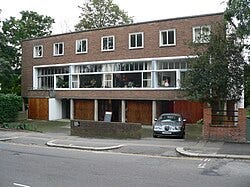
He gradually became famous, such as when, in the immediate postwar period, he was hired to build new offices for the Daily Worker newspaper and the headquarters of the British Communist Party. These were predictably wretched-looking, defining the souls of the architect who designed them and the communists within them quite well.
They also became representative of the horrible drift towards ugliness, socialism, and cost-cutting egalitarianism that was to define Britain in the post-war era. Brutalism, his preferred style, is “efficient” in that it is cheaper to build than pretty architecture (it weathers poorly and quickly falls to pieces, which is why it ends up costing much more in the long run). This was perfect for a London that needed to rebuild from the war, or so the authorities thought.
And so Goldfinger became prominent as a Brutalist architect who could design the so-called “tower blocks” that were to fill rebuilt London with housing. These were to be all structures built of reinforced concrete, without ornament other than off-putting architectural design elements. Like all Brutalist buildings, they disconcert rather than inspire.
Amongst his more famous designs was that of Balfron Tower, a 27-story-tall structure that appears like what one would imagine a vertical gulag might look like. It’s a horrid monstrosity, an eyesore and rotten presence.
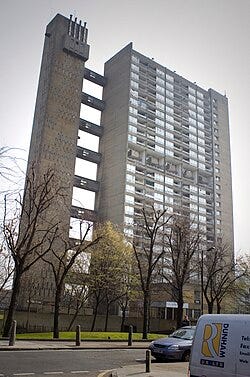
In that, it defined the new London that was emerging in the post-war era. Gone were all the splendid things that had characterized life in the before times. Gone was the Season, and its balls, arranged throughout the city palaces of great lords and with debutante appearances before the king. In was Balfron Tower, and the taxes levied to support its construction for the supposed benefit of the public. And Erno Goldfinger was the man who represented all of it.
Into this scene stepped Ian Fleming, of James Bond fame. He was an intelligence officer during the Second World War, and worked in the Admiralty. He worked with all the intelligence groups made famous by the war, formed and led a unit of commandos, and otherwise got up to the sort of escapades that were to so titillate his imagination as to eventually produce Bond, James Bond.
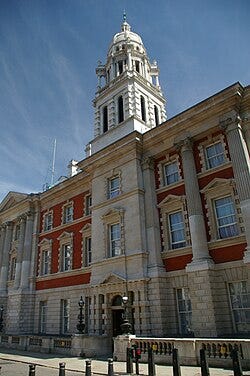
He also lived in London, and was very much a gentleman of the old school: old money, old blood, old taste. And as he moved on from Casino Royale to, eventually, Goldfinger, he needed a new villain for the Bond universe. He landed on the man whom he thought to be destroying London with wretched, ugly buildings: Erno Goldfinger.
According to legend, he settled on the “Auric Goldfinger” name after a discussion on the golf course with Erno’s cousin. What appears to have led to that final choice is that Erno’s architectural career blighted Fleming’s world, and he turned to Bond to correct it.
What had happened was that Erno didn’t just build 2 Willow Road in Hampstead on an empty plot of land. London is full, after all, and that wasn’t realistic. Instead, he bought and destroyed a slew of pretty Victorian-style cottages and homes to build his modernist monstrosity, and Fleming hated it. In that decision, and the destruction to which it led, he saw all that was wrong with Britain: a drift from tradition and taste to the dismal blight of communism and those like Erno who effectively promoted it through that which they created.
So, when he saw the old cottages torn down to make way for the monstrosity, he was enraged. The style was off-putting and ugly. The disruption of the pace of life in the neighborhood, a general area in which he lived, was dastardly. The visual blight was unforgivable.
This led him to name the villain Goldfinger: Bond could vicariously fight that which Fleming—always a reactionary in his political and cultural views—hated, but couldn’t stop.
Predictably, the real Goldfinger was a litigious fellow, and freaked out. He retained counsel and prepared for legal war, threatening to sue Fleming for defamation over the matter.
Fleming was apparently nonplussed, as he didn’t back down to the Brutalist architect. Instead, he doubled down and threatened to rename the character “Goldprick”. Humiliated and chastened by the even worse press that would naturally result, Goldfinger backed off in exchange for a few free copies of the book and Fleming’s publisher paying his legal bills. The villain’s name remained, and now “Goldfinger” is a name synonymous not with architecture, but with evil so obvious as to be cartoonish. Fleming got his revenge for 2 Willow Road and the destruction of old London’s visual beauty, even if he couldn’t recreate that which had been lost.
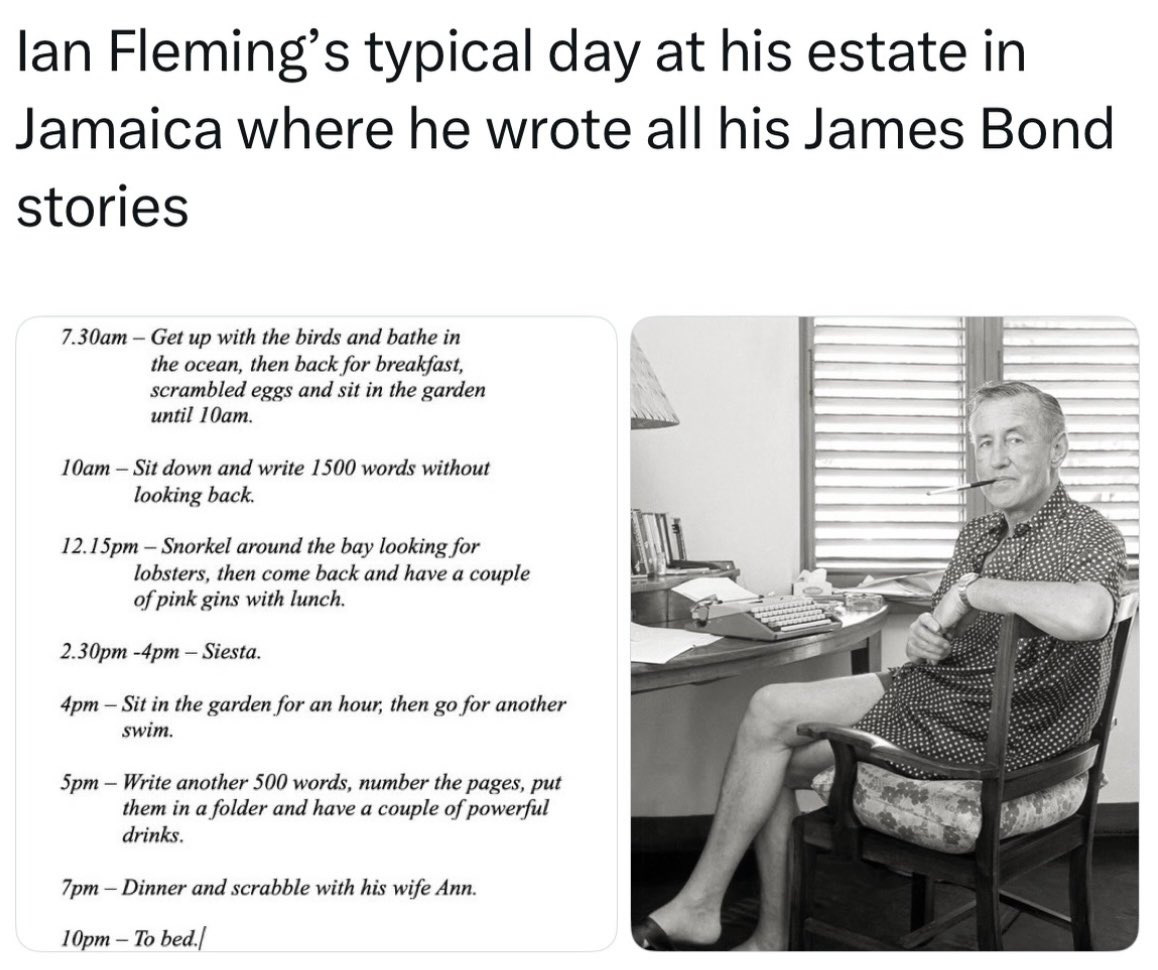
Meanwhile, he decamped for the former colonies and lived in his famous Goldeneye villa in Jamaica. Here’s what his schedule was like as he did so…one of obvious unconcern with whatever Erno thought of the books, and a life devoid of having to look at that which Erno and those like him created.
Featured image background credit: N19±, CC BY-SA 3.0 <https://creativecommons.org/licenses/by-sa/3.0>, via Wikimedia Commons