


Listen to the audio version here:
![[AUDIO] Competing in Excellence, Not Unifying in Mediocrity](https://substackcdn.com/image/fetch/$s_!e_Qs!,w_140,h_140,c_fill,f_webp,q_auto:good,fl_progressive:steep,g_auto/https%3A%2F%2Fsubstack-video.s3.amazonaws.com%2Fvideo_upload%2Fpost%2F201756517%2F4916b2b9-01ad-42e8-89d0-0983c55ff94c%2Ftranscoded-1781277009.png)
There is much talk these days of the need for various former enemies and constant competitor groups to “unite” in a more or less permanent state against some larger threat. This comes from both left and right.
Europe must “unite” against…well, something or other. Not the migrants, that’d be racist. Russia, perhaps. The bogeyman looms, and requires Europeans to set aside their differences in favor of letting a technocratic elite fight Russia by covering farmland with solar panels in cloudy Britain. Such is how the EU and its few dozen operational tanks will triumph over the Slavic menace (but don’t put it in such terms!)
In America, we’re told that all states, races, and (non-oligarch) classes must “unite” against…Jeff Bezos and Elon Musk building rockets, or something, and of course those pesky data centers! The real threat isn’t the migrant trying to saw your head off, you see, nor Karmelo Anthony’s supporters wanting to murder you for the crime of being white, nor the Cultural Revolution coming for the statues of our heroes and the spirit meant to be inculcated by them. It’s that Elon Musk wants to go to Mars! That’s the real threat to “freedom”, which often seems defined near-purely as “the right to be a homosexual and/or on welfare”. By that definition we remain united as the land of the free, I suppose.
More realistically, the left says all the (non-white) races of the world must unite against whites, for outlawing sati, ending cannibalism in Sub-Saharan Africa, and ending human sacrifice in the New World is now deemed to have been the greatest of all injustices. So the various “non-aligned” nations of the world align against the few places that can build a rocket, or produce clean drinking water…while demanding more foreign aid from them, of course. Often, that international Danegeld is paid without a second thought to the Union of Dysfunctional Diverse (Fledgling) Republics.
This somehow becomes even more absurd when pushed by the right.
For example, there’s the idea that all nationalist groups must unite in a supra-nationalist campaign against the globalists, which would replace the EU with a…uhh, well, the EU. But with nationalists cooperating in a globalist body. Such was what Oswald Mosley advocated by the end of his life, as do many current rightists who are interested in Europe and decry “micronationalism” as something that keeps Europe weak…ignoring that Europe was strong when the states that composed it competed amongst one another.
Sorry, guys. I just don’t think that globalism, but with nationalist characteristics, will work.
Such seems like just as much a recipe for scleroticism at the leftist version.
That is, after all, what Europe’s recent history has shown. Compared to the Belle Epoque, has anything good come out of the European Union? No. Of any of the integration that preceded it? No.
Yes, being able to travel freely is pleasant enough, as is having a currency one can use across countries. But that was true in the pre-Great War time as well. Here is how AJP Taylor describes such a world in the famous opening to his English History, 1914-1945:
Until August 1914 a sensible, law-abiding Englishman could pass through life and hardly notice the existence of the state, beyond the post office and the policeman. He could live where he liked and as he liked. He had no official number or identity card. He could travel abroad or leave his country for ever without a passport or any sort of official permission. He could exchange his money for any other currency without restriction or limit. He could buy goods from any country in the world on the same terms as he bought goods at home.
Similarly, Keynes, in his The Economic Consequences of the Peace, notes:
The inhabitant of London could order by telephone, sipping his morning tea in bed, the various products of the whole earth, in such quantity as he might see fit, and reasonably expect their early delivery upon his doorstep; he could at the same moment and by the same means adventure his wealth in the natural resources and new enterprises of any quarter of the world, and share without exertion or even trouble in their prospective fruits and advantages...
He could secure forthwith, if he wished it, cheap and comfortable means of transit to any country or climate without passport or other formality, could despatch his servant to the neighbouring office of a bank for such supply of the precious metals [sovereigns] as might seem convenient, and could then proceed abroad to foreign quarters, without knowledge of their religion, language, or customs, bearing coined wealth upon his person, and would consider himself greatly aggrieved and much surprised at the least interference.
But, most important of all, he regarded this state of affairs as normal, certain, and permanent, except in the direction of further improvement, and any deviation from it as aberrant, scandalous, and avoidable.
Whether in Berlin or Buenos Aires, Paris or the Panhandle, a man could do all is now regarded as remarkable in the European Union. Indeed, he could do more. For, as Taylor notes, he was free. Free from oppression and from anarchy, in fact. The state maintained order, collected enough taxes to keep the debt paid and the border or empire defended, and that was that. The idea that a man would be arrested for thought crimes would be deemed remarkable, as would be the idea that he couldn’t travel to France for a bit of fun in Paris or to Katanga to investigate a new mining concern in which he might wish to invest. Now things are more than a bit more controlled, and much more dangerous.
It seems that no state other than Singapore and the Gulf States can provide order or convenience as a general thing, as the two require exclusion and chastisement of those who get in their way.
What made their world better? Much, not least of which was spirit.
But, perhaps more importantly, it’s that they were not “unified.” Rather, they were competing. And that competition bred excellence; like a plant becoming hardier as it struggles to survive or a bird’s plumage becoming more beautiful as it tries to find a mate, the Western world blossomed when the member states that composed it were competing for prestige.
This prestige was a tricky thing to quantify, but it was nevertheless important to the states of the era, and thus is important to understanding the era itself. As Lawrence James notes in his Churchill and Empire:
Prestige was hard to quantify with any precision, but it mattered enormously for all the imperial powers. Its magic bewitched politicians, newspaper proprietors and voters in Britain, America and the Continent. Perceptions of national prestige facilitated the grafting of imperialism on to the intoxicating nationalisms that had emerged among the middle and working classes during the middle decades of the nineteenth century.
And it was more than just imperial possessions for which they competed.
This was the era of national poet laureates, after all…and they were generally quite good. Similarly, this was an era of monumental architecture. Of incredible national palaces, booming ports and shipyards that betokened a nation’s prosperity, and of arches, statues, and monuments still without par. Each nation strove to have better operas and opera houses, more glorious deeds attached to the names of their greatest citizens, and more powerful economies that could outproduce and outinnovate rivals. Nations competed scientifically, and used events like the Crystal Palace Exhibition and World Columbian Exposition to show off their greatness, grandeur, and capacity for innovation. Such was the spirit of competition that defined the Victorian Age.
But it would be a mistake to view it as a period of purely intra-national competition. The classes and factions competed as well, as did their constituent members. Aristocrats competed with each other and plutocrats to outdo and outshine each other in displays of both splendor and rootedness. Military men, blue-blooded or not, competed with each other to achieve greater feats; to be involved in more of what battles there were, to win more imperial skirmishes, to do battle despite the odds and win with more courage than their peers. The Maxim gun (a result of innovation spurred by this period) helped with this, of course, but so did the bravery of the men behind it and the officers who directed its fire.
Honor, prestige, and glory were at stake at every level of society, and men acted like it. They were competing, after all, and so wanted to win. Whether that meant laboring crews on the Transcontinental being spurred to greater effort and mileage per day so they could outdo their rivals, innovators like the feuding Edison-Tesla-Westinghouse triumvirate1 competing to define and create the era in a better way, cities competing to have better amenities and more glorious buildings, or industrialists competing to build more successful and innovative concerns.
Indeed, when Carnegie was competing with the others, what became the bedrock of US Steel was still an innovative concern2; it is only when JP Morgan cobbled all the constituents together into US Steel that it became generally sclerotic and started raising prices. Such is what characterizes a life of unity with former competitors: competition defined the era, and so excellence did as well. When the competition went away, the fat and happy former competitors let their excellence fade away as well.
But this is nothing new. As author Adrian Goldsworthy notes repeatedly in his fabulous new book, Athens and Sparta: The Rivalry That Shaped Ancient Greece, the Greek city-states of Greece’s Golden Age3 were not “united” in any sense of the term. Some of them would occasionally co-operate—three dozen(ish) out of a few hundred banded together to defeat the Persians in the war that mostly ended at Plataea—but generally they were always competing, and always bickering amongst each other.
What great things they accomplished were attempts to earn more prestige than their rivals through displays of excellence. Describing this in the context of Athens, Goldsworthy notes:
Athenians celebrated their democracy because Athens flourished and became strong under it. In the same way, the Athenians’ greatest and most famous monument, the Parthenon, celebrated the glories of their city and its democratic system, not some abstract sense of Hellenic culture. While in design and decoration this monument—at which we still marvel today—drew upon concepts and taste shared with other Greeks, it was meant to parade the glory of the Athenians as greater and better than everyone else.
Similarly, describing that spirit and the sort of behavior that stemmed from it more generally, Goldsworthy notes:
One central theme of this book is that competitiveness lay at the heart of these societies. Within their own communities, Greeks vied for prominence, prestige, and power, while collectively they were just as eager to assert their city’s status and show its superiority to all the other cities out there.
And, much as in Europe two and a half millennia later, personal excellence counted for as much as a city-state’s excellence. Leaders and officers would only be followed by their men if they demonstrated their bravery and skill in grand ways.4 Men who wished to be recognized by their fellows as a cut above the rest had to earn that, which meant displaying their riches, talents, and courage publicly. Describing this culture, Goldsworthy notes:
At the start of the eighth century BC, the aristocratic culture remained dominant, and a small minority of the population continued to be buried in conspicuous style reflecting their status in life. Feasting, with its attendant vessels and luxuries, was a way of displaying wealth, while competition, in running, riding, or racing a chariot, allowed aristocrats to excel publicly, just like Homer’s characters. The Olympic Games and other festivals emerging around this time reflected this ethos. The aristocratic male ideal remained a good-looking, well-tended body, long hair, generosity in gift giving, and conspicuous bravery in war. For centuries most of this would remain the goal of the wealthy…
In short, it was a world of competition. “Free men wanted the respect of their fellow citizens, and ideally their admiration, and at the same time also wanted the equivalent reputation for their community as a whole,” as Goldsworthy puts it.
And that competition is what led to the glory of their people and their era. From the great architecture to the noble deeds of the phalanxes, from the incredible tragedies of Aeschylus to the statuary that remains inspiring, Greece was built and defined by the desire of its constituent cities to excel and rise beyond their peers, whether in democratic Athens or highly regimented Sparta.5
It was this relentless competition, this drive to compete in excellence rather than unify in mediocrity, that defined the Greek world. As Goldworthy writes:
Competition drove Greeks in all communities to excel, leading to competition, power struggles, and war. Of all these rivalries, the one between the Spartans and the Athenians led both to the greatest achievements and the worst destruction. Together they saved themselves and the other cities from the Persian threat and later fought a war that drew in the majority of the wider Greek world. The individualism so fundamental to Greek society meant that even when Athens was defeated, the competition soon revived as different states asserted themselves.
…
[T]he Greeks of this era came together to form communities but showed no inclination towards combining these to create a bigger state beyond attempts at leagues and the Athenian imperial experiments. Only in the city did they feel it possible to create effective corporate identity without altogether stifling individual freedom. Thus both the Persians and later the Macedonians dealt with many separate cities rather than a single united opponent. Xerxes lost in spite of this, and the margin of victory for Philip II may well have been less than is often assumed, for the Battle of Chaeronea was not a walkover but a hard-fought, costly victory.
Once, under first the Macedonians and then later the Romans they became an amalgamated Greece rather than a large collection of bickering city states, they lost much of what made them great, and it was only in the realms in which competition remained somewhat possible—namely philosophy, history, athletics, and the arts—that they excelled. But the glory days were past, for the grander sense of inter-city competition had passed.
We Must Learn from Greece
There’s much to learn from that. Yes, as shown by the defeat of the Persians, the ability of disparate factions to work together to defeat a greater enemy is useful and civilizationally important. Similarly, failing to do so can be an existential problem, as happened when Philip II turned his eyes on Greece.
But that cooperation is not the end-all, be-all. When engaged in more than necessary, when political ties that bind are imposed upon those who should be generally struggling against one another, whether as internal or external factions and always as individuals, stagnation sets in. No organism survives stasis for long: it either grows or dies, as indeed happened to Sparta, Goldsworthy notes, once it chose to stop growing.
In our world, that stasis and death from it is best seen in the imposition of ever more rigorous unification schemes. Economic zones, amalgamated political entities, intra-national homogenization efforts, and much else besides all combine to crush any real spirit of competition.
Imperial expansion has been snuffed out, as has the drive for prestige that led to it. Now those who once ruled the waves again lumber about in pot-bellied equanimity as invaders from the former colonies blight their shores; they’re all equal, after all, so why resist such deparations? Better to just homogenize.
Regulation has snuffed out the old sense of economic competition and the related field of competition in innovation. If anything, Europe (and increasingly blue America) compete in who can be the first to snuff out such innovation.
Tax policy is a leveling scythe that serves to snuff out or chase out those who build or inherit large fortunes, ending the old cycle of competition for displays of greatness amongst the various elites. They at least built country houses, city palaces, and leavened the social sphere and aesthetic of the lands in which they lived while providing good jobs, as was also done by Athens.6 Now, as Paul Fussell noted so well in Class, money hides from the public so that it won’t be taxed, and the result is a muddled mix of the death of duty and uglification.
Indeed, uglification brought about by Brutalist and modernist homogeneity is one of the most striking ways in which unification has brought about stagnation and mediocrity. In the past, beautiful styles of public and private architecture developed organically for the lands from which they came. Now, everything that is new is just ugly in the same way. Take, for example, these graphics showing how architectural styles around the world have changed over time, and the general monstrosity on which they converge:
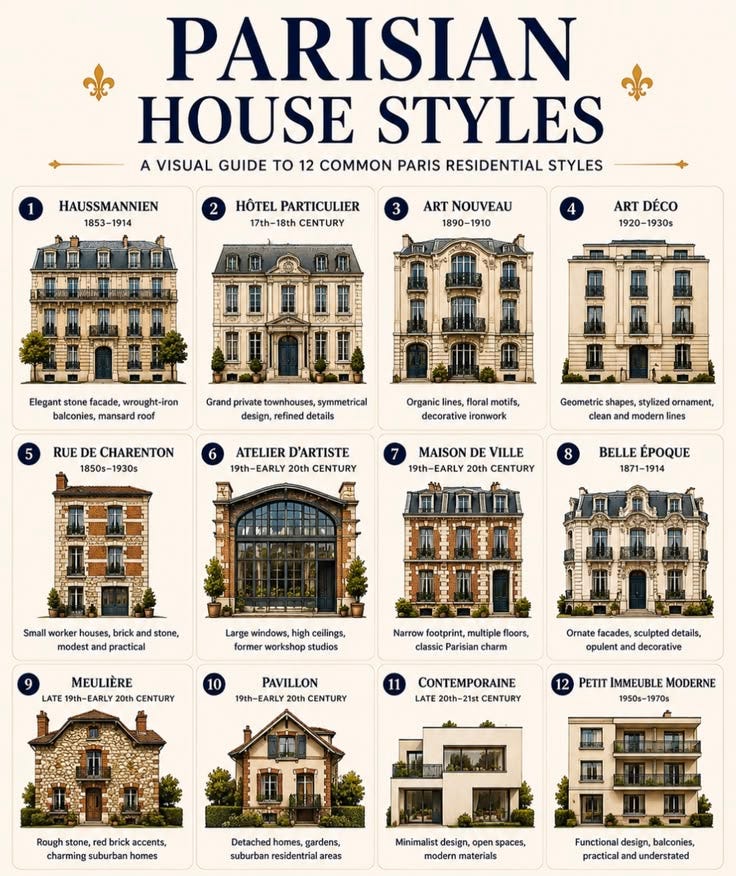
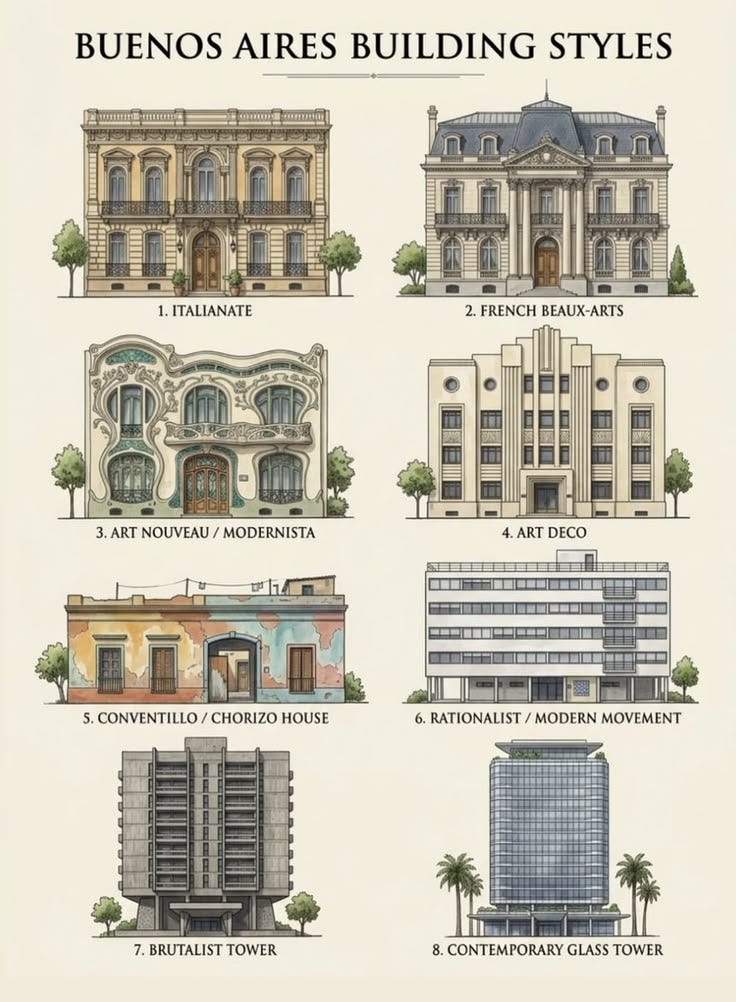
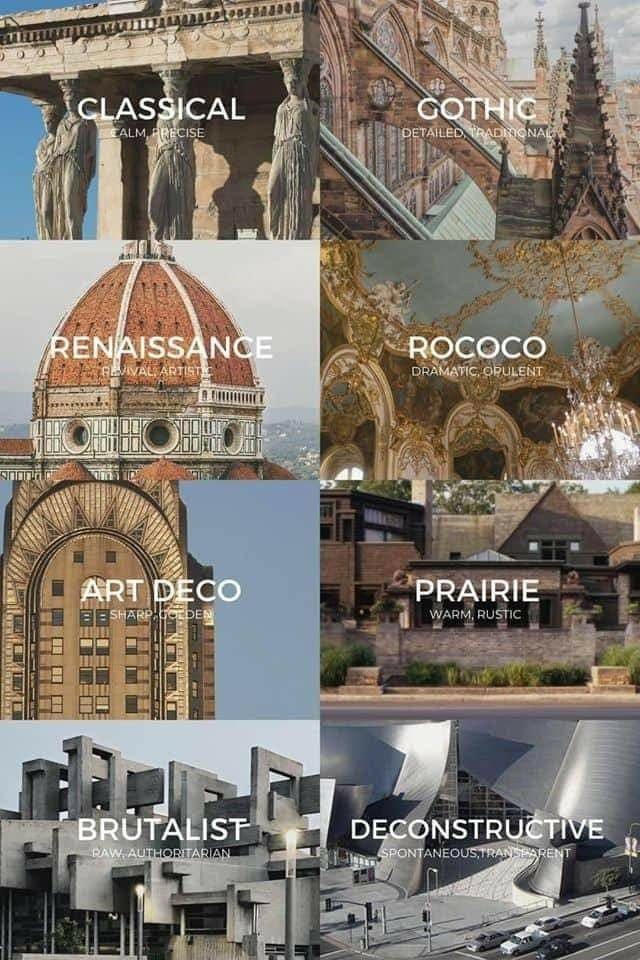
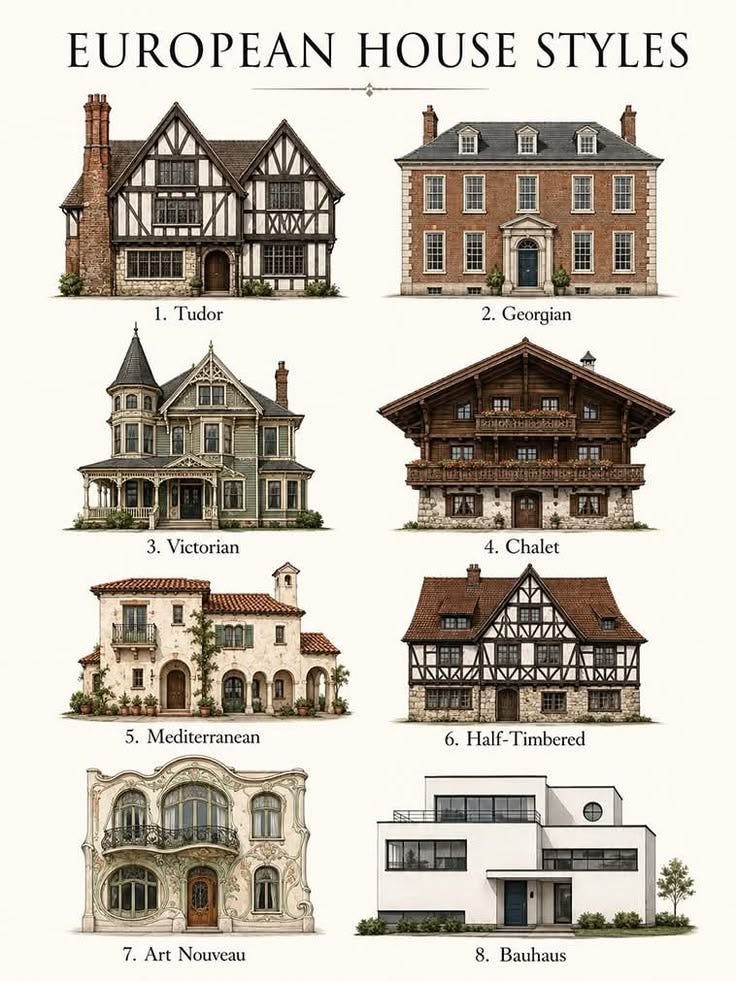
There used to be different styles, well-suited to their environment and beautiful in their own ways. Those cities, states, and individuals within them all tried to set themselves apart and demonstrate their excellence by building what was appropriate, tasteful, and beautiful. Such was what was wrought by their competition amongst each other.
Then that spirit died in the 20th century, and the distasteful blocks of modernist/brutalist/Bauhaus/etc. all converged on the same ugly style that shows nothing other than poor taste and a lack of a sense of place. It’s the perfect style for a cosmopolitan world scared of competition and that hates excellence.
Such is what we must not allow ourselves to become. Instead of worrying overly much about unity or cooperation, we ought try to reinvigorate the spirit of competition for prestige amongst men, cities, states, and nations. Such a world of competition is from what excellence comes, and it is that excellence that allows us to triumph, while giving us the spirit to do so.
If you found value in this article, please consider liking it using the button below, and upgrading to become a paid subscriber. That subscriber revenue supports the project and aids my attempts to share these important stories, such as the one on Civil War, and what they mean for you.
Also, please check out my history videos, such as this one on the FFVs!
The appropriately named Empires of Light: Edison, Tesla, Westinghouse, and the Race to Electrify the World tells this story well.
Another good book on this period, for those interested, is The Glory that Was Greece
Giving one such example of this, Goldsworthy notes:
Ancestry counted, but a basileus had to demonstrate his worth in order to rule, needing to be wise in council and most of all brave, skilful, and successful in battle beyond the mass of men. This being epic poetry, all the heroes are also spectacularly good-looking. They take risks, fighting in the forefront through choice, and this earns them the right to lead but not to command unquestioning followers. Whether at home or encamped on the shore outside Troy, men from the community or the massed army all gather for council. All can speak, but status, reputation, and past actions determined how likely someone was to be asked their opinion and, even more, what weight his words would be granted. On one occasion, Odysseus, acting as marshal at a meeting, told the majority to keep quiet and listen while those braver and more sensible spoke. A man named Thersites ignored him and continued a virulent critique of Agamemnon, until Odysseus turned on him, beating him with a staff of office and driving him away, because of what he said and the way he talked and, more importantly, because he had not earned the right to say such things. Thersites was the 'ugliest man' in the army, lame, hunchbacked, and bald on top, and was worthless in every way for all his ready tongue. The assembled army agreed with Odysseus, judging his silencing of Thersites to be right and proper. A hero and a leader had to stand out and be seen as worthy. The smallest contingent at Troy, carried in only three ships, was led by someone with a distinguished father but himself judged to be a 'weak man', so that very few were willing to follow him.
Describing the Spartan understanding of how to display such excellence, Goldsworthy notes:
Sparta's solution created 'the peers', the true citizens who alone possessed political rights and were full members of the community. Freed from the need to work with their own hands by the labour of helots, they lived a life in many ways resembling the Homeric aristocratic ideal. They were expected to train hard, to demonstrate both bravery and skill in war beyond the levels of ordinary men from other cities, and to be serious when they gathered to vote or were chosen by lot to serve as ephor. They were also watchful of each other, judging their fellow peers at all times, and the desire was to produce a race of men not identical in every way but doing their utmost to excel beyond their fellow citizens in showcasing their worth. They displayed their bodies as they trained, their character at all times in their own behaviour and that of their sons, their wit and wisdom in formal debate and conversation at communal meals, and their performance when they went to war…
Goldsworthy notes:
The building programme ornamented the city, and fresh projects would be added in the decades to come. They very publicly proclaimed Athenians' sense of their city's grandeur and status. Some were functional as well as decorative once complete, and all were expensive while at the same time sources of good employment.
Inscribed records reveal citizens, resident foreigners, or metics, and slaves working side by side for the same pay-some or all of which, in the slave's case, may have gone to the owner. Plutarch claimed that providing employment was one of Pericles's motives for encouraging the building programme, and although some scholars are inclined to see this as the reasoning of a man used to the actions of Roman emperors, on some level it was true. Apart from the construction workers and craftsmen on the site, others worked in the marble ries or provided other materials, so that a lot of people profited from the projects, and many honed their skills, which were then available for hire for less grand enterprises."
Yet another valuable and thought-provoking piece by Will that I agree with for the most part! Greatness indeed does come from competing in excellence. There is nothing wrong with peaceful nationalism and competition. I didn’t think there is anything wrong with thinking your country is the best as long as you don’t hate other countries. For example, I consider the United States the greatest country in the world, but I have nothing against Germany, India or Nigeria. Nationalism doesn’t necessarily mean going to war all the time. It can mean nations pushing each other to be the best they can be. You know what I want to see someday? I want to see a successful and prosperous United States competing with a successful and prosperous Great Britain, France, Germany, Ireland, Canada, Australia, New Zealand, Belgium, The Netherlands, Italy, Spain, Portugal, Greece, Israel, Japan, and Four Tigers all pushing each other to be as strong, wealthy and powerful as possible, make the best music, art and philosophy and the cultivate the best possible citizenry. I want to see the birth and development of a new American aristocracy who would compete with each other to build the most grandiose and beautiful architecture. Let us bring back Classical, Gothic, Renaissance, Rocco, and Art Nouveau style architecture! Let us also bring back Tudor, Georgian, Victorian, Chalet, Mediterranean, Half-Timbered, and Art Noveau style homes need to be brought back! Let us also get rid of all these unnecessary regulations, reform zoning laws and cut taxes on businesses. Let us reduce the size of government and cut down the overly bloated bureaucracies of western nations. In the United States, I call for the repeal of the PATRIOT Act, downsize the National Security State, bring the intelligence agencies under Congressional oversight, launch a second Church Commission, the elimination of unnecessary taxes, to balance the federal budget, to slash the defense budget by 50%, the elimination of corporate welfare, and to cut government spending overall.
We need to make the world’s cities great again! All the major cities on Earth need to compete with each other to see who can be the best! Leftist politicians will be voted out of power in America’s big cities. They should be replaced by Republicans and sane center-left Democrats. Costly infrastructure projects should be cancelled. More funding should be given to the police and more police should be put on the street. Laws against public drug use, urination and defecation will be strictly enforced. Treatment for drug addicts will be mandatory. Community centers will be opened to take care of and treat the mentally ill. The government will massively increase spending on infrastructure and public transportation. The inner cities will be cleaned up and jobs brought there by major corporations. More affordable housing will be built. London and Paris will elect new mayors and city councils. All migrant camps will be cleared out and the migrants deported. The two cities will be cleaned up, housing will be made more affordable. No-go zones will be stormed by the police and military and will be gentrified and integrated with non-Muslims. Paris will launch a city-wide initiative to create a Belle Epilogue 2.0. Mass deportations of illegal immigrants will be carried out in all major western cities. Lower density housing should be built to accommodate families and encourage folks having big families. A new Penn Station that looks like a modern and updated version of the old one will be built in New York City and replace Madison Square Garden which is an eyesore and will be immediately torn down. We must stop trying to unite humanity, which is an impossible task. No more international alliances, no more trying to create a one world government, no more globalism! Globalism is evil and terrible! It must be rolled back! The WEF needs to be investigated by Interpol! Klaus Schwab needs to be called before the European Parliament and rigorously questioned. The United Nations will be comprehensively reformed and purged of corruption and identity politics.
The Europeans will agree to pay more of the cost for NATO. The European Union will be reformed, the Euro eliminated, the EU will support free speech and become more pragmatic and transparent, and the EU will roll back its ridiculous regulations. The other NATO nations will stop being freeloaders and will increase military spending and the size of its militaries. Transient culture in big cities in the West will be ended and corporations will start offering more sedentary positions. Cities will make more of an effort to educate its people on its history. We need to start taking inspiration from the Athenians, Spartans and Ancient Greeks! Corporations will stop using minimalism in their buildings. There will be regulations on how many advertisements a company can display on buildings. The Olympic Games will be reformed. Trans people will be banned from competing in women’s sports. Politics and protests will be banned from the games. Identity politics will be purged from it. The states in this country must push each other to be the best they can be too. Texas will compete with Virginia, Missouri will compete with Iowa, California will compete with Oregon, New York will compete with New Jersey. The North will compete with the South and the West will compete with the Midwest.
I almost forgot! As always, here are some book recommendations for Will and The American Tribune's subscribers:
* New Deal or Raw Deal?: How FDR's Economic Legacy Has Damaged America by Burton W. Folsom Jr.
* FDR Goes to War: How Expanded Executive Power, Spiraling National Debt, and Restricted Civil Liberties Shaped Wartime America by Burton W. Folsom Jr. & Anita Folsom
* The Myth of the Robber Barons: A New Look at the Rise of Big Business in America by Burton W. Folsom Jr.
* Joseph E. Johnston: A Civil War Biography by Craig L. Symonds
* General A.P. Hill: The Story of a Confederate Warrior by James I. Robertson Jr.
* Stonewall of the West: Patrick Cleburne and the Civil War by Craig L. Symonds
* The Life of General Albert Sidney Johnston by William Preston Johnston
* George Mason, Forgotten Founder by Jeff Broadwater
* James Madison: A Biography by Ralph Ketcham
* Rhodesia: Worthy of the Name by H.P. Hornblower
* Kill the Boer: Government Complicity in South Africa's Brutal Farm Murders by Ernst Roets
* Who Are We?: The Challenges to America's National Identity by Samuel P. Huntington
* Defending the West: A Critique of Edward Said's Orientalism by Ibn Warraq
* Defenders of the West: The Christian Heroes Who Stood Against Islam by Raymond Ibrahim
* The Enemy at the Gate: Habsburgs, Ottomans, and the Battle for Europe by Andrew Wheatcroft