


Welcome back, and thanks for reading! Paid subscribers: thank you so very much for your support, I have another paywalled article for you today. All those who are not yet paid subscribers: while some of this article is free, please subscribe for just a few dollars a month to support this project, get access to audio episodes, get ad-free versions of my history videos, and read this article in full. As always, please tap the heart to “like” this article if you get something out of it, as that is how Substack knows to promote it! Listen to the audio version here:
![[AUDIO] Brutalism Is an Act of War Against the Soul](https://substackcdn.com/image/fetch/$s_!CVzY!,w_140,h_140,c_fill,f_webp,q_auto:good,fl_progressive:steep,g_auto/https%3A%2F%2Fsubstack-video.s3.amazonaws.com%2Fvideo_upload%2Fpost%2F195189765%2F8f7ec02a-39b5-4af3-8e83-4405876df322%2Ftranscoded-1776989264.png)
It’s no secret that our cityscapes have become increasingly ugly in the wake of the Second World War. What few new statues are raised are ugly and discomfiting rather than heroic and inspiring. What non-criminal people there are wandering about are in a general state of slovenly undress, generally with their eyes fixed in front of them so they can see and avoid the zombie-like vagrants who choke most streetcorners. The advertisements put a panoply of vices on display, and aren’t even attractive.
And, of course, there’s the general collection of strip-mall-style parking lots and stores that add to the depressing nature of the environment. If one had to define the modern urban environment in a picture, this would be it:

But that is just the beginning of it, for all of those aggravating abnormalities are just the cherry on top of the true urban demoralization campaign waged against us: Brutalism.
Brutalism is that architectural style that consists of a horrid collection of geometric shapes built out of raw, unadorned concrete. The Boston City Hall is the pre-eminent American example of it.
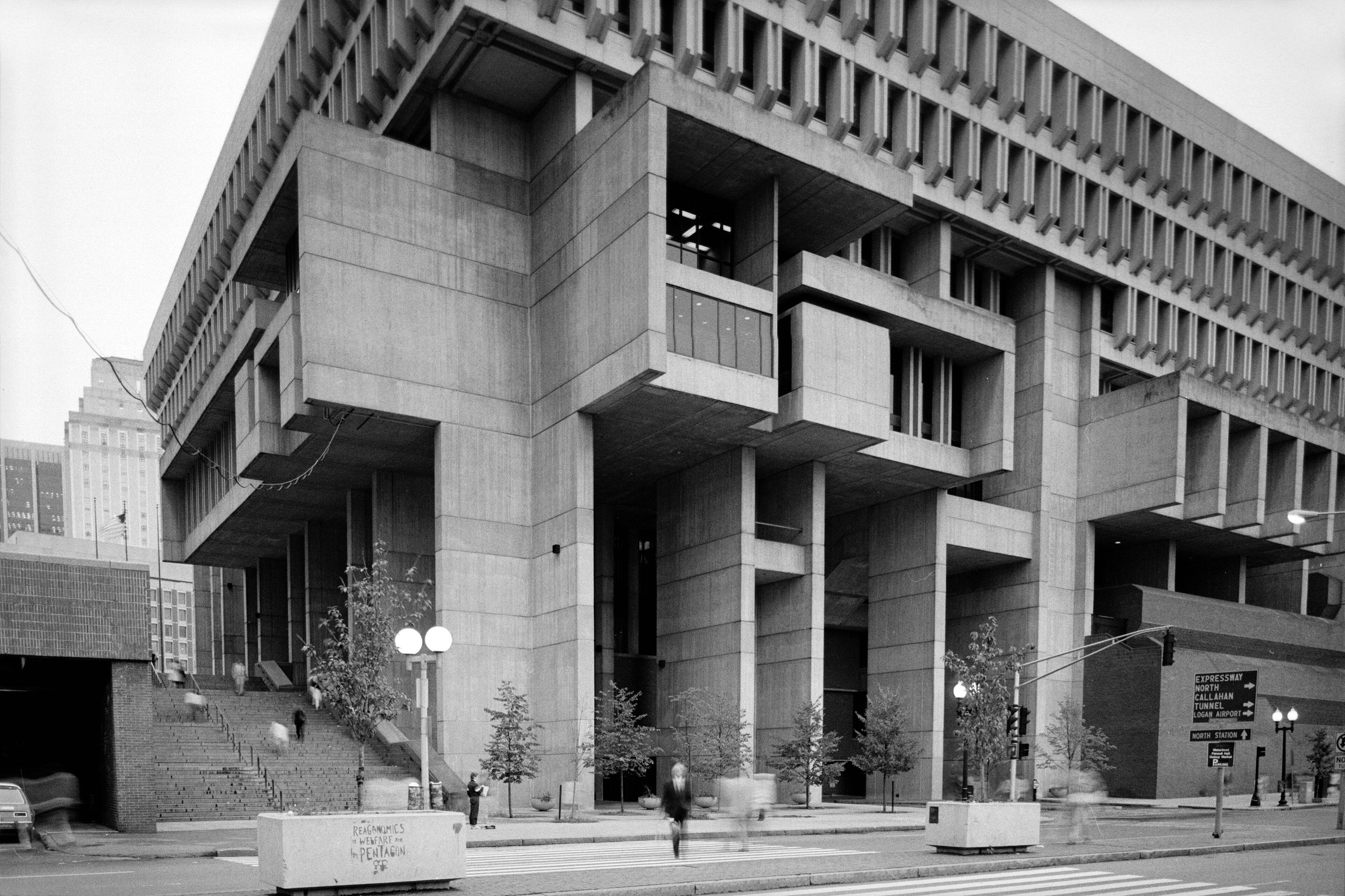
The wretched style came out of Europe in the post-WWII era, and is closely related to modernism. It was meant to be both ideological and practical, as it was a simultaneous rejection of the sort of pre-war architecture that people find beautiful, and the unadorned nature of it makes it theoretically much less resource-intensive than traditional styles such as Neo-Classical, Victorian, and Art Deco.
It initially floundered, as everyone but a select group of socialists found it abhorrent, but “the movement got new wind in the 1950s when European cities sought to rehouse populations displaced by war and to remake the built environment”.1
This largely meant that the post-war socialist governments that ruled the “free” West and communist East relied upon it for the construction of public housing, for example, as part of their communal housing schemes. Not only were such buildings inexpensive and easy to build because they were unadorned and ugly, but they also sent a message about the new sort of world that existed after the war: one that was ugly, resource-strapped, and utterly egalitarian. Such was the point of the style.
Naturally, those with “reactionary”, which is to say normal, aesthetic senses have been repulsed by Brutalism ever since its inception. The story goes that Ian Fleming, the author of James Bond fame, was so horrified by Erno Goldfinger’s Brutalist/modernist designs around London, including one in Hampstead, that he named the Bond villain “Goldfinger” as a dig at the architect. This supposedly sparked legal squabbling between the two men, with Goldfinger claiming he was being defamed. Perhaps the story is apocraphyl, perhaps not. Either way, it does capture the emotions of the movement: those who have traditional tastes hate Brutalism, while those who hate tradition love Brutalism.
And while few have the opportunity to name a legendary character after a proponent of the despised style, it remains generally unpopular. Whether the Hoover Building or Boston City Hall, normal people find the style repulsive and off-putting. It exudes totalitarianism, is the opposite of beautiful, and reeks of the same ideology of spite and wretchedness that drives the Bioleninists. Yet it nevertheless remains popular in the architectural community, and a certain sort of client—the nouveau riche, NGOs, and leftist governments—remains willing to build in it.
Why?
Because the sense of revulsion and horror it produces within you when you see it is the point. Brutalism was designed to be ugly, designed to be a rejection of beautiful Classical architecture, and designed to make you feel uncomfortable rather than uplifted. Such is the point of it, and why it was effectively required by a slew of post-war construction laws.
