


It was early May of 1865, and the war was lost. A bedraggled but still proud band of Confederates needed to find a Union general to whom they could surrender for the war to be over in their now-miserable corner of a once-flourishing cotton state, and so their general set about doing so.
That general’s name was Richard Taylor. A descendant of Richard Lee I and son of former President Zachary Taylor, he was as American as they come, his blood here almost from the beginning. Raised in Kentucky, he served in the Mexican-American War as an aide-de-camp to his father before becoming a large-scale sugar planter in Louisiana. When the Civil War broke out after many years of bad blood and John Brown’s abolitionist terrorism, he volunteered and found himself a rising star in the Confederate forces despite having no combat experience; his courage in combat and knowledge of the history of war and its great captains made him near-universally respected and an excellent commander.
Listen to the audio version of this article here:
![[AUDIO] Annoyed Heritage Americans and Tiresome Migrants](https://substackcdn.com/image/fetch/$s_!Y_Gd!,w_140,h_140,c_fill,f_webp,q_auto:good,fl_progressive:steep,g_auto/https%3A%2F%2Fsubstack-video.s3.amazonaws.com%2Fvideo_upload%2Fpost%2F216318288%2F2f588dff-4b4a-40d9-bcf6-9e1a97aa3585%2Ftranscoded-1789744015.png)
In fact, on July 28, 1862, he became the youngest major general in the Confederate forces, and commanded them with no small degree of skill in defense of his adopted Louisiana home during the war. His men raided and resisted much larger Union forces, using lightning raids and light artillery to overcome numerically superior Union forces. Taylor even managed important successes in the dark days of 1864, crushing a Union army of 30,000 with a much smaller force of Confederates in the Battles of Pleasant Hill and Mansfield during the Red River Campaign. Unfortunately for Taylor and the Confederacy, the fruits of these victories were squandered by Gen. Kirby Smith’s buffoonish orders in their aftermath.
Nevertheless, Taylor’s excellence as a commanding officer—one of the few good ones left in the Confederacy by the fall of ‘64—was recognized by the Confederate government, and he was made a lieutenant general in command of the Department of Alabama, Mississippi, and East Louisiana. Then, after John Bell Hood wasted his army in rash campaigning outside Nashville, Taylor was put in charge of what pitiful remnants there were of the Army of Tennessee. There was little he could do with this army. It was hollowed out by Hood’s wasteful offensives, undersupplied, and what effective units there were had been sent off in a desperate attempt to stop Sherman.
Having retreated into Alabama by the spring of 1865, it was here that he heard of his distant kinsman, Robert E. Lee, surrendering at Appomattox to Grant on good, fair terms. And so he knew it was time for an honorable peace, time to surrender after a war hard-fought. As the commander of the last major Confederate force remaining east of the Mississippi, this was a momentous event in the winding down of the war, and so something of an event for both sides. To mark it after discussing terms and signing the papers, there was a luncheon in Citronelle, Alabama.
At this luncheon, General Taylor—who perhaps had had reason to fear what the terms would be, given that his Louisiana home had been barbarically plundered during the conflict by rampaging soldiers—received the fair terms the surrendering Confederates generally did. But he also had to listen to the tiresome ramblings of a certain Union general.
That was General Peter Joseph Osterhaus, a recent “German 48er” immigrant. Unlike Taylor, whose blood had settled in America back in the swampy and pestilential days of poorly situated Jamestown, here to build fortunes and expand English civilization, Osterhaus was in America and serving the Union because he was a leftist. Specifically, he revolted against the Kaiser in an attempt to replace tradition with subversion in the chaos of 1848, and lost badly. Like many other German liberals, socialists, and communists, Osterhaus took his red shirt and retreated to America, where he was welcomed with open arms…and then set about fighting relatives of the Founding Fathers.
Not just fighting them, but lecturing them about what it meant to be an American, and scolding them (in broken English, with a thick German accent) for resisting a government the diktats and policies of which they, based on their long record of contribution to the Founding and creation of America, found tyrannical! The failed revolutionary of a foreign leftist would scold the Confederates!
Here’s how Taylor, who had a witty sense of humor despite all the misery heaped upon him, describes that in his memoir, Destruction and Reconstruction:
There was, as ever, a skeleton at the feast, in the person of a general officer who had recently left Germany to become a citizen and soldier of the United States. This person, with the strong accent and idioms of the Fatherland, comforted me by assurances that we of the South would speedily recognize our ignorance and errors […] and rejoice in the results of the war. […] I apologized meekly for my ignorance, on the ground that my ancestors had come from England to Virginia in 1608, and, in the short intervening period of two hundred and fifty-odd years, had found no time to transmit to me correct ideas of the duties of American citizenship. Moreover, my grandfather, commanding the 9th Virginia regiment in our Revolutionary army, had assisted in the defeat and capture of the Hessian mercenaries at Trenton, and I lamented that he had not, by association with these worthies, enlightened his understanding. My friend smiled blandly, and assured me of his willingness to instruct me.
The German general who hectored Taylor and had no sense of tact or propriety was Osterhaus. The commanding Union general, Edward Richard Sprigg Canby, who was exceedingly courteous throughout the surrender and whose family was of English stock that arrived in 1684, tried in vain to get Osterhaus to be quiet and quit the lecture, but failed.
Migrants and Americans
Taylor was no Confederate radical. He owned a great many slaves and a large plantation, yes, but he was no firebreather. In fact, he was a Know-Nothing before the war, a party typically associated with American nationalism and the Northeast rather than the Democratic South. He only became a Democrat in the late 1850s, and was one of those who tried in vain to piece the Northern and Southern splinters of the party back together in 1860 to keep Lincoln out of the White House so that war might be averted. He failed, but at least tried. Like his kinsman, he was a reluctant soldier of the Confederacy.
What he did sense, as indicated by his Know-Nothing sympathies, was that mass immigration of foreign radicals into America was changing the nation for the worse. Particularly, tiresome and buffoonish 48er leftists of Osterhaus’s stripe, men who thought of America as a radical leftist idea that rebuked the land of tradition they hated rather than as a people with its own traditions into which they would have to slowly and quietly assimilate to ever become American, were wrecking the country by pushing it toward the rocky shoals of cultural revolution.
For example, it was thanks to the 48ers that Milwaukee developed a strong socialist party and was blighted by that odious form of leftism. Further, all across the United States, the 48ers brought with them a particular hatred of both slavery and nativism, seeing both as at odds with the leftist, egalitarian ideas they cherished.
As they saw America as a canvas on which they could paint the political outgrowths of their hatred of the Kaiser rather than as a particular place and people, they set about pushing American politics in a much more leftward direction than might have otherwise been the case.
To them, it did not matter that actual Americans held views with which they, recent arrivals, were the ones who disagreed. They thought their ideology should win, and so pushed it fervently despite it being foreign. This was to the detriment of our nation, as it helped divide America in the run-up to war, and thus led to war.
Mobs of foreigners pushing their views on America and causing a mess in their doing so should not have been a surprise.
Thomas Jefferson, after all, had warned against it half a century earlier in his Notes on the State of Virginia, noting that the importation of migrant groups with political traditions different from those present in America would not be of benefit to America:
But are there no inconveniences to be thrown into the scale against the advantage expected from a multiplication of numbers by the importation of foreigners? It is for the happiness of those united in society to harmonize as much as possible in matters which they must of necessity transact together. Civil government being the sole object of forming societies, its administration must be conducted by common consent. Every species of government has its specific principles. Ours perhaps are more peculiar than those of any other in the universe. It is a composition of the freest principles of the English constitution, with others derived from natural right and natural reason. To these nothing can be more opposed than the maxims of absolute monarchies. Yet, from such, we are to expect the greatest number of emigrants. They will bring with them the principles of the governments they leave, imbibed in their early youth; or, if able to throw them off, it will be in exchange for an unbounded licentiousness, passing, as is usual, from one extreme to another. It would be a miracle were they to stop precisely at the point of temperate liberty. These principles, with their language, they will transmit to their children. In proportion to their numbers, they will share with us the legislation. They will infuse into it their spirit, warp and bias its direction, and render it a heterogeneous, incoherent, distracted mass. I may appeal to experience, during the present contest, for a verification of these conjectures. But, if they be not certain in event, are they not possible, are they not probable? Is it not safer to wait with patience 27 years and three months longer, for the attainment of any degree of population desired, or expected? May not our government be more homogeneous, more peaceable, more durable? Suppose 20 millions of republican Americans thrown all of a sudden into France, what would be the condition of that kingdom? If it would be more turbulent, less happy, less strong, we may believe that the addition of half a million of foreigners to our present numbers would produce a similar effect here.
Such is what happened, and why General Taylor, son of a president, found himself being on the receiving end of a lecture about American values delivered in broken English with a clipped German accent by some leftist from abroad.
It’s Happening Again
Such is happening again, as recently shown by the explosion of interest in what is going on in Texas, which is being colonized by Indians because Greg Abbott wants the GDP chart to go up and to the right a bit longer. For that, he is apparently willing to sacrifice his state’s future, doing the exact thing against which Jefferson warned Virginians over two centuries ago.
Namely, Gov. Abbott has repeatedly engaged with India to encourage it to flood Texas with migrants. In 2024, for example, he went on an “economic development mission to India”.1 Then he gave an absurd speech about how celebrating Diwali is a Texan value.
The result is that Texas has been swamped by a deluge of migrants who don’t share the political sense of Texans. In fact, Indians, of whom there are about half a million in Texas, are the leftmost immigrant group in America. To them, America means an economic zone they can take advantage of, not a people and culture that George Washington or his kin would have recognized.
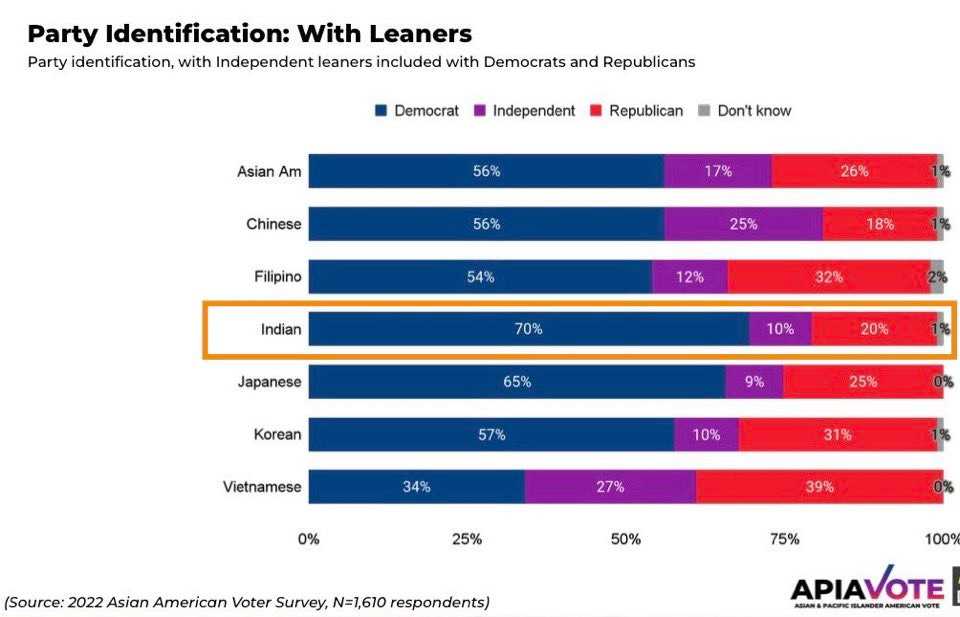
So, while some of them are great, large numbers of them are not. Republican nominee for Texas Railroad Commissioner Bo French pointed this out, using a screenshot from the recent University of Texas game to draw attention to it: UT looks like the University of Mumbai, and that’s a problem.


And this is no phantom menace. Much like Osterhaus, these migrants see fit to lecture the descendants of the Revolution on what America means and what the Confederacy stood for, and of course they always take the leftist side when explaining to Heritage Americans what our history really means.
Pradheep, who thinks half of America was treasonous in 1861 (no Confederate was ever found guilty of treason), is employed by the National Review. He is, nominally, a “conservative”. How little that means is shown by his views: it’s certainly not the Founders’ America that he wants to conserve.


As a side note, what Pradheep did is not a rarity. Indians routinely do this on X, for whatever reason, and it is so frequent that it has become a meme.
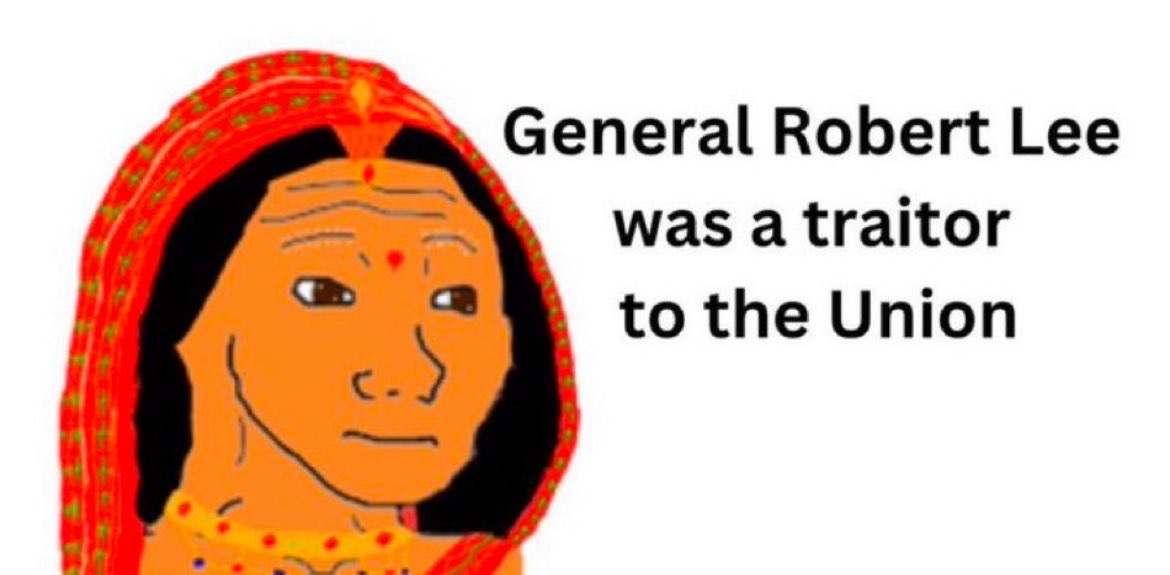
This attitude is a major problem, and it is far more widespread than just Pradheep’s caste and its habitual tendency to refer to Confederates as traitors.
For example, Maria Salazar is a Hispanic “conservative”…and she is, of course, freaking out over Trump’s deportation policies and demanding he allow illegal aliens to remain in America. “Allow me to explain what MAGA is and how it includes my 15 million co-ethnics Biden allowed to walk across the border” is apparently her brand of “conservatism,” one that will only make America weaker, for, as Jefferson noted, it will make us less united as a people and more susceptible to the demented politics of the invaders.


Then, of course, there’s the openly leftist immigrants. For example, we recently saw Mamdani (an Indian Muslim communist from Uganda) and AOC (a socialist Hispanic) laughing during the 25th anniversary of 9/11 ceremony, as caught on tape by CSPAN. Real Americans, notably, weren’t laughing. They understood the importance of the moment. But the leftist migrants were. They didn’t care. Then they lectured Americans on how Islamophobia was the real legacy of the murder of thousands of Americans.


There is an American people. There are American ideas too, but there is an American people. To pretend there is not, and to flood the country with those who claim to love American ideas (by this, they always mean their own political views superimposed over the American canvas) but who share no connection to our people or traditions, is to create a disaster of a political earthquake.
A few here and there are fine, particularly if unusually competent or valuable. But the ~600,000 Indians in Texas, nearly all of whom are leftists? Hardly, even if they wear the UT shirt and get excited about football, just as Osterhaus and his ilk were not Americans and weren’t fit to lecture General Taylor on what it meant to be an American…as General Canby realized.
This is why deportations are so important, and why the border must be closed, as our ancestors recognized with the 1924 Immigration Act. When signing that act, President Coolidge said he was making America American again. We must do the same if we wish to avoid the fate of Gen. Taylor: being a son of the Founders, lectured to in broken English by some foreign leftist about what it really means to be an American.
RELATED:
