


Welcome back, and thank you for reading! I know I’m due to get you a paid article today. However, events have conspired to delay my writing (a friend is getting married in Texas, and I have to travel from the depths of the Old Dominion to Austin), and I didn’t think that what I could send out would be of the requisite length for a paid article. So, here is a shorter one, and hopefully it bids you over until next Tuesday. For reasons of travel, there will also be no audio version of this article until next week. Thank you for your patience and your support.
I recently had the opportunity to speak with The Black Horse on his podcast to promote my show The Old World, and one very interesting thing that came up is wealth in the context of virtue. What was it about the Old World and the sorts who characterized it in its heyday, whether the gentry of Virginia or Sir James Brooke-type explorer-adventurers, that kept them from falling into a pit of torpor, degeneracy, and inconsequence that their lives could have been, given the leisure their wealth allowed?
A few bad sorts were, of course. The Dukes of Manchester have always been disasters, and the present one is a criminal, for example. Still, there were remarkably few scoundrels and wastrels compared to the wealthy of our day. It used to be seen as remarkable and a shame if a gentleman turned into a ne’er-do-well. Now it is expected that trust fund kids will be walking disasters, living lives of infamy and frivolity.
That question gets to a key change that came with the 20th century. Perhaps the greatest economic change between the Old World and Our World is what counts as consequential wealth, and what form that wealth takes.
Wealth in the Old System
It used to be that wealth was measured in income and acres. It was not so much the capital value in one’s possession that mattered, but rather what income and socio-political power could be sustainably generated by that wealth. Such is why the old landed elite preferred agricultural acres. For one, such wealth long generated a reliable income, making it the safest and steadiest form of wealth. Just as importantly, it was extremely conducive to the sorts of cross-class relationships that tied country society together and, whether through the borough system in Britain or Burgess system in Virginia, led to political power.
That’s not to say they exclusively relied on agricultural assets. The villages that sat around those acres, urban real estate, forests, mineral rights, infrastructure projects (primarily canals and railroads), and the like, were also assets in which many of them invested. Similarly, some were investors in banks. For example, Robert E. Lee’s early life was sustained by his mother’s bank stock because Light Horse Harry had frittered away the Stratford estate during a life of service and speculation.
However, all but the most impecunious had at least a core estate composed of agricultural acres farmed primarily by others that served as the basis of their fortunes. Yet further, those alternative investments were all real things either held directly, or only slightly abstracted. What they are is tangible and obvious, and they are conducive to relationship formation and the inculcation of stewardship.
Farms require tenants, investment in agricultural improvement, and keeping things steady and stable over many years. Foresteters must be met, hired, and kept on the payroll to maintain a timber forest, which also must be maintained with time horizons that span decades if not centuries. Railroads cut across the landscape in a tangible way, and led to a rural class that could have become overly provincial—and thus cut out of the future—forming relationships with the moneyed capitalists and newer politicians. Town and urban real estate had similar advantages.
That wealth generated an income that was mostly passive—allowing lives of service rather than work—but not entirely. Instead, members of the landed elite had to both keep an eye on things and stay abreast of changing economic conditions, while also being intentional about building the relationships that kept the assets valuable and remunerative over the long term. This was as true of the Virginia planters as of their British cousins. Wealth was not just an abstracted number on a screen expected to go up forever, but something that knitted the constituent elements of society together.
This encouraged a generally pro-social way of acting. A bad landlord who was too willing to squeeze his tenants would certainly drive them to new farms, diminishing the value of his own and the income generated by them. Yet worse, he’d probably alienate such men and drive them against him politically and risk costing him everything. He who chopped down his forests too early, or ignored them when they grew, was likely to permanently impair the value of his estate. He who ignored what was going on at the bank or railroad he owned part of was likely as not to lose everything as sharp-elbowed insiders pilfered it. He who did business with mine managers who were cruel and drove the workers like slaves was likely to become hated, whereas he who invested in safety and good wages was likely to become wealthy and beloved, as were the Fitzwilliams.
In short, wealth was measured in terms of generally real, tangible things—primarily acres and the income generated by them. Further, because it was real and obvious, the name and personal honor of the owner were caught up in them. If he did as he ought and acted as a gentleman, he would profit economically, socially, and politically, while also keeping things stable. If he did as he oughtn’t, any number of crises could bring a permanent end to things. Knowledge of that fact generated not just conservatism, but a generally pro-social attitude that led him to reinvest in all levels of the rural community around him, from the large farms of his tenants to healthy cottages for the workers, while also remaining politically and socially involved.
It was imperfect, of course, but the incentives were generally well aligned toward prosperity built by durable and long-term investment, a vigorous and healthy citizenry, and a hierarchy that did reflect a society led by the best men in it. A few passages show this quite well.
The first comes from The Age of Federalism, a fabulous book on the early American Republic. In it, the authors describe how the nature of wealth and politics knitted Virginia society together:
A wealthy planter of Washington's class presided over a domain all of whose members from the slaves on up - tenantry, neighboring yeomanry, and an extended group of kinship and cousinage - were in some way attached, directly or indirectly, as dependencies. But equally significant was that although such a man stood at the top of the social scale, he was not part of a hierarchy, Or rather, the hierarchy was peculiar in that it had no apex. His membership was in a community of peers, and for his ultimate sanctions, of whatever nature, he looked not upward but laterally. The embodiment of this system was a collectivity, the House of Burgesses, and the Burgesses in their corporate nature ratified a man's reputation. And yet before he could be one of them, he had to be elected - not by his Burgess-peers but by his neighbors, large and small, and to this extent he depended upon his dependents.
Similarly, Clifford Dowdey notes in his The Golden Age that those who governed Virginia largely did so because they were expected to lead. That expectation came not just from their class, but from all around them. It was a duty to which they lived up:
While the members of the General Assembly did not have to please the citizens, it was an aristocratic government by consent; the people had to be convinced that the men in government were acting for the common good. In acceptance of the hierarchical structure transplanted from England, the citizens generally believed their community leaders to be better qualified than they to make decisions at the capital which affected the total interests of the Colony.
Cannadine, describing British society of much the same period in his The Decline and Fall of the British Aristocracy, notes that it too was defined largely by the consent of those who did not just consent to the squires and grandees ruling, but fully expected them to do so. What forms of democracy existed largely ensured that the best among such men ruled rather than that an insurgency from the bottom would debilitate their ability to rule:
Moreover, this position as the power élite also rested on popular sanction. For the first three-quarters of the nineteenth century, the majority of the population unquestioningly accepted the patricians' right to rule. Landowners had leisure, confidence, experience, expertise: they had time to govern; they were expected to govern. The business of businessmen was business; the business of landowners was government.
Finally, Skidelsky describes well in his biography of Oswald Mosley how this trend played out at its best, through the lens of Mosley’s grandfather and his management of the family’s Rolleston estate:
Mosley's adored and adoring grandfather was clearly a paternalist of the old school, who took his obligations and his rights very seriously. He was not without enterprise: the diversification from arable to livestock farming to counter the North American grain invasions of the 1880s saved the Rolleston economy for another generation, As a young man, he worked with his labourers in the field from dawn to dusk. He raised a prize-winning shorthorn herd, placed his pedigree bulls at the disposal of his tenants for a nominal fee, and remitted a portion of their rents in hard times.
He built cottages and a recreation hall for his workpeople, maintained a school for their children, an almshouse for the aged, a church for their spiritual health, and threw open his grounds to fêtes and fairs for their entertainment. His solicitude on one occasion took a positively Tolstoyan turn when he started baking a special wholemeal bread at the stone mill of Rolleston: ‘Standard Bread' provided Northcliffe's Daily Mail with one of its carliest journalistic stunts, and Rolleston was deluged for samples of the health-giving loaves.
Nothing is ever perfect. But at least the incentives were aligned relatively well to encourage pro-social behavior and the development of virtue. The income supported the leisure, which was dedicated toward study, stewardship, and leadership. That crafted a better governing class, which could in turn use its position to steward the wealth of the nation and the development of the people towards higher ideals.
Out of this social system came the great empires of the 18th and 19th centuries, and all the achievements for which they were known. As de Tocqueville notes in Democracy in America:
Almost all the peoples that have acted strongly on the world, those who have conceived, followed, and executed great designs, from the Romans to the English, were directed by an aristocracy, and how can one be astonished by that?
That which is most fixed in the world in its views is an aristocracy. The mass of the people can be seduced by their ignorance or their passions; one can surprise the mind of a king and make him vacillate in his projects; and besides, a king is not immortal. But an aristocratic body is too numerous to be captured, too small in number to yield readily to the intoxication of unreflective passions. An aristocratic body is a firm and enlightened man who does not die.
Our World
All of that is quite different from the present. Now, wealth is largely not tangible. It is, rather, abstracted. Wealth is held largely not in acres, in forests, or even in private ownership of banks and railroads. The time of all of that is long since passed in all but a few increasingly minor cases.
Even the older forms of plutocratic wealth—great industrial enterprises, vast mercantile empires, and resource extraction companies that operate on a massive scale—are now held by distributed bodies of detached and uncaring “shareholders” whose wealth is primarily abstracted into shares of ETFs and mutual funds rather than being held by men of prominence and power. Rockefeller did not just own much of Standard Oil, but controlled it. Same with JP Morgan and his eponymous bank, or Ford and his eponymous car company.
That trend has only worsened over time. Now, the form of wealth that people want to hold is largely not real estate. Nor is it even profitable and dividend-paying companies, the yields of which could support a modernized version of the old lifestyle. Instead, people want increasingly abstracted forms of partial ownership over companies that don’t really make profits, much less pay dividends, but which might significantly appreciate in capital value indefinitely.
Hence the rise of near-countless Software as a Service companies with ridiculous names that do little and make less, but which theoretically might become trillion-dollar companies. Generally those aren’t even held outright. Instead, we’ve seen the rise of evermore ETFs that hold some fractional share of this dizzying array of companies that should be valueless in varying amounts. Such is what the people want.
So, they are sold an ETF or mutual fund with some absurd name like BUTTZ that holds varying amounts of “Blotto”, “SquareSync”, “DynamoZ”, and so on. For a 1.5% annual fee, of course. Perhaps they are right to want such things. The capital value of them has certainly appreciated, for now. Profits, however, generally remain on the far horizon.
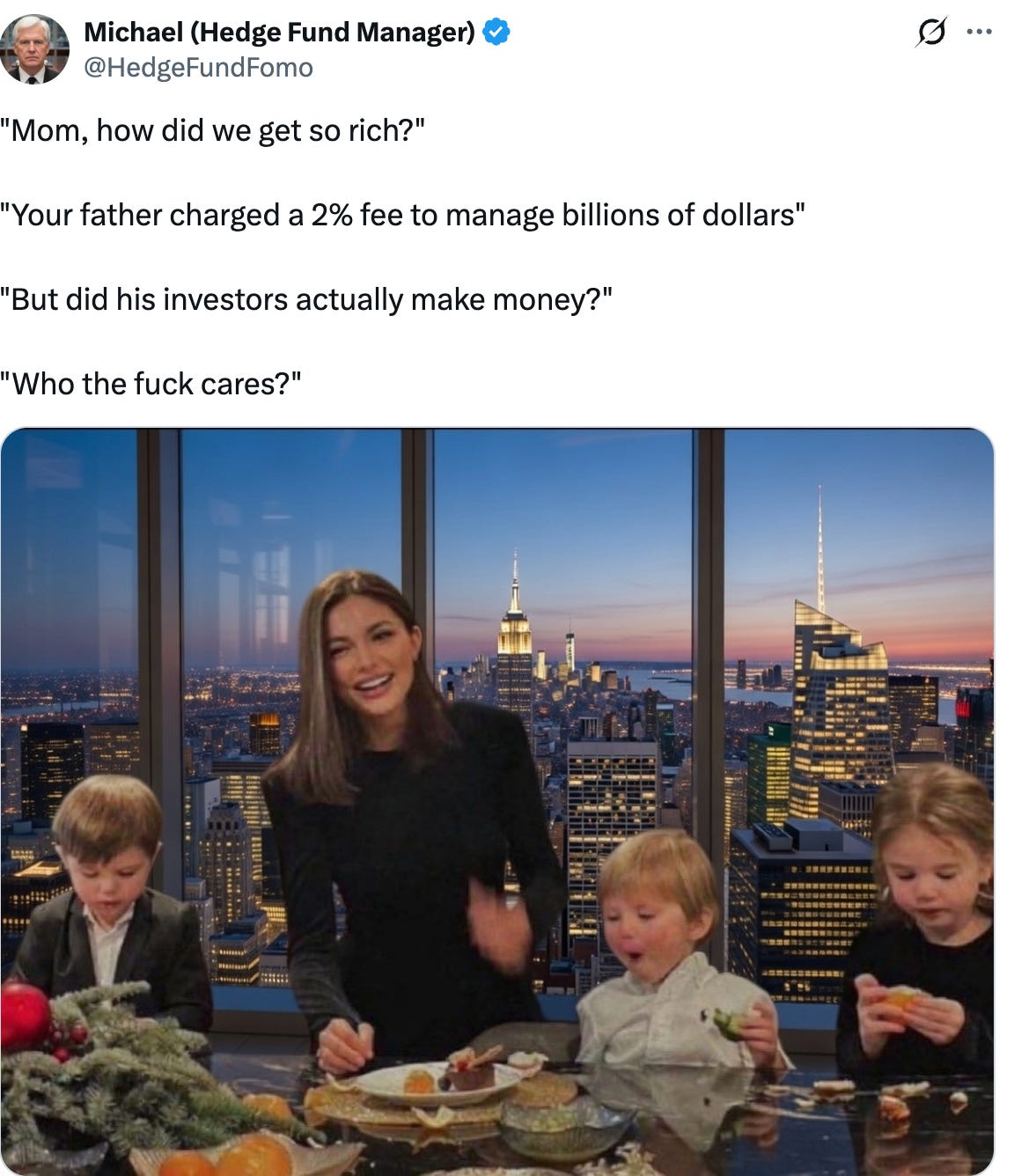
Regardless of how well it has or hasn’t played out in terms of people’s pocketbooks, that abstraction has been a cancer. He who owns a farm and has to deal with the consequences has some degree of care for those on it by necessity. They provide his income, and the quality of the enterprise reflects upon his name. The same is not true once abstraction sets in, and one instead owns an unclear share of an unclear thing. That reflects on no one’s name, and so all that matters is the degree to which the lemon can be squeezed by corporate managers so that people remain “invested in” (speculating on) the stock.
Hence the offshoring of industry that destroyed countless towns and communities across America, while relying on the exploitation of Third World labor. Hence the scams so many companies run, from chargebacks to impossibly obtuse foreign customer service personnel. Hence the constant frauds, manipulations, and general concern with artificially inflating the share price in the short term rather than long term capital building fueled by re-investment. CEOs will be in and out with their golden parachute; they don’t care. Employees aren’t well looked after; they don’t care. Customers know they are the sheep to be flayed rather than sheared; their main concern is pulling one over on the despised company.
When wealth was real and direct rather than abstract, that encouraged some good behavior. Now that it is not, and the impossible-to-pierce veil of abstracted ownership and bureaucracy means anyone can get away with anything with no one being able to figure it out, bad behavior is effectively encouraged. The result is the decline that surrounds us, and the horrid behavior that has landed us in such a situation.
This is nothing new, even if it has gotten worse and worse as more and more abstraction has set in. As de Tocqueville notes in Democracy in America:
In aristocracies, farm rents are discharged not only in money, but in respect, affection, and services. In democratic countries, they are paid only in money. When patrimonies are divided and change hands, and the permanent relation that existed between families and the land disappears, it is no more than chance that puts the property owner and the tenant farmer in contact.
They are joined for a moment to negotiate the conditions of the contract, and afterwards they lose sight of each other. They are two strangers whom interest brings together and who rigorously discuss between themselves an affair whose sole subject is money.
Indeed. And the nasty nature of much of our present, from the millions of Indians living in Canada to the constant stories of crypto “rug pulls,” are a testament to this reality.
The Old World Alternative
The alternative is to return to the old way of doing things as best we are able in the present state of things. The shift from land and resources to companies has happened for a reason, and probably isn’t reversing. To ignore that entirely would be madness, and a recipe for becoming irrelevant.
But it can be done better than what is currently happening, as my friend Johann Kurtz noted in a recent essay titled The Neo-Feudal Wager. He writes, after describing how one South Korean CEO is trying to do everything possible to encourage employees to have kids and produce the next generation, including spending lavish sums out of his own pocket on the project:
The question for Western families who wish to preserve their way of life is not whether particularism will return — it is already here — but whether they will organize their own, or be organized by others.
What, then, is to be done? The answer begins with a change of self-understanding. The successful Christian businessman or professional — the man who has built something of value in the modern economy — must cease to think of himself merely as an employer, an investor, or a civic participant.
He must begin to think of himself as a patron, in the old sense: a man with obligations that extend beyond the contractual, who bears personal responsibility for the flourishing of a defined community of families.
What might that mean in practical terms? Using ownership of real estate to keep pockets of cities beautiful and pleasant is one thing those with large means must be encouraged to do. If all with the resources to do so did as the Grosvenors have done in Mayfair and Belgravia, keeping a pocket of London very beautiful while also adapting it to the times, our lived environment would be much more pleasant.
Investing in and supporting small companies that make high-quality products and do so by employing American labor. Jocko Willink’s Origin is a great example of this: they make very high-quality jeans and other textiles, and have managed to resurrect the dying American textiles industry while providing good jobs to American workers.
Supporting regenerative agriculture by connecting with ranchers, investing in their operations, and buying meat from them rather than from stores is another great example. Regenerative ranching is simply more expensive, and so the meat is more expensive. But it employs more Americans than the mega operations like those run by JBL. It is far better for the soil, and brings back wildlife like quail and pheasants into coverts from which the factory farming operations had driven them. It is more resilient and uses fewer of the inputs like RoundUp that are poisoning us. It is simply better, and we should be doing what we can to support and invest in it.
In each case, whether from large operations like urban ground rents or a textile factory to small things like supporting local ranchers, the focus should be on cutting through the abstraction and diffusion of responsibility that has long been metastasizing and restoring the direct and real. When things are direct, how they are done reflects on one’s name and honor. That leads to pro-social outcomes, from the beauty of Mayfair to government by those who ought be governing. When they are abstracted, they become bureaucratic muck, and the inevitable result of that is the grey morass of constant decline in which we now find ourselves.
We’ve seen the wages of endless abstraction, detachment, and reduction of things to coins in the cup. The result is social catastrophe and the turning of our nations into dysfunction-riddled strip malls viewed only as economic zones by those who poorly govern them. The old way wasn’t perfect. But it, and the virtues that undergirded it, at least did much that was good, and much that might get us out of the present jam in which we find ourselves.
If you found value in this article, please consider liking it using the button below, and upgrading to become a paid subscriber. That subscriber revenue supports the project and aids my attempts to share these important stories, such as the recent one on the decline of the WASPs, and what they mean for you.
In a sense more superficial than wiser agricultural land usage by Americans, nevertheless, arguably still very critically important could be state constraints upon what body politic is actually employed in the existing service sector simulacra. It's a symptom not root cause, that most "middle management" in the digital economy has been offshored. But if I'm a resident of Arizona or citizen of Texas then when I contact service/support of any sort, I want that live agent to be a local / regional American in America. It's a fairly narrow brush; would help redirect the wealth extractive corporate policies more in favor of American economy and workers, and would be politically hazardous law to oppose.
I agree 100% with the article and was impressed by the quality of the writing but I am skeptical any of this will happen voluntarily. Wealth of the kind we seek to promote has its drawbacks, which is why it's been largely abandoned by our top 0.01%. It's quite a tall order to get many wealthy people to start the kind of projects we're looking for out of the goodness of their hearts, losing some of their liquidity for the sake of others. But when it happens, we should sing their praises to the moon. Thanks for shouting out Willinks company, I'll definitely check out their products.
The best example of the kind of pro-social wealth we are looking for that I can think of is Musks purchase of Twitter. He bought a failing company that was not commercially viable bc he believed in the power of a free public online square. And God bless him for doing it bc we really needed one in those days when Bidens government was publicly scheming to put out propaganda in the name of fighting "misinformation". He didn't have to do it, and he got tons of flack for it.