


Hawkers of financial advice often woo potential readers with the promise of “passive income”. Indeed, though personal finance blogs seem to have somewhat died out, when they were popular during the FIRE (Financial Independence, Retire Early) era, passive income was something toward which they tended to orient their articles, as the “passive income” search term was an increasingly popular one. Perhaps those articles brought their writers some passive income down the line, but rarely were such puff pieces much more than a way of displaying ads for “passive income” products.
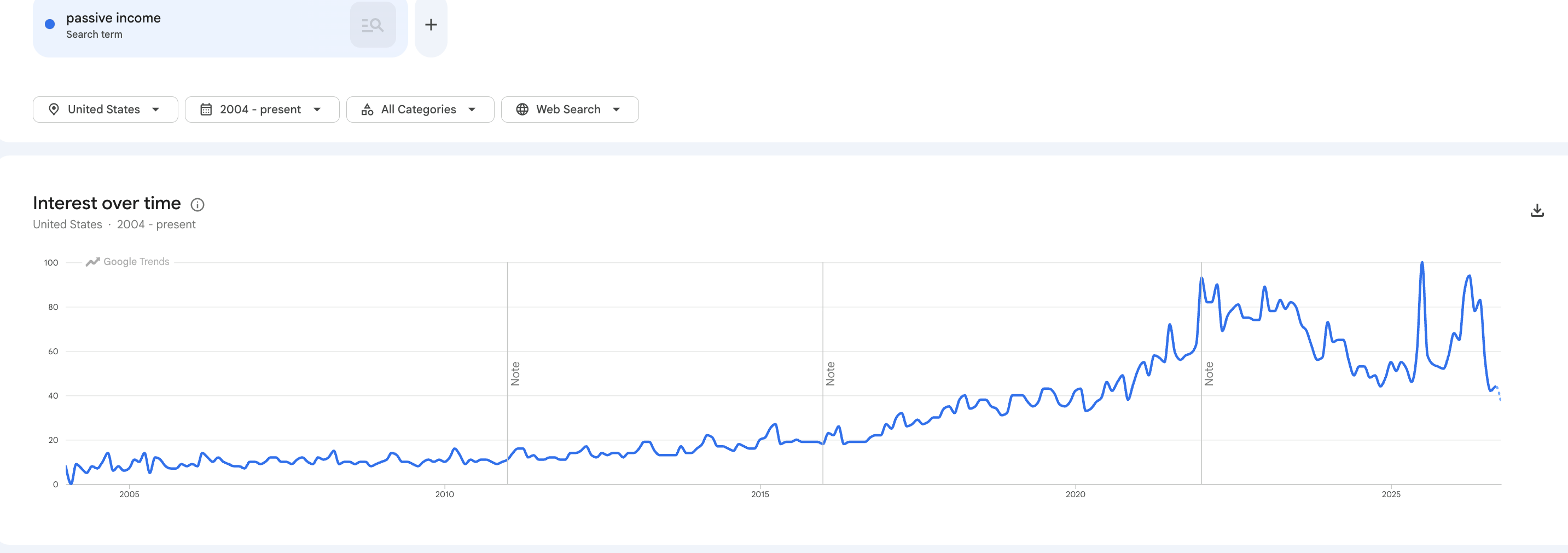
Why the idea of “passive income” is popular is obvious: who doesn’t want income without working? Such certainly has its advantages compared to the alternatives. Namely, an income that requires work, or starvation.
But “passive income” is also a term as nebulous as it is nefarious.
Listen to the audio version of this article here:
![[AUDIO] We’re Making the Same Passivity Problem that Killed the WASPs](https://substackcdn.com/image/fetch/$s_!0zQ7!,w_140,h_140,c_fill,f_webp,q_auto:good,fl_progressive:steep,g_auto/https%3A%2F%2Fsubstack-video.s3.amazonaws.com%2Fvideo_upload%2Fpost%2F219118454%2F931a369b-e7d1-4bcb-8106-10f5bdef7a93%2Ftranscoded-1791301157.png)
For one, what is passive? Does managing an investment portfolio of dividend-paying securities count? That doesn’t require digging ditches, but also isn’t really “passive” in the sense that it requires no work. Similarly, being a landlord—or, to put it more politely, “owning rental properties”—is one such path to financial freedom hawked by the pushers of such dreams. But is dealing with a tenant’s refuse after he refused to pay rent for the fourth month in a row, evicting said tenant, and then finding a new tenant with “a good credit score” really passive? Is cleaning up an Airbnb property after a motley assortment of “youthful scholars” trash it really passive?
No. Typically, what is hoped for by such a term is an investment in which one can park cash that requires no work, no continued oversight, and a steady income. That leaves government bonds and some bond/dividend mutual funds and ETFs. You can either get the “risk-free” rate of return from the government, or trust a collection of strivers working in Manhattan to put your money in a place where it’ll produce an income for you.
Those on the quest for the Holy Grail of the Would-be Dissipated could have ignored the blog puff pieces, for this is something the WASP class found two centuries ago, and is what they did. They bought American and British government bonds (this is why the gold standard was so important to them), or invested in trust companies that did the hard work of investing in corporate bonds and equities for them. They could then live lives of leisure that were divorced from work, attention, or reality. As I discussed recently, this ended in disaster for them, as the risk of government bonds is persistent inflation, and the risk of trust companies is that fools or frauds run them into the ground. Both happened to the WASPS, and the calamitous collapse of the Knickerbocker Trust Company and persistent inflation throughout the 20th century are much of the reason they are no longer around as a class.
That leads to the nefarious part of “passive income” as a concept.
Notably, the WASPs were the only “aristocracy” of sorts in the Anglo world that died as a result of their own fecklessness. Admittedly, the British landed elite and colonial elite both died out, as did the Virginia gentry and Southern planters. But they died because they were murdered; in some cases, literally, but more typically, metaphorically. They died because they faced expropriation of various sorts—outright expropriation in the case of the colonial elites like the planters of Southeast Asia and farmers of Rhodesia, death and income tax-driven expropriation in the case of the British landed elite, and invasion followed by tax-justified expropriation during Reconstruction throughout the South—and it was eventually enough to kill them.
In some cases they folded without much of a fight, as in Britain and the plantations of India and Malaysia. In other cases, such as Rhodesia and the Confederacy, they fought like lions.
Regardless, in no case was it their own lack of attention to detail that diminished their patrimonies and powers as a class. Individually, perhaps, but not at any scale.
But the WASPs did. They were inattentive to finance, inattentive to politics, inattentive to inflation, inattentive even to their own money…and so it flowed out of their pockets and into the pockets of others, and all of a sudden they found that they’d have to work to eat at all, much less off silver platters. There were exceptions, namely the Mellons and Goelets, but they were few and far between. Much more typical were those of the sort Fitzgerald describes in books like This Side of Paradise and The Beautiful and Damned, frittering away frivolous lives of indolence that could have been great—as shown by sparks of glory, like their service in the Great War and as Rough Riders in the Spanish-American War—if only they had applied themselves.
So, what was the difference between them and those like the Rhodesians and Virginians, men noted for the habit of command and incredible exemplars of the Anglo-Norman spirit of excellence?
The key is the form of wealth they held, and how they held it. The WASPs are a case study in the dangers of abstracted wealth, namely in how detachment from the real leads both to a loss of power and a loss of money.
The other gentries and aristocracies, after all, were landed elites. They might have prudently diversified their wealth by buying equities, urban real estate, bank ownership, mineral rights, and so on, but they were at their core an elite that drew its power, prominence, and position from engrossment of the land. They possessed large estates on which they had either workers to farm it in hand or tenants to farm it and pay rent.
The British system of biannual rents required somewhat less oversight than the Southern and Rhodesian preference of farming land in hand, or renting it to sharecroppers if forced to rent, but was nevertheless a management-intensive exercise. It required constant inspections of farms, close attention to the collection of rents and signing of rental agreements, prudent investment in the farmed properties—everything from tile drainage to make waterlogged land productive to marling overfarmed soil to return it to fertility and productivity, and much more besides. Most of all, it required good relations with one’s tenants and neighbors, great and small alike.
This is what built the habit of command—and command over society—for which British lords, Virginia gentlemen, and Rhodesian farmers were known. If they did a bad job of it, whether growing tobacco or getting the right tenants on the right farms under the right terms, they were liable to first fall into debt and then have to sell their ancestral estates. This was too mortifying to contemplate—the mark of a proper gentleman in such societies was his excellent stewardship over that which he had inherited—and so he forced himself to pay attention to the details of management rather than simply the pleasures of life at the top.
The way in which their properties were held helped force this. Unlike today, large farms were not corporate entities managed by a bland set of bureaucratic managerial elites and stodgy board members. Instead, they were the specific property of a certain man, and over them he was sovereign. If a dissolute fool like Light Horse Harry Lee, he could run them into the ground and lose them. If a prudent steward of wealth like a Grosvenor of England or Carter of Virginia, he could derive much local and national power, prestige, and honor from them…along with much pleasure, of course.
In either case, as the man atop the hill—often literally, given the positioning of great houses—he had to be the one to decide the exception, make decisions, and live with the consequences. He had to develop his own judgement to the point that he could trust it, and then actually do so.
For one, that forced a certain realism. As Charles Sydnor notes in American Revolutionaries in the Making, “A man who could not manage well his own affairs would hardly impress his neighbors as a man who ought to be entrusted with the management of public affairs.” As participation in public life with one’s wealth as the basis of that participation was seen as the point of life to such men, they had good reason to pay close attention to their affairs.
Yet further, the reality that chaos in their area was bound to make their lands less productive—rapine, anarchy, and dysfunction carry a cost, after all—meant that they were forced to participate in local and national affairs so as to prevent that. This is why every Virginian of note was a member of the vestry and a justice of the peace and most served as officers in the colonial militia. It is why the British gentry constantly served in the justice of the peace role, and otherwise administered the affairs of their counties and served in the Army as officers. It is why the House of Lords, not the Commons, produced so much of the pro-worker legislation that staved off revolution in the tense times of Victorian England: they cared about long-term stability, not short-term extraction, and understood that they had a role to play in achieving such. Additionally, the general progression from local to national affairs in the world of the Anglo landed elites had the added benefit that “men learned to administer law and observed the effects of law before they were entrusted with its making.”
Had they simply lived in the cities as detached rentiers and left the management of their estates entirely to stewards—as the feckless French nobles who populated Versailles were infamous for—this would not have been the case. Had they relied purely on abstracted wealth like government bonds and widely distributed equity ownership rather than land for their wealth, this would not have been the case. But because they were landed and made it a point to remain part of the nitty-gritty of country life, it was the case, and they developed the attention to their own affairs and habit of command that meant the tyrannical and bureaucratic state eventually had to kill them, rather than just wait for them to waste away.
This was not the case with the WASPs and their passive income. Some were more attentive than others, but by and large, their wealth was not just premised upon the labor of others—a fact common to all upper classes—but the judgment of others as well. This was disastrous for them, as it atrophied their ability to be men of consequence possessed of good judgment, as any true upper class must be or face extinction. Some manager at some trust company made their decisions for them, or the government did through the interest rates issued on the bonds they bought, and the pleasure vessel that was their lives kept sailing while they whiled away their time upon it…literally, in the case of many of them, like Jack Morgan.
And then the party was over, and all that could have been was wiped away. Suddenly their country was not their own—it had been filled with hordes of migrants they had done little to stop, imported by the bosses of the companies they technically owned but had done little to control. The political system was hostile to them, for the Republicans were incompetent and Democrats were tools of communist tyranny. The demographically transformed population was hostile to them, filled with visions of anarchy and socialism imported from the impoverished lands of Southern, Central, and Eastern Europe. And their money was gone, frittered away on pleasures, whittled away by inflation, or both.
Other plutocratic elites faced much the same situation throughout the 20th century, by the way. As discussed in my favorite academic study, Trajectories of Aristocratic Wealth, 1858–2018: Evidence from Probate, Britain’s plutocrats began the 20th century far wealthier than the old, land-based, Anglo-Norman peers. By the time it ended, despite facing generally favorable taxes and regulations compared to those peers, it was the plutocrats rather than the descendants of William’s Conquerors who were broke.
This is something from which we ought learn. Indeed, it is why I think my friend Johann Kurtz was so correct to, in his book Leaving A Legacy, push families interested in dynasty to generally eschew investment in highly liquid, highly abstracted financial instruments of the sort that are now typical—broad-market ETFs, and the like—and instead invest in that which requires members of the family to exercise direct, consequence-connected oversight.
A familial portfolio of rental homes, private business interests (owned directly, for the income, not as part of some Private Equity fund handled by others for capital appreciation), farmland, timberland, a small basket of individual stocks, and the like will undoubtedly be much more tiresome and effort-intensive to manage than a Vanguard account with VOO and VYM in it. It takes the kids participating—dealing with tenants, scouting out potential purchases, working with (or as) contractors, and all the rest—to succeed.
It is also more concentrated in given locales, and is thus politically riskier. If your town becomes a hellhole, those rental properties will be unpleasant and unremunerative investments at best. That’s as good an incentive as ever there was to be deeply involved in politics, and ensure your community locks up criminals and doesn’t import Haitians. And that is the point, as I recently argued in my article on Detroit and Neo-Feudalism.
The habit of command does not come from nothing. Nothing comes from nothing, and to believe otherwise is to be racing towards the rocks atop which the Sirens sit. Our world is an increasingly passive one. Passive wealth is the obvious example, but it is true of nearly everything.
As a child, one participates in a highly regulated set of highly curated activities so that such “experiences” help one get into the “right classes” then the “right school”. A select set of majors at the “right school” help one get the “right job” in the “right field”. A “good job” in the right field is a ladder to middling prosperity, divorced from ownership in anything real with which one can provide patronage opportunities to potential allies, or anything more than advice and perhaps cash support to kids. Many of those who trod along this path are now discovering that however good a middle manager for a Fortune 500 company that hates them they might be, it will fire them and there’s little they can do about it, as white men, and even less they can do to then get another such “good job”, much less get one for their sons. Such are the consequences of the passive life, and its track to nowhere.
The alternative is the life of consequence. Going on outdoor adventures with one’s friends instead of endless weeks spent slogging through travel tee ball and spelling bee preparations. Pursuing interests deeply, rather than performatively engaging in the “right” classes and extracurriculars. Finding what one is exceptional at and doing it, rather than trying to compete with the whole world for a bureaucratic post of some sort. Gambling on oneself and accepting the consequences—certain inconvenience, probable derision, likely failure at one attempt or another before eventual success—rather than gambling on the munificence of a company with a DEI policy to a white man who is wired correctly, biologically speaking.
To glorify the passive—passive income in particular—is to glorify the doing of nothing. It is to glorify dissipation-creating pleasure and indolent frivolity, the marks of passivity when it works out. And it rarely works out for long. Believing otherwise is to make the same mistake the WASPs made, the one that led to their demise as a class.
We ought not do that. We ought instead cherish and cultivate the life well lived, the life spent in pursuit of consequence and excellence. We can start by rejecting the idea of passivity to which our world is so attached, and instead find ways to encourage the path less travelled, the one of being sovereign and deciding the exception over whatever little area of life one is able, learning how consequences work and how to manage them for the best without it becoming a devouring obsession.
That is what the gentries about which I write—the British, the Virginians, the colonials—did so well, and why they proved far more resilient than did their Yankee peers of a sort, who found themselves doubly humiliated in their dispossession, for it came as a result of their own faults rather than a tyrannical government reacting fearfully and harshly to their strengths. And this time, we ought to figure out how to win that battle with the monstrous strength that is the rapacious, egalitarian-minded bureaucracy.
So, I know we are due for a paywalled article. That is what this one was supposed to be. however, as I wrote it, I decided it should probably be open to the public, as I do think this mindset shift is important and must be encouraged as widely as is possible. Further, I finally finished a book that gave me some insights for the article coming on Friday, which I will paywall, and which I think you will both like and get a lot out of reading. So, I would of course very much appreciate you becoming a paid subscriber, and apologize for the delay on getting a paid article to you. I hope you understand. Finally, I am all moved in! So the content schedule should be back to normal.
I like the theme here. Active wealth is one that is both managed directly, but also one that is working for and within a given community - this social aspect of work and wealth being an active social enterprise is something that is highly obscured or even unseen when talking about aristocracy of yesteryear.
While probably meant to portray them in a bad light, one of the characters on Downtown Abbey (I happened to catch it on tv as it was left on absent-mindely) responded to someone complaining about a new footman being hired that it was their duty to the local area to provide work. Noblesse oblige was really the meaning behind the system, and even when portrayed as aloof or exploitative, it doesn't really stick for the reasons you outline.
Excellent and insightful article. I have always bern interested in «passive» income streams. But as you rightfully have discovered, active stewardship indeed produce the right long term incentives. Ownership of land and local businesses is the right way to go. However the phenomena of family owned businesses where the first generation starts it, the second scales and builds it and the third one throws it all away is a common occurrence. That being said, there are lots of examples in Europe and Japan of several hundred year old family owned businesses, like Beretta. Great article!