


Become a paid subscriber to listen to the audio version of this article here:
![[AUDIO] The Spiteful Mutants are Coming for Your Home](https://substackcdn.com/image/fetch/$s_!-7jf!,w_140,h_140,c_fill,f_webp,q_auto:good,fl_progressive:steep,g_auto/https%3A%2F%2Fsubstack-video.s3.amazonaws.com%2Fvideo_upload%2Fpost%2F202729176%2Ffd52a9b8-1c6b-4c5c-bf30-f1be232fca48%2Ftranscoded-1781880442.png)
Rhodesia-Zimbabwe has become the classic example of spiteful mutants expropriating private property in the name of the “common good”, but really just as handouts to the envious and the kleptocrats who rule them, taken from the rightful owners and delivered up thanks to the machete and the Kalashnikov. This is real enough as a concern—it’s what is currently happening in South Africa, after all, and will cause a famine there as it did in Zimbabwe.
But it also breeds a perverse sort of undue confidence and certainty: “if they ever come for my home/farm/etc., I have my guns, and I’ll fight them off!!!” Such blustering is often the remark from a certain sort of American whenever the subject of race-based or envy-based expropriation is broached online. That cocksure attitude is certainly better than the alternative: the famous “Rooftop Koreans” are an example of it happening and working, as are the McCloskeys of St. Louis.
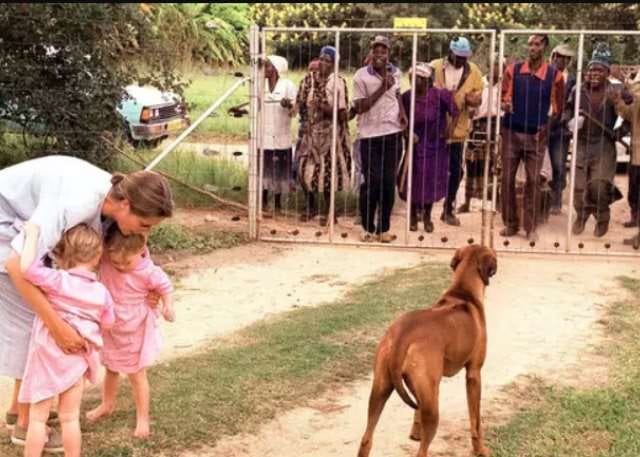


But the machete isn’t the only problem. If anything, it’s typically the easier one to deal with—so long as you have a few friends—as stopping a rampaging horde of malcontents from attacking your home is at least likely to be considered self-defense…if you live in the right jurisdiction (you should).
The much larger problem is that of expropriation by the government, through “legal” means, which is a much trickier problem to solve. Who does one fight, after all, when the bureaucrats claim your property is theirs? The courts can be appealed to…but those are notoriously unreliable in these situations. The Supreme Court has even ruled that eminent domain can be used to seize private, familial property so that a private developer can use it.1
Just last year, the wretched cretins who rule New Jersey tried using eminent domain to seize a two-century-old family farm to turn it into slum housing for the “underprivileged”.2 Yes, really. They wanted to turn a family farm into a favela. They would have won, too, had the case not captured so much national attention that the state was forced to back off.
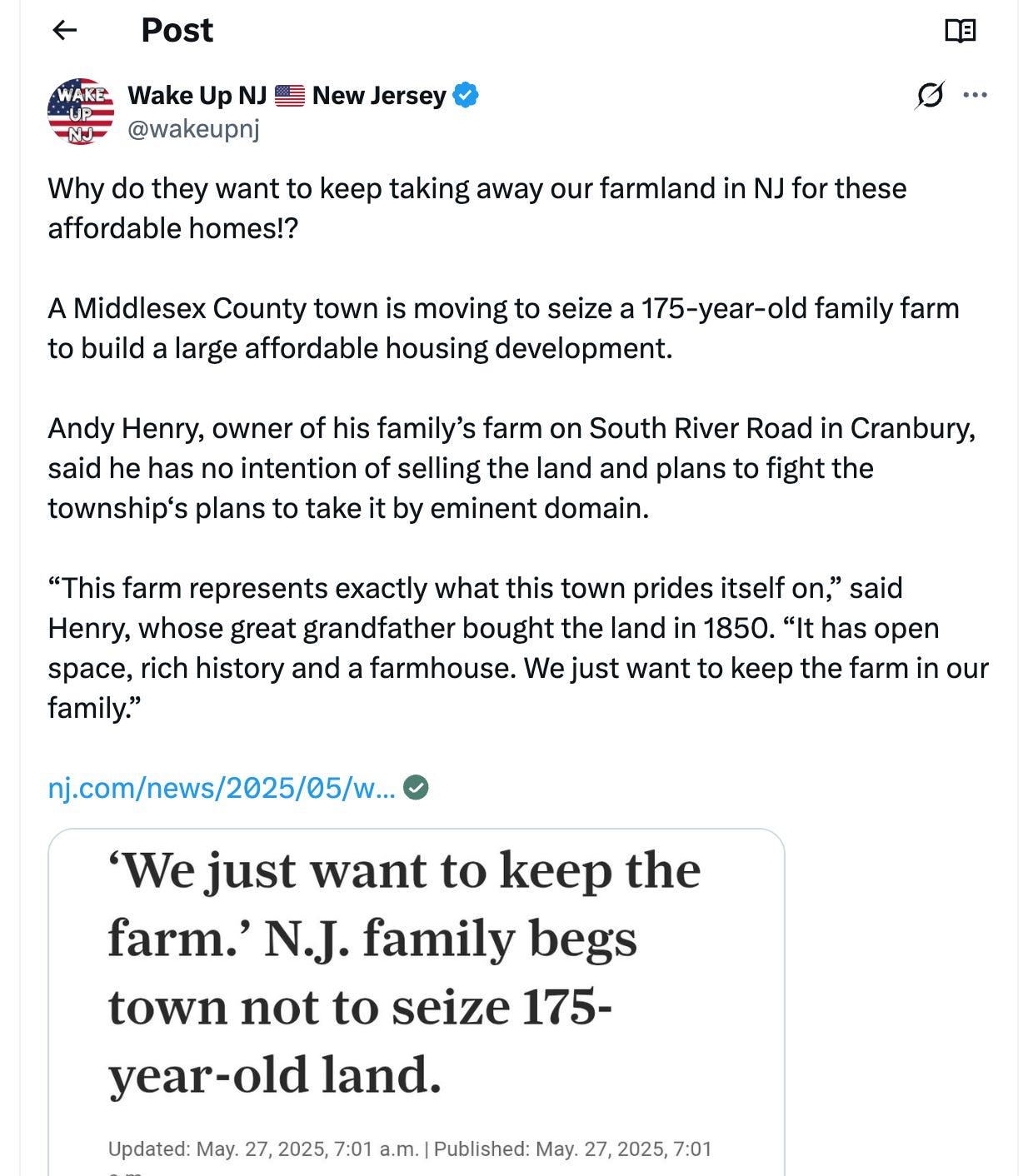
There are two particularly poignant examples of this from England that I will discuss below, along with why they are important and relevant to Americans as we consider property expropriation and the form it is likely tot take here. I’ve mentioned them before, but both are worth discussing here in full, as they show just how socially caustic this sort of thing can be.
Wentworth Woodhouse
If there was one noble family that lived up to the duties of noblesse oblige during a democratic, industrial age—fully participating in both the industrial economy and their duties as lords of the land—it was the Fitzwilliam family.3 One of the oldest families in England, able to trace not just its name but its estate to the Norman Conquest, the family found by the 18th century that the Wentworth estate it inherited through marriage was rich in coal.
The natural response of all owners who found such mineral resources on their land was to try to exploit them. Much as oil turned barren Texas prairie into the good life for many an unsuspecting family…or an already rich family, like the King Ranch clan, it was iron, coal, tin, and the like that revived flagging fortunes across Britain in the eighteenth century.
But the Fitzwilliams decided to exploit their coal fields differently than most were, a story told well in the fabulous book Aristocratic Enterprise. Instead of selling off the coal lands to some ruthless Scots industrialist, or renting the coal lands on the Wentworth estate to such an extractive plutocrat, they decided to develop the mines themselves and to do so in a socially responsible way.
Doing so meant that they hired a workforce of locals who needed good work—a workforce that eventually approached 2000 men on the mines alone—and paid them good wages. The family sank coal mines that were built to the best safety standards of the day in every way, from pumps and fans to proper ventilation and lighting. Work in them was still difficult, of course, but it was fairly paid work and was far safer than could be expected elsewhere in the nineteenth century. The Fitzwilliams continued this tradition of ensuring work in the mines was safe and well paid throughout their ownership of them.
That wasn’t all. In addition to making sure the workers were as well off as could be hoped, the family did what it could to help their families. It built good schools for the children and churches for the families. They built housing for the workers that was nationally renowned for being spacious, clean, comfortable, and provided at a fair cost to workers. Similarly, families were given small plots of land on which to grow fresh vegetables or raise livestock, which helped them stay healthier and better fed than most other industrial employees…and at no cost to themselves.
On and on it went. The family provided sick pay to workers, and pensions to injured workers or families of those who tragically died in the mines. When work in the mines was slow—as sometimes had to be the case because of national economic slowdowns—it provided alternative work for the men in the family, such as improvement work on the estate, so they’d still have something of an income. Such was even the case during the 1926 General Strike: William, the 7th Earl Fitzwilliam, paid his miners out of pocket when they were unable to work in the mines.
That’s not to say there weren’t tensions. The munificent paternalism came at a cost for workers: they couldn’t form unions, and would lose the benefits like model housing if they didn’t uphold their end of the bargain, which was providing a fair amount of work in the mines. But, all in all, it was far better than what existed nearly anywhere else. It was noblesse oblige exercised for about a century and a half in the new age.
And the Fitzwilliams profited tremendously from it. By building such a loyal local workforce that had good cause to be generally content and hardworking, they managed to create some of the best-run and most profitable mines in the country, from which they managed to extract massive profits. Their good behavior (and good luck to inherit such property, of course) made them one of the wealthiest families in the land.
With those profits, they built the fabulous Wentworth Woodhouse. With 300 rooms and a 180-acre park, it was one of the most magnificent and largest private homes in the United Kingdom.
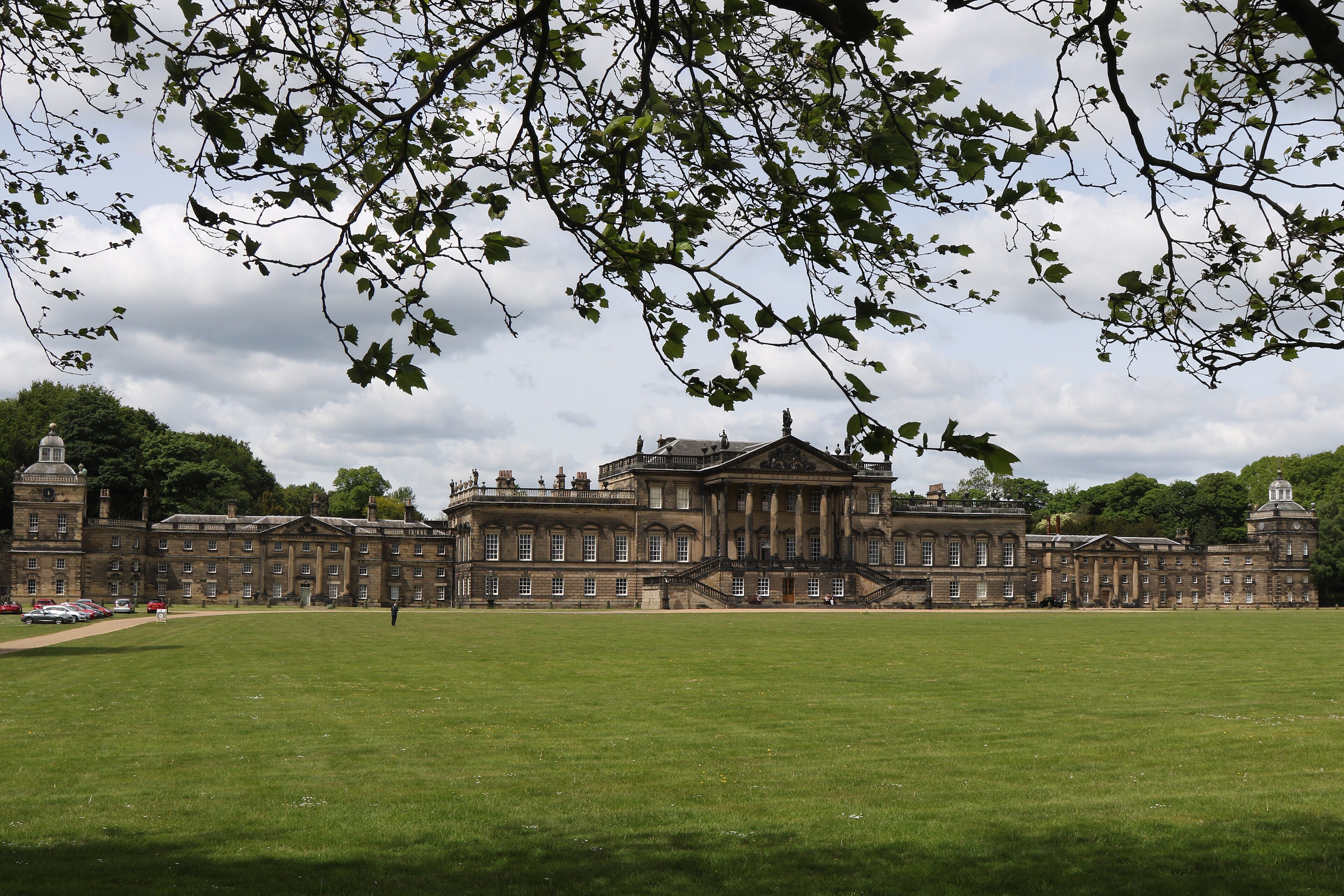
Such lasted for quite a while. The tumultuous 19th century was marked by hardly any incidents of note (just small feuds over unionization in 1844 and 1858), and the first half of the 20th century was similarly unproblematic at Wentworth, at least compared to the rest of the country. The Earls maintained their side of the bargain, the workers did as well, and both sides were happy enough.
Then came the post-war era in Britain, which was marked by a horrific Labour government that set about to fundamentally transform British society. It confiscated banks, hospitals, railroads, steel mills, iron mines…and coal mines from their owners in the name of “the people”, nationalizing practically all of heavy industry to help pay for the massive welfare scheme it decided to launch, a safety hammock for every Briton.
As part of that national reordering, a spiteful mutant to rule them all named Manny Shinwell4 ordered not just that the family’s coal mines be nationalized, but that the seam of essentially valueless coal that ran through the estate’s park be mined as well. This was an act of spite and envy-driven class warfare that horrified not just the Fitzwilliams and members of their class, but the Fitzwilliam miners as well. There was no reason to extract the coal; it was dirty stuff that had next to no value. It was clearly an act of malice, and was one entirely undeserved given the good reputation of the Fitzwilliams.
So the miners tried to fight it alongside the earl. They threatened to strike as their leader, Joe Hall, President of the Yorkshire Area of the National Union of Mineworkers, wrote to Prime Minister Clement Attlee and begged him to halt the mining in the park. Hall also went out on a personal limb and threatened the government on behalf of the earl, declaring that the “miners in this area will go to almost any length rather than see Wentworth Woodhouse destroyed. To many mining communities it is sacred ground”.
But it wasn’t enough. The government overcame the opposition, and forced the open-cast mining through. Shinwell wanted the beautiful parkland of the estate destroyed, and so ordered nature-wrecking open-cast mining right up to the doorstep of Wentworth itself. He uprooted ancient trees, destroyed a beautiful drive of pink shale made from shale brought out of the mines, wrecked 100 acres of parkland, and piled a mound of debris 50 feet high right in front of the family’s living quarters. Here’s what that looked like:
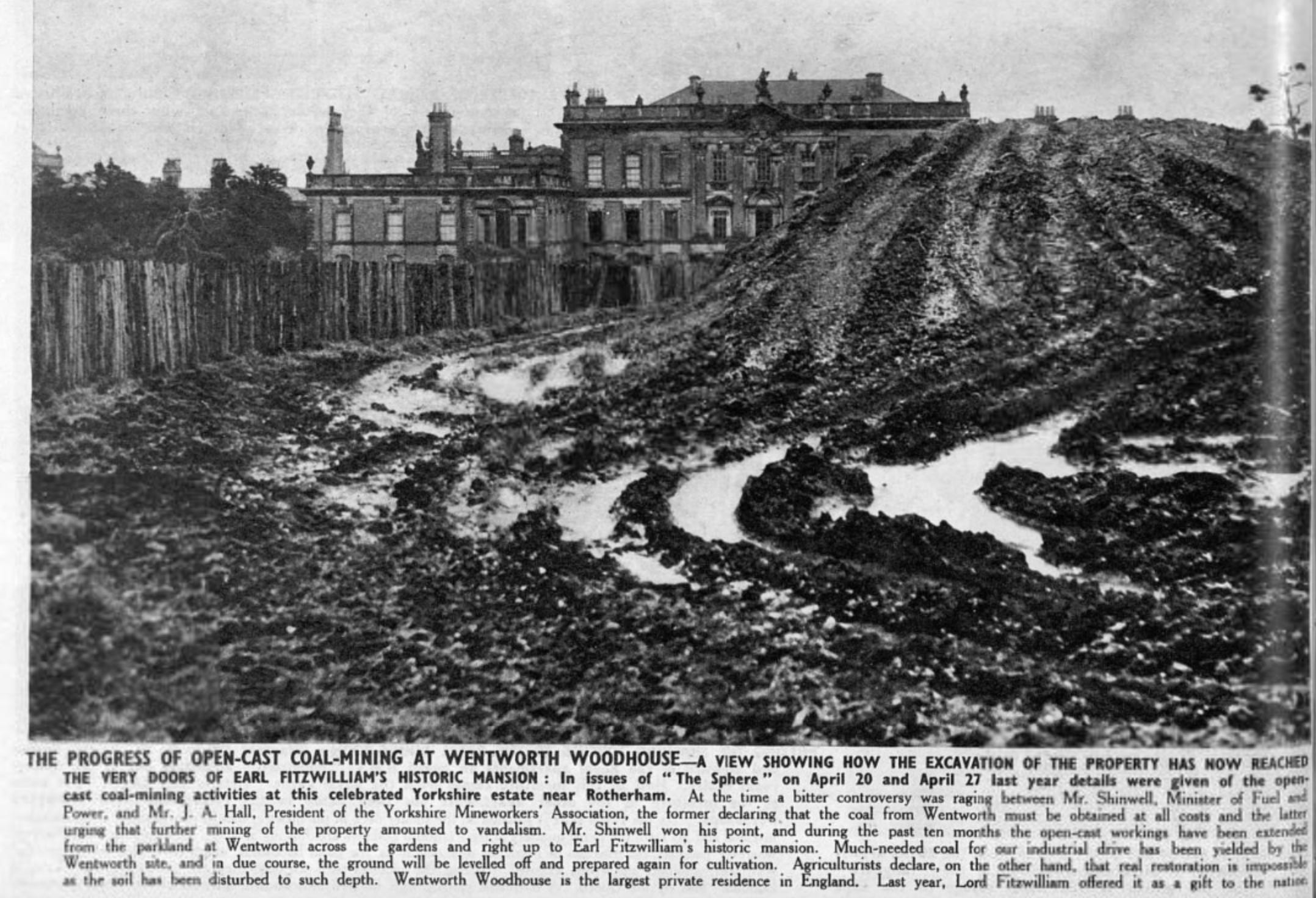
This destroyed Wentworth. For one, it cracked the foundation and made the house uninhabitable. It also made the grounds unpleasant, as they had been ruined. And the confiscation of the coalfields made the family unable to pay for the maintenance of the massive house. For those interested, a great book on this is Black Diamonds: The Downfall of an Aristocratic Dynasty and the Fifty Years That Changed England.
And it was all done for nothing other than envy and spite. The Fitzwilliams had been good employers. Beloved employers, even. Yet their property was stolen and their house destroyed regardless. Such were the wages of envy in postwar Britain for one of the few families that tried to ensure noblesse oblige survived in the modern age.
Egginton Hall: Wartime Destruction
And it wasn’t just the post-war Labour government that was responsible for such expropriation and destruction of priceless national heritage.
Churchill’s government also took over family homes during World War II itself, and quartered troops in them, as is covered in painful detail by both Adrian Tinniswood in his Noble Ambitions and David Cannadine in The Decline and Fall of the British Aristocracy. The government needed space for units, personnel, and certain high-profile officials, along with schoolchildren who needed to be gotten out of high-danger areas, and so took over the country houses for which England was famous.
While some of that could have been uncontroversial—and even welcomed as an opportunity to serve by the families whose homes were taken over, as had been the case during the Great War—what was controversial is the manner in which the government, particularly the troops, treated the homes.
Nearly all of these houses were neglected by the government, which let them fall apart from rot, dry rot, mold, and the like as it used them. Yet worse than the neglect was the gratuitous destruction by the troops quartered within them.
Describing this in his The Decline and Fall of the British Aristocracy, David Cannadine notes:
“From the standpoint of the war effort, the country houses made a major contribution; but from the perspective of their owners, the result was an unmitigated disaster. Very few of the temporary tenants showed any respect for their surroundings, not surprisingly, since most of them had never been inside such houses before, and had no sense of their value or importance. Everywhere, the fabric decayed, the park was ploughed up or abandoned, the railings and gates were requisitioned.
“At Blickling, the grounds were full of Nissen huts, and the troops who were billeted there broke the windows and forced the doors to the state rooms. At Lyme, the park was used as a lorry depot, and was cut to pieces by thousands of RAF vehicles. At Compton Verney, the balustrading of the Adam bridge in the Capability Brown park was knocked off by the soldiers. At Erddig, the garden went completely to ruin. At Eggington Hall in Derbyshire, the army left the house with all the taps running, the ceilings collapsed, and the building had to be demolished. And at Tyneham in Dorset, the whole village was taken over, including the big house, from the Bond family who had held it for [many generations].”
There are other examples as well.
Woburn Abbey—longtime seat of the Dukes of Bedford—was so mismanaged and neglected by the army that parts of it had to be destroyed when the family finally got it back, to save the rest of the house from rot-driven destruction; they were then fined by the government for doing so without permission. At Wilton House, the ancient stone staircase was bashed to pieces by a safe that the Army gratuitously pushed down them, and saw centuries-old panelling crumble to dust thanks to an immense amount of rot the Army’s neglect allowed. At houses like Culverthorpe and Netley Park, “licentious soldiery” smashed windows, cracked painted ceilings, and destroyed gilt-framed mirrors just for the fun of it.
Never were the families fully reimbursed for the ravages their homes suffered. Often, they weren’t even paid at all.
Such were the wages of wartime requisitioning in Britain, and they persisted well after the war. Families that had seen it as their duty to maintain ancient seats and the relics within them as guardians of cultural heritage—doing so for many generations at no small expense to themselves—were effectively punished for it. All they had stewarded was destroyed, often out of spite, malice, and envy.
Remaining Engaged
There is little that can be said about this, other than that it is quite sad, and it is a relevant threat for far more people than the ultra-wealthy of the sort profiled here.
Much like the income tax was originally meant only for the “1%” and now is a massive exaction placed on the backs of nearly every American, this threat of expropriation is something we all face.
Between the massive buildout of data centers, which are quickly approaching a “public-private partnership” type of infrastructure, the increasing use of private homes in normal neighborhoods for Section 8 recipients, and so on…there is a governmental desire to take and use private property held by all sorts of Americans.
While that is a muted problem at present, there is a distinct likelihood that it will become a much larger one if and where the left comes to power and is able to implement its race communist agenda. Already, they have tried to do this through informal means, as shown by the squatter problem across much of America, and the abominable rights afforded to squatters. When the opportunity comes to enforce equity through more formal means, they will indubitably do so.
Taxation is the other way they’ll do so, as I will be discussing next week in an article (which a friend and paid subscriber asked me to write!) on Georgism and how the basic premise behind it—that land should be turned over and developed, with that outcome ensured through onerous taxation—is being used to strip Americans of their property and bash to bits the ties that should bind across generations.
Much like eminent domain, outright confiscation, and all the rest, this is deeply relevant to Americans, and is the most likely way one is to see properties broken apart and sold off, whether family farms or family homes. And, unlike a mob, it can’t really be resisted with a pink shirt and a self-loading rifle. Rather, the modern property tax regime is onerous and meant to dispossess those who would hold for generations, and can only be fought by being politically involved.
Indeed, this is true of all these cases, great and small alike: the only way to fight that is to remain in political power, and garner influence of the sort that can be used to push back in a substantive way on the local and national scale.
Had those whose houses were stolen by the regime been in a position to push back with more force and vigor, perhaps it wouldn’t have happened. Had the Fitzwilliams been able to garner a national reaction rather than just from their coal miners, perhaps they could have saved their house. Had the Henry Family of Cranbury Farm not been able to garner national attention and pushback, they wouldn’t have saved their farm.
Such, in short, is why we need a durable counter-elite that can organize and lead these fights for the long term, and resist the spiteful mutants until they are thrown firmly out of power, and our counter-elite once again becomes the governing class. Such is what I wrote about here:

Like most everything the Government does, eminent domain is abused. I was once selected for
The jury pool at the county level for a trial involving a family farm resisting the county government’s attempt to “take” the bulk of their farm for a sewer project at way less than market rates for the acreage. When the attorneys asked if anyone had problems with eminent domain, I raised my hand. Inevitably, one of them asked me the nature of my objection. The moment I mentioned the word “theft” in relation to subjective value and cost of relocation, I was interrupted and told I was excused.
As always, here is some recommended reading for Will and his audience:
* Meltdown: The Classic Free-Market Analysis of the 2008 Financial Crisis by Thomas E. Woods, Jr.
* End the Fed by Ron Paul
* The Politically Incorrect Guide to the Great Depression and the New Deal by Robert P. Murphy Ph.D.
* The Politically Incorrect Guide to the Bible by Robert J. Hutchinson
* The Politically Incorrect Guide to the Civil War by H.W. Crocker III
* The Forgotten Depression: 1921: The Crash That Cured Itself by James Grant
* America's Great Depression by Murray N. Rothbard & Paul Johnson
* The Progressive Era by Murray N. Rothbard
* Hitler's Revolution by Richard Tedor
* Hitler Democrat by Leon Degrelle