


You can listen to the podcast-versino of this article here, if you become a paid subscriber:
![[AUDIO] John Brown Shows What the Second Amendment Is Actually About](https://substackcdn.com/image/fetch/$s_!HGZm!,w_140,h_140,c_fill,f_webp,q_auto:good,fl_progressive:steep,g_auto/https%3A%2F%2Fsubstack-video.s3.amazonaws.com%2Fvideo_upload%2Fpost%2F203718440%2F858febde-33ab-4289-8094-a8fca92315ff%2Ftranscoded-1782489190.png)
My friend John Carter recently published a fantastic article titled “Why Don’t British Men Do Something?” in which he notes that 1) it is actually the Northern Irish who have “done something” about immigration by inflicting limited and organized violence on the state and its pets (migrants) until some sort of behind the scenes deal was struck, 2) that the mainland British men generally have not done the same, and 3) that American men largely haven’t “done anything” about migration or black crime either despite being armed to the teeth.
American men, armed to the teeth as no other people on Earth, have allowed themselves to be pushed around this way and that since the sleep of the good Reverend Doctor Martin Luther King, Junior (PBUH) was disturbed by his little dream.
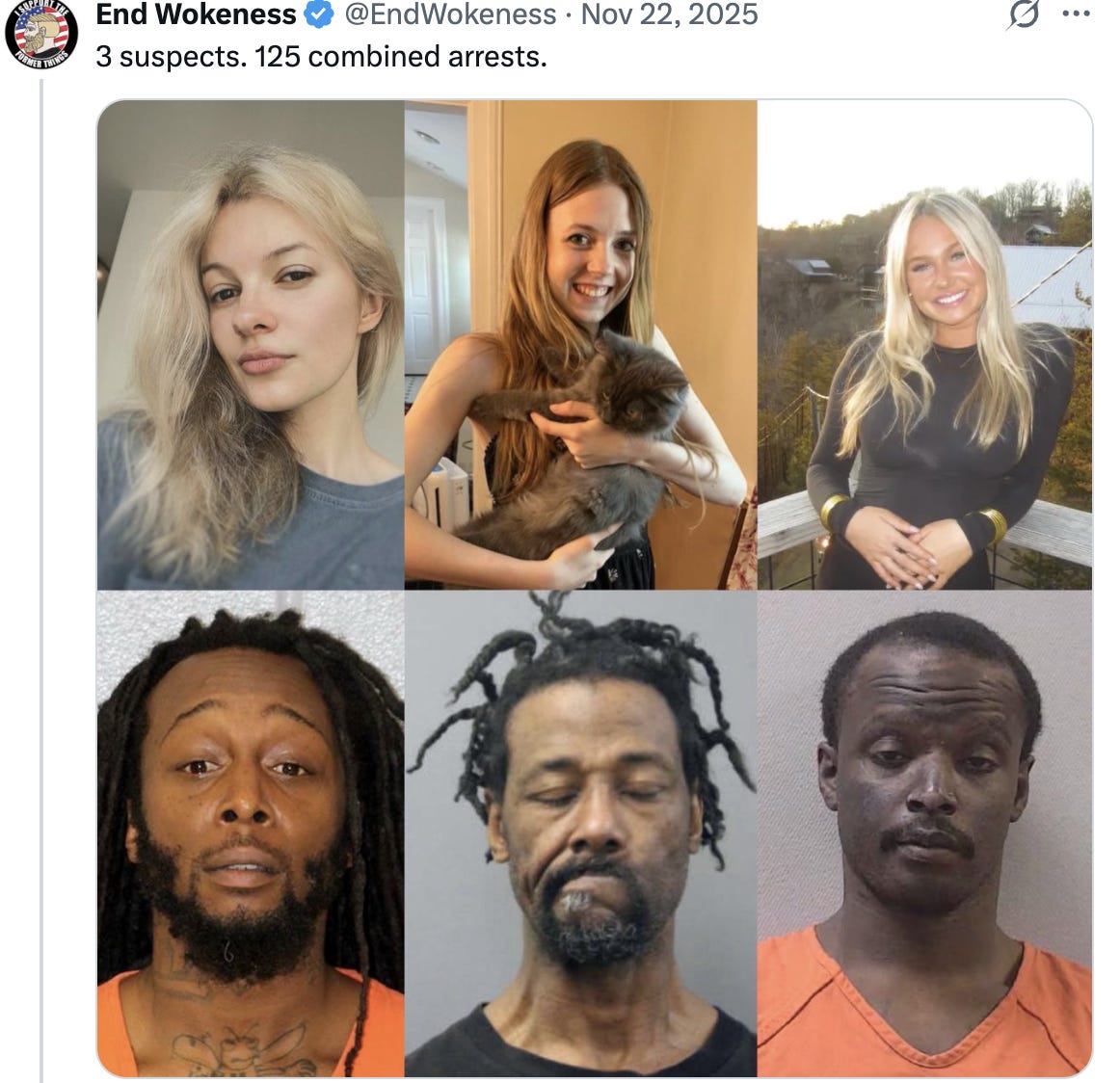
The existence of AR-15s, apparently, is not enough to stop this sort of thing from happening…or to hold the guilty accountable after the fact, at any level of the guilt chain. Decarlos Brown is “mentally incapable,” you see…so just sit down and take it.
Such raises an interesting question: if not the British, and not the Americans, then why the Northern Irish? Wouldn’t the Ulster Scots in America, at least, be expected to act the same way as their cousins across the sea? Wouldn’t the steady drumbeat of these sorts of horrible crimes in America, and the well-armed nature of the citizenry, make that even more likely?
One would think, but such has not been the case. Murals were painted after the death of Iryna Zarutska at the hands of a 15-time arrestee, and nothing else of note happened. A few protests followed the horrid murder of Henry Nowak in Britain at the hands of a Sikh invader who was effectively aided by the state,1 but nothing else happened. But when a man was grievously injured during an attempted beheading by a migrant in Northern Ireland, Belfast exploded.
So, back to the question: what explains that difference?
I think the obvious answer is something identified by Ghost of Arthur Powell in his fantastic article on The Troubles, “Civil and Ethnic Conflict in the West”: those in Northern Ireland formed themselves into groups that were not only armed, but willing to use those arms in defense of their ethno-religious community against outsiders, and in retaliatory attacks against those outsiders.
We see how a State tradition of maintaining an ethnic Police reserve created fertile grounds for the birth of community defense groups that would quickly turn to violent terror. We see how the IRA's path of direct violence created and instilled a deep-seated fear within Loyalist communities even during a time when most attacks were still directed against the State.
Despite the general peace that followed the end of The Troubles (which were, per capita, less deadly than life in most “diverse” American cities), some form of that organization still exists in Belfast and Northern Ireland.
As John Carter notes, methodical and targeted operations were carried out within hours of the attempted beheading, barricades staffed by masked men were raised within a similar timeline, and there was a degree of tactical competence—leaving phones at home, etc—that shows the counter-attacks against migrant violence were organized rather than the work of a spontaneous rabble.
Not quite traditional UFF tactics, perhaps, but close enough…particularly considering that nearly all of the “fiery but mostly peaceful protesting” occurred in areas where the Protestant, Loyalist paramilitaries remain strong. Such tactics were clearly intended to drive the migrants out.2 And, much as the UFF at least didn’t lose The Troubles, it won a negotiated settlement in this: the government clutched its pearls but also made significant concessions, and migrants are leaving:
Only 27 migrants were actually made homeless by the arson, but reportedly, quite a few are already clearing out on their own. The British government quite naturally condemned the violence, organizing a rally against racism in the aftermath, but it also responded by instructing the media to emphasize that it would be cracking down on illegal immigration into Northern Ireland. Underneath the condemnation, there is a clear message to all of this: in this case, violence worked.
In short, the Northern Ireland paramilitaries were not just armed, but organized and capable of applying the use of those arms to the defense of their community in a way they thought legitimate, justified, and not particularly likely to lead to their imprisonment.
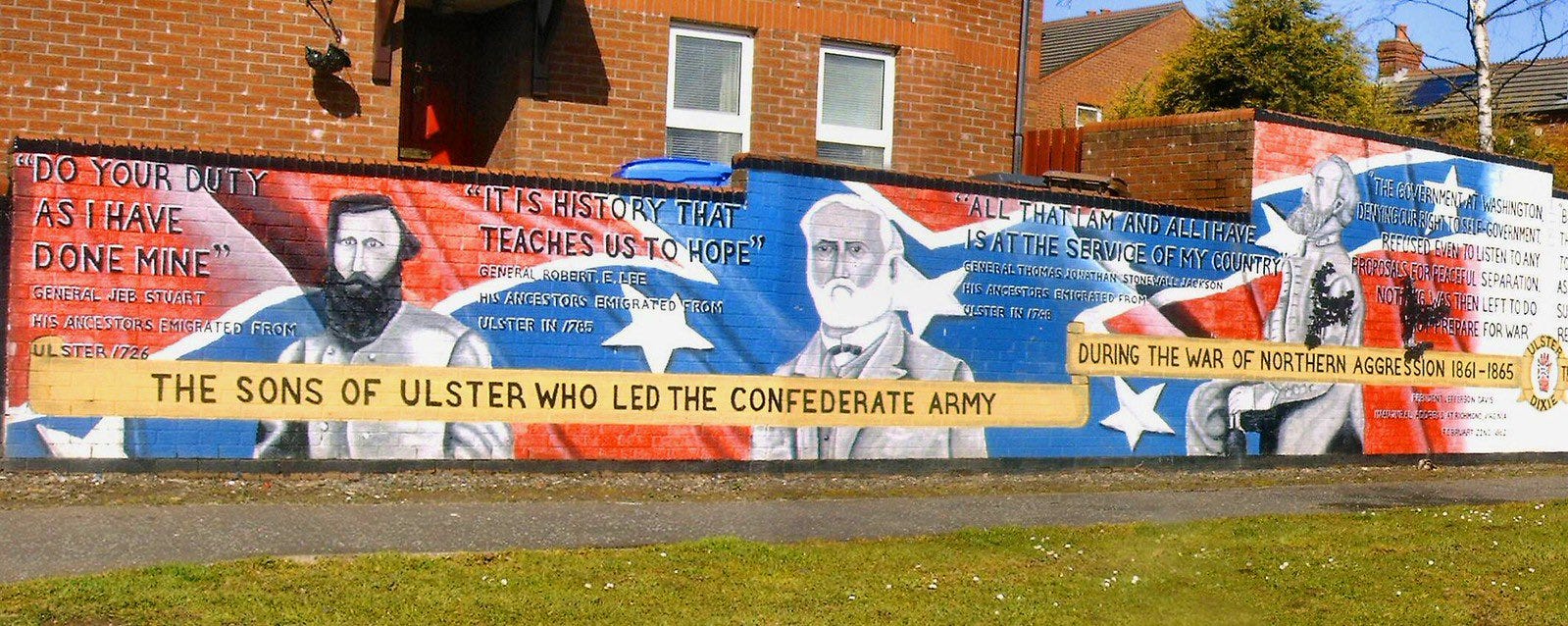
This is something of which Americans were once capable—as the pro-Confederate UFF propaganda mural serves as a reminder of. So, back to the question: what happened? I think the answer is that we forgot the point of the Second Amendment and lost the infrastructure necessary to make it workable, all of which will have to be rebuilt to align institutions, leading men, and the general citizenry toward effecting community defense.
John Brown and the Second Amendment
When product of the Virginia Golden Age James Madison drafted the Second Amendment, he included two provisions, the combined effect of which is important and indicates what it is really about.
The more famous provision is the right of “the people” to “keep and bear arms.” This right of individuals to keep arms and use them in self-defense has a long and storied tradition in Christian and Anglo-Saxon culture, as Librarian of Celaeno discussed in a fantastic article titled “A Brief Guide to Biblical Sword Shopping” and John Carter discussed in his terrific “The Sons of the Knife”. This was enshrined in the Constitution as the Second Amendment because it was part of America from the beginning. As historian Philip Alexander Bruce notes in his Institutional History of Virginia in the Seventeenth Century:
From the Colony’s earliest settlement, there was to be found in the hands of private citizens a large quantity of arms of every sort, which they were ready to use when summoned to resist an invasion. The need of such arms as the property, not of the public, but of the planters themselves, was an urgent one during almost every part of the Seventeenth century; for there was not a household residing in the frontier’s vicinity which, in time of war, was not in constant apprehension of an Indian assault; and this fear was only slightly allayed in time of peace. But one instrument of protection against this treacherous foe existed, namely, the rifle, and this the colonist could employ with unerring skill.
But there’s more to it than that, of course. While the use of arms by private individuals for private defensive purposes was critical, so too was the ability to use them in an organized way in pursuit of a grander objective.
Hence why there’s also the “well-regulated militia” part of the 2nd Amendment. While since retconned to mean the National Guard, what it meant at the time was that the central government would not interfere with states and communities organizing their men to inflict violence upon enemies, whether defensively or proactively, so long as such warfare was justified.
Why Madison, a Virginian, would have understood the importance of this is obvious. With the exception of a ten-year peace brought about by the marriage of John Rolfe to Pocahontas, his state had essentially been at war with the Indians from the moment the English arrived in 1607 until Nathaniel Bacon the Younger crushed the Indian menace during Bacon’s Rebellion. When the Ohio River Valley needed to be opened to settlement, it was not the British government but the state of Virginia and Thomas Lee that led the expedition to do it…which they backed by threats of armed force that would have been carried out by the state militia. Then, during the French and Indian War, it was not the British government but the Virginia militia—led successfully by George Washington—that defended the frontier from rampant and murderous Indian attacks in the wake of Braddock’s defeat.3
The importance of the militia continued through the Revolution. The importance of the Minutemen in New England is well known, but similar such units were integral to the defense of Virginia and, when the Revolution began, were instrumental in driving out Gov. Dinwiddie and the British. Militia were less reliable than professional line units, but also much less expensive and could be called up as needed.
From the beginning, this militia had been designed both to repulse foreign invaders if such were ever necessary, but also to be able to fight off Indian attacks of the sort that had been hugely problematic ever since the days of John Smith. Such was much more likely, and the militia was almost the sole means by which the Indians could be put down. As Bruce notes:
The Military System of Virginia in the Seventeenth century was based entirely on a militia. The Colony never sought to establish a regular army for constant service, unless the companies of rangers guarding the frontiers could be looked upon in that light. For a short time only were the red coats of English troops seen at Jamestown; and with the exception of the conflicts among the Virginians themselves occurring during the Insurrection of 1676, or of English seamen with pirates, as in Lynnhaven Bay in 1700, no event approaching the character of a battle took place on the Colony’s soil or in its waters, between white persons during the course of this long period. Nevertheless, its military system was fairly well organized as a protection against Indian invasion by land, and foreign invasion by both land and sea. There was never, as it turned out, a well founded reason for apprehension on the score of a European foe except during the progress of the wars with the Dutch, but the danger of Indian incursions was almost always present; and at times that danger developed into an actual attack, which carried destruction far and wide among the frontier settlements, and even to the very heart of the Colony. The recollection of the appalling massacres of 1622 and 1644 was enough in itself to cause the people to maintain a more or less efficient military system so long as any savages roamed along the borders, as they continued to do down to the last day of the century.
The average Virginian was expected to possess the arms required for effective militia service, and to have the skills necessary to make him an effective member of the militia.4 Yet further, all prominent citizens were expected to play a part in the militia’s leadership,5 tying their fates to their ability to lead and stopping them from pawning the duty out to others. Hence why it was George Washington and William Byrd III who led the militia during the French and Indian War.
Thus, the right that Madison was enshrining was the right to bear arms for self-defense, but also to be armed as a community to defend against external or internal threats to the community, with the militia being “well-regulated” because it was led by the leading men of the community and governed by their authority rather than the discretion of the external government. In the 17th and 18th centuries, it was Indian attacks that posed the internal danger. With those Indians long since gone with the frontier by the 19th century, that internal danger turned into the threat of slave rebellion, which the militia was also used to stamp out.
Slave Rebellion and the Militia
First came Nat Turner’s Rebellion, which showed both sides of the Second Amendment. Believing himself to be a prophet and God to be telling him to kill the whites, Nat Turner led a rebellion to kill as many of them as possible, often in quite horrific ways. The rebellion was first checked by a family that used its private right to keep and bear arms to fight them off, then was crushed by the arrival of the rapidly mobilized militia. Describing the first part of this in his Virginia: The New Dominion, Virginius Dabney notes:
Turner, a part-time preacher who thought he saw visions, had gathered up a group of about sixty other slaves and embarked on an orgy of indiscriminate slaughter, beginning with his master and mistress and their baby. A hatchet and an ax were used in dispatching this gentle couple as they lay in their bed, after which the child’s brains were bashed out against the brick fireplace. Guns, daggers, swords and razors also were employed in killing some fifty-five others, mostly women and children.
The rebellious blacks, some of whom were emboldened by stolen brandy, moved across the rural countryside toward the county seat, Jerusalem (now Courtland), slaughtering men, women and children as they slept, or as they begged for mercy or fought back. Terrified women were pursued from their homes and ruthlessly struck down; children were decapitated.
A staggering reverse for the insurrectionists came at the handsome home of Dr. Simon Blunt. Dr. Blunt gave his slaves the choice of fighting to protect the family or leaving. All remained loyal to him. The doctor, his young son and the overseer fired on the approaching blacks, and as the latter neared the house, the slaves of the Blunts leaped from hiding places armed with hoes and pitchforks and engaged the attackers. Turner and his followers fled, shaken by the realization that slaves had chosen to defend their master.
And then, as Thomas Fleming records well in A Disease in the Public Mind, the militia arrived and destroyed Nat Turner and his band of murderous savages. First, “whites who had managed to flee Turner’s rampage sounded the alarm and Virginia called out hundreds of militiamen.” Then, though some federal units were eventually called out, by the time they arrived, “Virginia militia had dispersed, killed, or captured Nat Turner’s men.” Turner remained on the run for seven weeks before being found and killed. Had the militia not been organized ahead of time, led by local men of prominence trusted to lead it well, and entitled to act as it saw fit in the crushing of the disorder, many more Virginians would have died.
The same sort of situation—though fortunately with far less loss of life, in the immediate term—came when John Brown launched his raid on Harper’s Ferry. Backed by funding from rabid abolitionists in Boston, Brown struck the federal arsenal at Harper’s Ferry in a desperate attempt to spark a state-wide slave rebellion of the sort seen in Haiti, one that would mean the deaths of tens if not hundreds of thousands of whites and the destruction of America’s oldest state. He raided the town, shot a few civilians, captured the arsenal, and hunkered down. It was the militia that arrived on the scene and did battle with Brown. As Fleming notes:
This discovery [of who John Brown was] more or less coincided with the arrival of several hundred armed militia from Charlestown on a Baltimore & Ohio train. They drove the two guards off the B&O bridge, sealing off any hope of Brown escaping into Maryland. Other militiamen cleared the Shenandoah Bridge. That ended the possibility of the raiders escaping southward into the Blue Ridge Mountains.
From the surrounding hillsides, militiamen began firing into the armory yard. One of the first shots killed Dangerfield Newby. A free mulatto, he had joined Brown in the hope of rescuing his wife and children from slavery in Virginia.
…
With a thunderous roar, a locomotive pulling cars full of armed Baltimore & Ohio employees crashed through the gates into the upper end of the armory, rescuing most of the hostages, who were being held in the watchman's office. Brown managed to get ten of the most important captives, including Colonel Washington, into the brick firehouse, which had stout oak doors. Confined to this single building, the raiders were still armed and dangerous. They fired often and accurately from the half-open door and from loopholes they created in the walls by knocking out bricks.
Fancying himself a general conducting a siege, Brown sent three of his men out the door under a flag of truce to see if he could negotiate a withdrawal from the town with his hostages. He promised to free them when he was at a safe distance. The militiamen ignored the flags of truce and seized the first man to emerge, William Thompson. They riddled the next man, William Stevens, and mortally wounded the third negotiator, Brown’s twenty-four- year-old son, Watson, who crawled back into the engine house to die. More bullets sang through the open door, mortally wounding Oliver Brown and Stewart Taylor, a Canadian who had been seduced by Brown’s faith in his destiny. Another raider tried to escape by swimming the Potomac. He was hit by numerous bullets as he crawled up on a small island in the river and soon died there.
Eventually, over six hundred militiamen arrived in Harper’s Ferry and besieged Brown. It was a contingent of Marines led by Robert E Lee and JEB Stuart who finally stormed the Armory and captured Brown while killing most of his rabble, but it was the militia that had successfully stopped the raid, besieged him, and stopped him from escaping or his rebellion from spreading.
The Point of the Second Amendment
In the stories of both John Brown and Nat Turner, we see the reality of the Second Amendment and what it was meant to achieve. Private citizens who were armed could defend themselves in extremis because of the right to keep and bear arms. More importantly for public order and the defense of the state from internal and external enemies, the wide organization of most members of the body politic (enfranchised citizens) into the militia, with the trusted prominent citizens as their leaders, meant that communities were able to quickly respond to disorder. The militia could be summoned in time to stop Brown, crush Turner, or fight off the Indians, and the men who composed it were armed well enough for doing so, proficient in the use of arms, and seasoned to the rigors of a temporary campaign. They were far from being professional troops, but were organized well enough to respond to threats to their communities.
Such is what the Second Amendment used to mean in America. It was not just a way for males in frustrating marriages to spend lots of money on tools they’ll never use, but rather a way of enshrining the right to personal and community defense. It was understood that such a right was sacrosanct, and also that those on the ground had the duty to fully exercise that right by organizing themselves ahead of time in a way that worked for their community and was largely detached from the national government. The National Guard they were not.
Further, there was the understanding that those who led the units would come from the community, would lead well, and would support their men, and that the institutions they defended would back them after the fact (they wouldn’t be prosecuted for firing on Brown’s men, etc.).
The closest modern parallel is what still exists in Northern Ireland. To take a few more passages from John Carter’s article, here’s how he describes that:
The Ulster loyalists may well be a special case, and not only because they’re one of the only groups in the UK who almost certainly did not hand in their firearms . . . Their paramilitaries manage to balance clear chains of command alongside superb operational security: to this day MI5 has difficulty penetrating their ranks with informants. This requires close community bonds, high levels of interpersonal trust, extreme suspicion of outsiders, and a relaxed attitude towards extralegal violence in furtherance of community protection.
…
The lads roaming about Belfast last week didn’t strike me as street thugs. Their numbers, coordination, and discipline rather suggested that they were by and large just ordinary young men engaged in what they saw as the legitimate defense of their community, rather than criminals out for a thrill.
…
Perhaps most importantly, the violence ended quite abruptly after three days, exactly as if someone up the chain of command gave the order to stand down, and they all obeyed. Perhaps it was felt that the necessary message had been sent; perhaps there were quiet back-channel negotiations, which resulted in the leadership getting what they wanted, such as money, or a promise to redirect migrants away from Belfast.
Legitimacy is a key aspect to all of this. Non-criminal men do not tend to engage in organized violence unless they feel that they are justified in doing so, and not only personally: they must feel that the people whose opinions matter to them agree that they are justified.
What separates that from the present state of things in America is the level of proactive and productive community organization in a real way. This is not a small group of guys wishcasting by imagining themselves as guerrillas fighting off a communist invasion, nor lone wolves bent on wish fulfillment above all else. Both are pointless, and the pointlessness makes them buffoonish at best, reprehensible at worst, and illegitimate generally. Rather, it is a community organizing itself to respond in an anti-body-like way to internal and external threats in an effective manner.
Critical there is the thing we most lack, and the reason why the Northern Irish did something in an organized and effective way while the British and Americans haven’t: leadership and institutional backing that makes them legitimate in the eyes of those participating in the campaign and their community members.
Here, the sense of what the militia is and should be has died out since the War Between the States, with the central government and organized police forces abrogating what used to be the militia’s duties to themselves and reacting harshly against those who would push back in a more private way against internal or external threats to the community. Hence why the state is ambivalent towards ordinary crime and criminals, but will crush any vigilantes or vigilante groups the moment it discovers them,6 and “organizing” along the lines of the UFF at present would be a disaster, a bad decision, and generally pointless. What should be done instead will be described in a minute.
First, it should be noted that we do have some examples. The Bundy Ranch standoff is the clearest in America: the militia’s ability to organize and deploy quickly enough to matter (temporarily) stopped the Obama regime. The Grooming Gangs feared the English Defence League. In the end, both were crushed by the regime via lawfare because they lacked institutional backing of any sort. But they showed the model can succeed in its traditional objective—crowdsourced community defense—in modernity, up until the hammer of the state falls.
This is why, as I have written about before, building a counter-elite with a sense of duty—a new aristocracy, or gentry—is an existential matter, particularly given the unrest on the horizon that Matt Bracken has identified.
The lynchpin of militia success in the past was the involvement of the leading men in the community. This meant the interests of the wealthy and the rest were largely aligned as to community defense, that the institutions of the state were aligned with the actions of the militia, and that the members of the militia were thus willing to act as needed in the suppression of disorder. There was no fear they would be stabbed in the back after the fact, as those who were in charge were on their side.
But Wade Hampton III’s campaign to drive the Radical Republicans and carpetbaggers out of South Carolina at the end of Reconstruction is the last real example of this happening in America. Since then, the financialization of the economy and the manner in which duty and property have been separated by the abstracted nature of “wealth” have generally cleaved the prominent from the humble, with the result that “nothing ever happens”.
As prominent citizens now largely fail to serve as “community leaders” at all and certainly don’t participate in any organized paramilitary activity in the manner of their ancestors—indeed the very idea is laughable, I know you chuckled even thinking of that—no one can be trusted to lead any budding pushback of the citizenry against the sort of threats the militia used to handle. Grifters, federal agents, and insane people instead fight for command of imaginary battalions. Such is unlikely to prove effective.
The Solution: Is This Even Relevant
Building back what is lost in a way that doesn’t lead to those involved being thrown in the place where there is weeping and gnashing of teeth will be difficult, and is probably impossible in the short term. Being dumb and getting arrested is not the way to do anything. In the John Brown example, the governor called out the militia, giving them color of law to act. Even if they might have acted regardless of that permission, the governor’s involvement and that of the various local authorities of note, from respected men to the Mayor, were instrumental in making the overall operation and mindset surrounding the militia a success. Perceived legitimacy, legal cover, and general authority matters.7
But the place to begin is by winning local power that 1) obviates most of this by just not letting disorder happen in the first place, 2) allows for a community to just have the police—preferably led by a man known and respected locally—generally do it, and 3) leaves open the door for anything that does occur to have color of law thanks to deputization of trusted members of the citizenry by the sheriff (most every sheriff can do this on as grand a scale as he thinks appropriate, which is one of those weird but helpful holdovers from the old days).
Similarly, winning judicial elections at the local level, winning elections at every level from dogcatcher to governor, waging a propaganda war, winning DA elections, winning sheriff elections, and all the rest is a precondition to anything “happening” in a way that it useful and legitimate—and it will hopefully just be arrests, detentions, and the like carried out by lawful authorities.
That sort of welding of political and legal objectives can be achieved, as Soros’s success shows. If one lives in a reasonable area, as one should, enough money and effort can allow one (or one’s agents) to wield the levers of power, making most of this a non-issue. In any case, it’s the sort of thing that is instrumental in establishing the institutional power necessary to make the rest of it even possible. Step by step, brick by brick, the whole social and political order that used to exist and made it possible will have to be built back.
That will be difficult, but is also possible. Just look at the gun rights movement, which has expanded our access to the other part of 2nd Amendment, the personal defense part. By tirelessly advocating for personal defense and pragmatically pushing forward the sort of laws that make it legally permissible and unlikely to lead to reprisals from the state, the gun rights lobby has dramatically expanded the practicality of exercising the right to self-defense. Castle laws, stand your ground laws, and constitutional carry only exist because of that dedicated effort and the tireless nature of those who pushed the ball forward.
The same will have to be done with community defense. America is not Ulster, nor is it Britain. We can learn from them, and can see some glimmers of ourselves in them. But conditions are different, the state is different, the threats and possibilities are different. When such is examined, the importance of building a durable counter-elite that helps us achieve all this should be clear, and will be useful whatever situation we face in the future.8


Carter notes:
The uprising in Belfast was not nihilistic violence for the sake of violence, though I’ve no doubt the lads were enjoying the opportunity for mayhem. It was violence towards a specific political objective: driving the foreigners out. Migrants whose domiciles were destroyed were directly deprived of housing. Migrants who managed to avoid this were made to worry that they will be next. Landlords taking government money to house migrants, or even thinking about doing so, now need to worry about the immediate cost of repairs and the ongoing expense of higher insurance premiums, making the Home Office’s lucre a lot less attractive. Landlords also need to worry about escalation: reportedly, letters were circulated which heavily implied that bricks and petrol bombs were just the first step on the violence ladder, and that the paramilitaries would be quite happy to take more decisive measures against the landlords themselves should the message not be received.
Often forgotten is that Washington was a hugely successful Indian fighter as commander of the Virginia militia during the French and Indian War
The task he faced was a monumental one, and existential for frontier communities. “‘They go about and commit their outrages at all hours of the day and nothing is to be seen or heard of, but desolation and murder heightened with all barbarous circumstances, and unheard of instances of cruelty. They spare the lives of young women, and carry them away to gratify the brutal passions of lawless savages. The smoke of the burning plantations darken the day, and hide the neighboring mountains from our sight,’” as Colonel Adam Stephen wrote to Washington in 1755
Similarly, Washington noted, “The supplicating tears of the women, and moving petitions of the men, melt me into such deadly sorrow, that I solemnly declare, if I know my own mind, I could offer myself a willing sacrifice to the butchering enemy, provided that would contribute to the people’s ease.”
And when Braddock was defeated, that unleashed the Indians upon the frontier:
“It is impossible adequately to depict the terror and despair that descended upon the hundreds of scattered family groups of the Virginia frontier when the news of Braddock’s defeat reached the countryside… if small numbers of savages had been successful in making murderous forays before the Braddock disaster, it was felt that hundreds or even thousands might now be encouraged to descend upon the settlements, not as an organized army but as slaughter,” Matthew Page Andrews notes in his Virginia: The Old Dominion
And to fight them, Washington had to rely on militia members who, naturally, wanted to be at home protecting their farms and families rather than in forts defending the frontier generally
Still, he succeeded in fighting off the Indians much better than the neighboring colonies.
“Washington hastened to add that in spite of ‘these disadvantageous restraints’ the regiment had done ‘a vast deal of work’ and had been very alert in defending the people. This was shown by the fact that although Virginia was closer to the French and their Indian allies than any of the neighboring colonies, the Colony had lost not half the inhabitants which the others, with considerably more soldiers, had lost,” Richard L. Morton notes in his Colonial Virginia
Bruce notes:
There were certain features of the plantation life of Virginia during the Seventeenth century which animated every youth of that period with some of the spirit of a soldier long before he was, for the first time, summoned to take part in the martial exercises of the muster field, or to accompany a military expedition to the frontiers. First of all, it was a life passed principally in the open air without regard to the season of the year. The biting cold of winter, the relaxing heat of summer, the drenching downpour of spring,-all these the young Virginian had, from his early boyhood, been accustomed to endure, and they had only served to harden his frame. His self-confidence and self-reliance had been strengthened by a brave defiance of all sorts of weather
…
Then too from the time he could shoulder a fowling piece he had been in the habit of using firearms; at an early age he not only acquired all the skill of a practised marksman,' but also learned all the craft of an accomplished woodsman. By his many tramps over hills and valleys in his keen search for wild game, a search often made in the darkness and loneliness of night,-he cultivated the ability to stand any amount of unusual fatigue. His pursuit of the hare, fox, and deer during the day, and of the coon and opossum after the evening star had risen, prepared his sinews for the weary marches in which at a later day he was to take part for the destruction of the savage foe.
…
And finally the hardy Virginian boy had been in the habit of riding horses without any emotion of fear, however wild they might be in spirit; indeed, to break an untamed animal was an occupation that appealed irresistibly to his love of the dangerous and adventurous. A large part of his life was passed on horseback, and if, as soon as he reached the military age, he elected to become a member of a cavalry troop, he at once showed that he was as much at home in the saddle as the oldest and most daring of his comrades.
Hardened by constant exposure to every variety of trying weather; accustomed to endure every form of physical fatigue in the open air in the pursuit of wild game; trained in the use of a gun so far as to become an almost unerring marksman; skilful in all those sports and crafts that make the foot surer, the hand steadier, and the eye more certain; and, finally, an accomplished horseman,-the Virginian youth, when the hour for military service arrived, took his place in the ranks of the militia with all those aptitudes already perfected which were of the first importance for a soldier destined to engage in warfare with such an enemy as the Indian. As soon as there was added a knowledge of the military drill taught in those times, a young militiaman was far less raw than would be a person of our own day in the same situation who had had no experience of actual battle.
Bruce notes:
The prominence of the citizens filling the different military positions was not characteristic of these two years alone, it will be found to have distinguished all the men occupying the same grades during every period of the Seventeenth century. The reason for this is quite plain,-serving as officers in the militia did not simply create an opportunity for personal display on occasions when an entire county’s inhabitants were present to take part in the muster drill; it meant far more even than the gratification of a taste for military exercises, for, in the end, every officer was certain to have an experience of actual warfare in some of its harshest forms,-long and fatiguing marches in all kinds of trying weather, through thick forests and over swollen streams; an increasing vigilance by night and day to avoid the ambuscades of the wily savages; and finally, perhaps a desperate battle from behind boulders, logs, and trees. It was not merely to a parade or a promenade that the officers of the militia had to look forward, but to the dangers and perils springing from the presence of a cunning and implacable foe, to be circumvented only by the coolest bravery, and by the most thoughtful prudence. The most ordinary foresight, therefore, dictated that, when the appointment of these officers was to be made, the most capable men whom each county could furnish should be chosen, if for no other reason, to strengthen the confidence of the common soldiers when the hour for fighting arrived. The prospect of personal peril must in itself have been a powerful inducement to the younger members of the principal families to seek a position higher than that of the file; should war break out with the Indians, it was the officer who would occupy the chief post of danger, and it was also the officer who would enjoy the best chance of winning distinction, a combination that has always appealed irresistibly to the minds of those who have in their natures the promptings of ambition and a thirst for adventure. The general uneventfulness of the plantation life very probably caused these men to relish the more the different excitements always experienced by the officers called out to repel an Indian attack, so often so suddenly precipitated against the outlying settlements. The appalling features of warfare with a foe regardless of all the amenities of civilized combat must also have had its effect in stimulating that patriotic feeling which was no small factor among the motives causing the foremost citizens to apply for positions of command in the militia. And appointment to such a position as involving the defence of every fireside, tended also to enhance that general influence in the community at large already enjoyed by the man filling it.
Noting this in the context of the Grooming Gangs, Carter says:
The truth, as the report makes clear, is that British men did try to do something, repeatedly, and were shut down hard at every turn by a state that treated their attempts at self-defence and justice as a worse threat than the rape of their daughters by foreign invaders. Individual fathers attempting to rescue their daughters from sexual bondage were given the runaround by the authorities, and were arrested when they got frustrated with official inaction and intervened directly, while the rapists themselves were left untouched. The rape gangs were of course completely unworried by the police, who they knew would treat them with kid gloves, but they were extremely worried about the English Defence League, who they knew quite well would not hesitate to kick the crap out of them. For a few years, at least. Until the full weight of the British security state crushed the EDL ... in rather sharp contrast to the community defence leagues organized by Sikhs, which the authorities turned a blind eye to, and which successfully used street violence to deter the Pakistanis from preying upon the daughters of the Punjab.
As Carter notes:
The problem is fundamentally one of legitimacy. The duly appointed authorities are on the side of the invaders, and as of yet there is no widely recognized alternative authority to step into the moral vacuum left by the subversion of the state apparatus.
Absent such a recognized authority, resistance to the state’s depredations amounts to an atomic dust of angry individuals, who may be numerous and might take lots of individual actions but are utterly powerless to really change anything.
As Carter notes:
The best means of turning this around is to take control of the state via conventional means; but if that fails, the very effort to do that will have built the foundation necessary to erect a parallel state that can supplant the occupation from within.
Excellent insights. I'd recommend Dr. Edwin Vieira's work on the Constitutional Militia for anyone who wants to understand the institution as the Founding Fathers did.
Excellent history demonstrating the value of 2A.