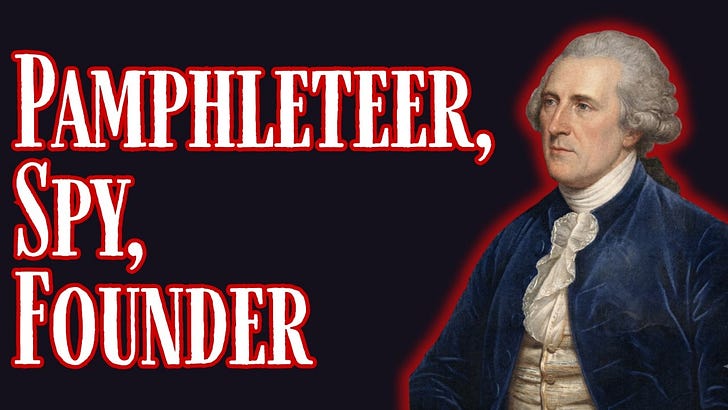
As a reminder, these history episodes are provided ad-free to paid subscribers. If you would like to watch it in full without subscribing, you can listen on YouTube or Spotify! If you would like to read it, the (rough) transcript, with timestamps, is provided below the paywall.
Without Arthur Lee, America would not have won the revolution: one of the earliest revolutionaries and most important pamphleteers, he became a spy and diplomat whose efforts secured the arms that won the battle of Saratoga. Yet now he is all but forgotten. Why? He was described by John Adams as a man too honest and intrepid to be popular, and the episode traces how that temperament shaped his career, a career that was integral to the Founding of America and victory in the American Revolution.
Listen ad-free here:
Born at Stratford Hall, Arthur Lee was the youngest son of Thomas Lee. Educated in Britain, Arthur was trained in the classics at Eton, where Greek and Latin study, particularly the works of Sallust, shaped his moral and political thinking. He became intelligent, gifted, and difficult, developing an unyielding belief in virtue and Republican principles.
He then studied medicine at Edinburgh and Leiden, earned a medical doctorate with high honors, and returned to Virginia to practice in Williamsburg. He disliked the provincial setting and quickly grew frustrated with colonial medicine. During this period, he also became involved in a duel-related dispute with the Mercer Family connected to his brother Richard Henry Lee’s role in the Stamp Act controversy, an incident that was defused before it turned deadly.
Lee later returned to Britain and shifted from medicine to law, studying at Lincoln’s Inn and the Middle Temple. In London, he moved among intellectual circles, became a Fellow of the Royal Society, and began writing political pamphlets. Under pseudonyms such as Monitor and Junius Americanus, he attacked Parliament’s Townshend Act policies and argued for colonial rights, becoming the most influential radical writer of his day.
With the outbreak of war, Congress commissioned Arthur Lee as a secret diplomatic agent. He worked with Pierre-Augustin Caron de Beaumarchais to secure covert French and Spanish aid through the fake firm Rodriguez Hortalez and Company, helping arrange arms and supplies that supported the American forces over 1777, particularly during the war-changing Saratoga campaign. He also traveled to Spain and Prussia, where he negotiated for aid and had his papers stolen and copied by British agents.
Lee’s later service in the American commission in Passy, outside Paris, brought conflict with Benjamin Franklin and Silas Deane. He accused Deane of corruption and Edward Bancroft of espionage, but Franklin rejected his claims. These disputes split American diplomacy, led to Lee’s recall in 1779, and left him politically isolated.
After returning to America, a journey interrupted by two mutinies he provoked aboard the Alliance, Arthur Lee served in Virginia and Congress, worked on treasury oversight, and later withdrew to Lansdowne, where he lived in isolation and died in 1792. A century later, archival evidence confirmed some of his suspicions about Bancroft and Deane.
All in all, Lee was a gifted patriot and his role in the American Revolution was long underestimated. This is the story of how a doctor, lawyer, pamphleteer, spy, diplomat, politician, and planter was, at his core, a patriot who helped win the Revolution.
Chapters
0:00 Arthur Lee: The Forgotten Patriot
4:15 How Studying the Classics Turned Arthur Lee Into a Revolutionary
8:36 Arthur’s Foray into Medicine and London Politics
12:21 Arthur Lee Almost Fights a Duel with George Mercer
15:54 Radical Writer in the Empire
19:11 America’s First Secret Agent
24:53 “Militia Diplomacy” in Paris, Spain, and Berlin
30:40 Squabbles with Benjamin Franklin, Feuds with Silas Dean, and the Discovery of Corruption
36:56 Arthur Lee’s Recall from France, Mutiny on the Alliance, and Homeward Exile
47:01 Arthur Lee Vindicated by the British Archives
48:56 Arthur Lee’s Revolutionary Legacy
Sources Referenced in this Episode:
I am an Amazon Affiliate. If you would like to support the show at no added cost to yourself, you can do so by using the links below to order and read the sources I used to create this episode. Thanks!
Potts, Louis W.: Arthur Lee: A Virtuous Revolutionary, https://amzn.to/4vpFLOF
Riggs, A.R.: The Nine Lives of Arthur Lee, Virginia Patriot, https://amzn.to/3Rh08Pd
Nagel, Paul C.: The Lees of Virginia: Seven Generations of an American Dynasty, https://amzn.to/4uCI6o9
Hendrick, Burton J.: The Lees of Virginia, https://amzn.to/4uCN4BF
Lee, Cazenove G. Jr.: Lee Chronicle: Studies of the Early Generations of the Lees, https://amzn.to/4vGzbDe
McGaughy, J. Kent: Richard Henry Lee of Virginia, https://amzn.to/4ewtGA4
Burt, Nathaniel: First Families: The Making of an American Aristocracy, https://amzn.to/3Sopnj2
American Revolutionaries in the Making By Charles S. Sydnor, https://amzn.to/4dZsPaZ
The First Gentlemen of Virginia By Louis B. Wright, https://amzn.to/43dW3Oh
Tobacco Culture By T. H. Breen,https://amzn.to/43N4FLY
Image credits:
Landsdowne house, By Ryanlintelman - Own work, CC BY-SA 4.0, https:/ /commons.wikimedia.org/w/index.php?curid=40834707
Transcript